

Edexcel Syllabus focus:
'Know the basic structure of an amino acid and understand how amino acids form polypeptides through peptide bonds in condensation reactions.'
Amino acids are the monomers of proteins. To understand how larger biological molecules are built, you need to know their shared structure and how they link together to make polypeptides.
The basic structure of an amino acid
All amino acids used in protein synthesis have the same basic framework. Each contains a central carbon atom bonded to an amino group, a carboxyl group, a hydrogen atom, and a variable R group. Because every amino acid has both of these functional groups, amino acids can behave as similar building blocks despite differences in side chain structure. Because of this shared arrangement they can all join in the same way.
The general structure is often written as NH2-CHR-COOH.
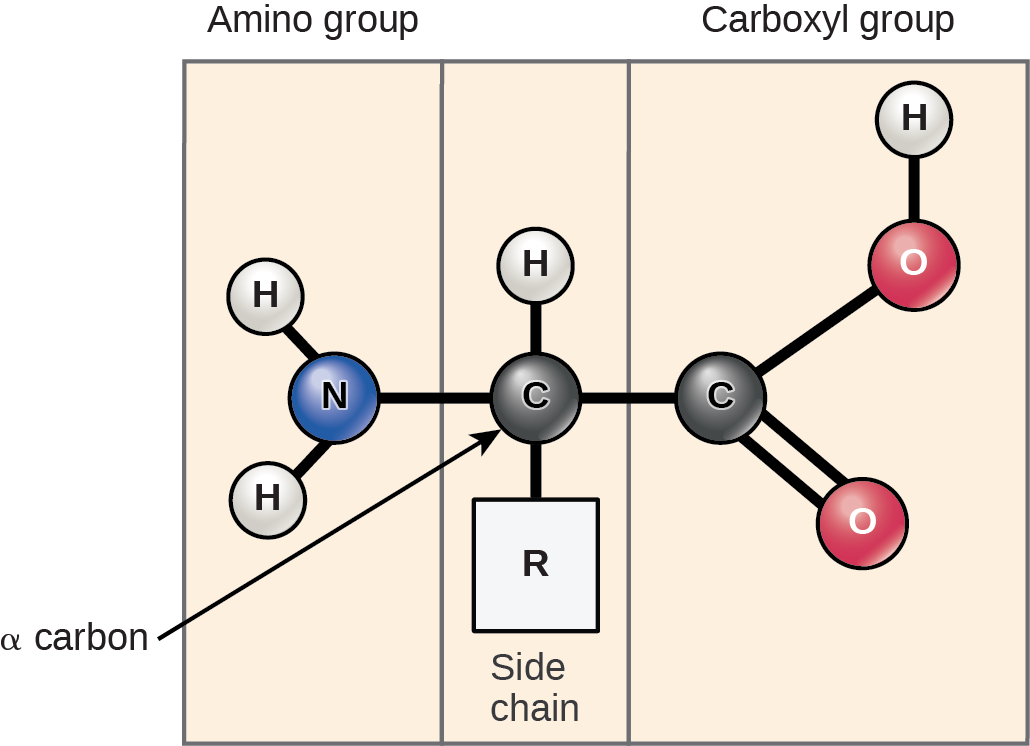
Generic -amino acid structure showing the central (alpha) carbon bonded to an amino group, a carboxyl group, a hydrogen atom, and a variable R group. The labels reinforce that the R group is the only part that changes between different amino acids, while the amino and carboxyl functional groups are conserved. Source
The amino group contains nitrogen and gives basic characteristics, while the carboxyl group gives acidic properties. Do not say an amino acid is just an amine or an acid; it contains both groups in the same molecule. The central carbon acts as the point to which the other groups attach. The only part that changes is the R group, or side chain.
Common features
Amino group: contains nitrogen
Carboxyl group: contains carbon, oxygen, and hydrogen
Hydrogen atom: attached to the same central carbon
R group: variable side chain that makes one amino acid different from another
Central carbon: links all these parts into one molecule
The variable R group
The R group determines the identity of an amino acid. Some R groups are very small, while others are larger and more complex. Some are polar and interact strongly with water. Others are nonpolar and do not. Some R groups carry charge, and some contain extra functional groups such as sulfur-containing groups. These differences mean amino acids have different chemical properties even though they all share the same basic structure.
For Edexcel, the most important point is that amino acids have a common structure with a variable side chain. In exam answers, if you are asked for the basic structure, name the shared groups first and then state that the R group varies between amino acids. This variation is why many different amino acids can be used to build many different polypeptides.
How peptide bonds form
Amino acids join together by condensation reactions. In a condensation reaction, two molecules become joined and a small molecule is removed. In this case, the small molecule removed is water.
When two amino acids react, the carboxyl group of one amino acid reacts with the amino group of another. An OH is removed from the carboxyl group and an H is removed from the amino group. These combine to form one molecule of water. After water has been removed, a new covalent bond forms between the two amino acids. This bond is called a peptide bond.
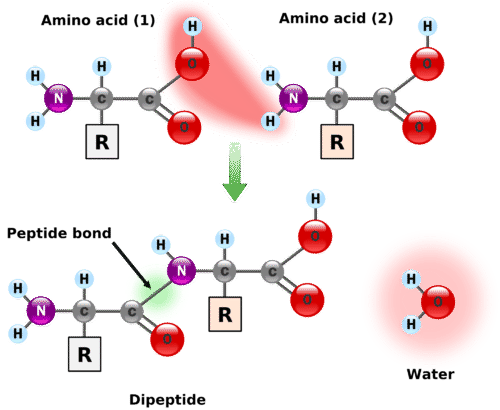
Condensation (dehydration) reaction between two amino acids to form a dipeptide, with the peptide bond forming between the carboxyl carbon of one amino acid and the amino nitrogen of the next. The diagram highlights the specific atoms lost as water (), making the link between ‘water removed’ and ‘new covalent bond formed’ visually explicit. Source
A peptide bond is therefore the bond that links amino acids together in a chain. It forms between the carbon of the carboxyl group of one amino acid and the nitrogen of the amino group of the next amino acid. Because it is a covalent bond, it is strong and stable. When describing this process, it is important to mention both the removal of water and the formation of the peptide bond. These two ideas are central to condensation in this context.
If only two amino acids join, the product is called a dipeptide. The two amino acids are now linked, but each still has groups that can react further. This allows longer chains to be built.
From dipeptides to polypeptides
A polypeptide is a long chain of amino acids linked by peptide bonds. It is formed when many amino acids join through repeated condensation reactions. Each time another amino acid is added, another water molecule is removed and another peptide bond is formed. A chain may be short or very long, but it is still described as a polypeptide if amino acids are linked in this way.
As the chain grows, the same basic pattern repeats along its backbone. The peptide bonds link the amino acids in order, while the R groups project from the chain and remain different for each amino acid. This means a polypeptide has a repeating peptide-linked backbone but a variable sequence of side chains.
A growing polypeptide has two different ends because amino acids do not link in a random orientation.
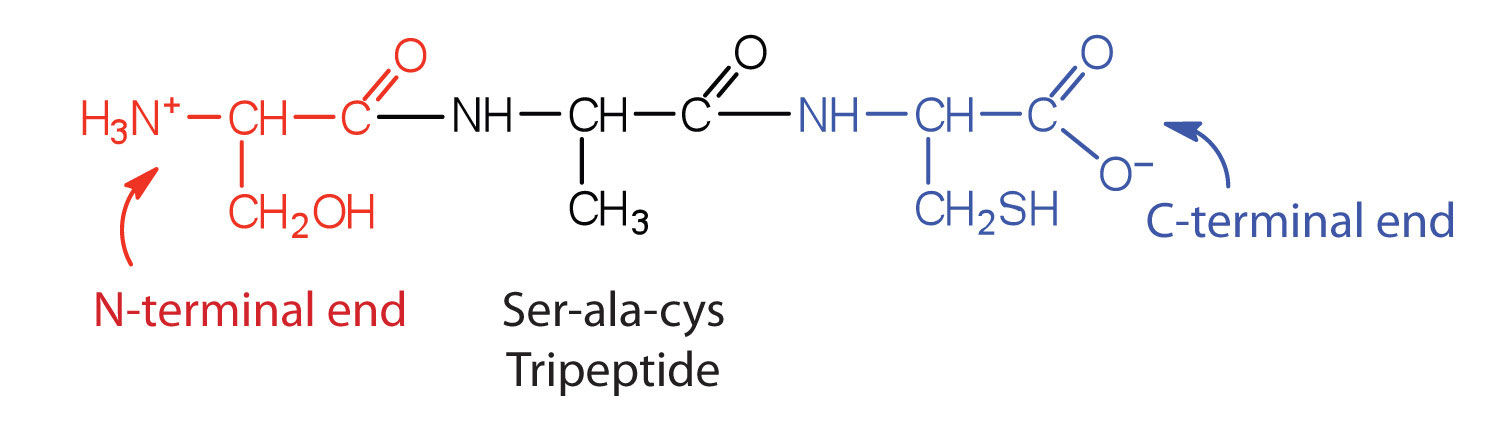
Tripeptide diagram emphasizing peptide-chain directionality, with the free amino group at the N-terminus and the free carboxyl group at the C-terminus. This visual supports the idea that polypeptides are built in a consistent head-to-tail orientation, giving the chain a defined order. Source
One end has a free amino group, and the other has a free carboxyl group. This is why amino acid chains have a definite order. You do not need advanced structural detail here, but you should understand that the chain is built from amino acid monomers joined by repeated condensation reactions.
Practice Questions
State what is removed and what type of bond is formed when two amino acids join together. (2 marks)
1 mark: water is removed / formed
1 mark: a peptide bond is formed
Explain how amino acids are structured and how they join to form a polypeptide. (6 marks)
1 mark: amino acid has a central carbon atom
1 mark: central carbon attached to an amino group and a carboxyl group
1 mark: central carbon also attached to a hydrogen atom and a variable R group
1 mark: carboxyl group of one amino acid reacts with amino group of another
1 mark: condensation reaction removes water / OH and H removed
1 mark: peptide bond forms and repeated reactions produce a polypeptide
FAQ
Amino acids contain both an amino group and a carboxyl group, so they can both accept and donate protons.
The amino group can gain a proton and become positively charged.
The carboxyl group can lose a proton and become negatively charged.
This means a single amino acid can carry both charges at the same time. That form is called a zwitterion.
These names describe the two ends of a peptide or polypeptide chain.
The N-terminus is the end with the free amino group.
The C-terminus is the end with the free carboxyl group.
Biologists use these terms when describing the direction and order of amino acids in a chain.
The peptide bond does not rotate as freely as many other single covalent bonds.
This is because the electrons are shared in a way that gives the bond partial double-bond character. As a result, the atoms around the peptide bond tend to stay in one plane, which limits movement in the backbone of the chain.
Peptide bonds are broken by hydrolysis.
A molecule of water is added across the bond.
This reverses the condensation reaction that formed it.
In living organisms, enzymes usually catalyze this process. During digestion, protease enzymes hydrolyze peptide bonds to release smaller peptides and amino acids.
Proline is unusual because its side chain bonds back to the amino group, forming a ring structure.
This makes it less flexible than most other amino acids. As a result, proline can introduce bends or kinks into a polypeptide chain. Its shape can therefore have a strong effect on how a chain folds later on.
