

Edexcel Syllabus focus:
'Understand the significance of a protein's primary structure in determining its three-dimensional structure and properties.'
Proteins do not fold randomly. The order of amino acids in a polypeptide controls the interactions that occur during folding, which determines the protein's final shape and its properties.
Primary structure and why it matters
Proteins are made of one or more polypeptide chains. For a protein to work properly, its polypeptide must fold into a precise three-dimensional shape. That shape is ultimately directed by the amino acids present and, most importantly, the order in which they occur.Primary structure: The specific sequence of amino acids in a polypeptide chain.
The primary structure is the foundation for all later folding. Each amino acid has a different R group, also called a side chain. These side chains have different chemical properties. Some are polar, some are nonpolar, some carry a positive or negative charge, and some can form disulfide bridges. Because the sequence fixes where each amino acid lies in the chain, it also fixes where these chemical properties are positioned.
Same amino acids, different order
Two polypeptides may contain the same types and numbers of amino acids but still fold differently if the order is different. This is because a different sequence changes the pattern of possible interactions along the chain. A protein's three-dimensional form therefore depends on sequence, not just amino acid composition.
How primary structure drives folding
As a polypeptide forms, different parts of the chain begin to interact. Regions with compatible chemical properties are attracted, while others are kept apart. This causes the chain to twist, bend, and fold into a stable arrangement.
During folding, both the peptide backbone and the side chains contribute. Some parts of the chain form regular local structures because of hydrogen bonding within the backbone. Later, interactions between side chains pull more distant regions together. The final shape depends on the exact positions of amino acids in the primary structure.
Tertiary structure: The overall three-dimensional shape of a single polypeptide chain produced by interactions between different parts of the chain.
Amino acids that are far apart in the primary structure can become close together after folding. This allows interactions to form between regions that were originally distant in the linear sequence.
This is why the linear sequence contains hidden structural information. A residue placed early in the chain may eventually help stabilize a region near the end of the chain. Folding is therefore a cooperative process: one interaction can encourage others to form, gradually locking the protein into its final shape. If the sequence changes, this network of interactions may change as well, producing a different final arrangement.
Interactions involved in folding
Important interactions that help shape a protein include:
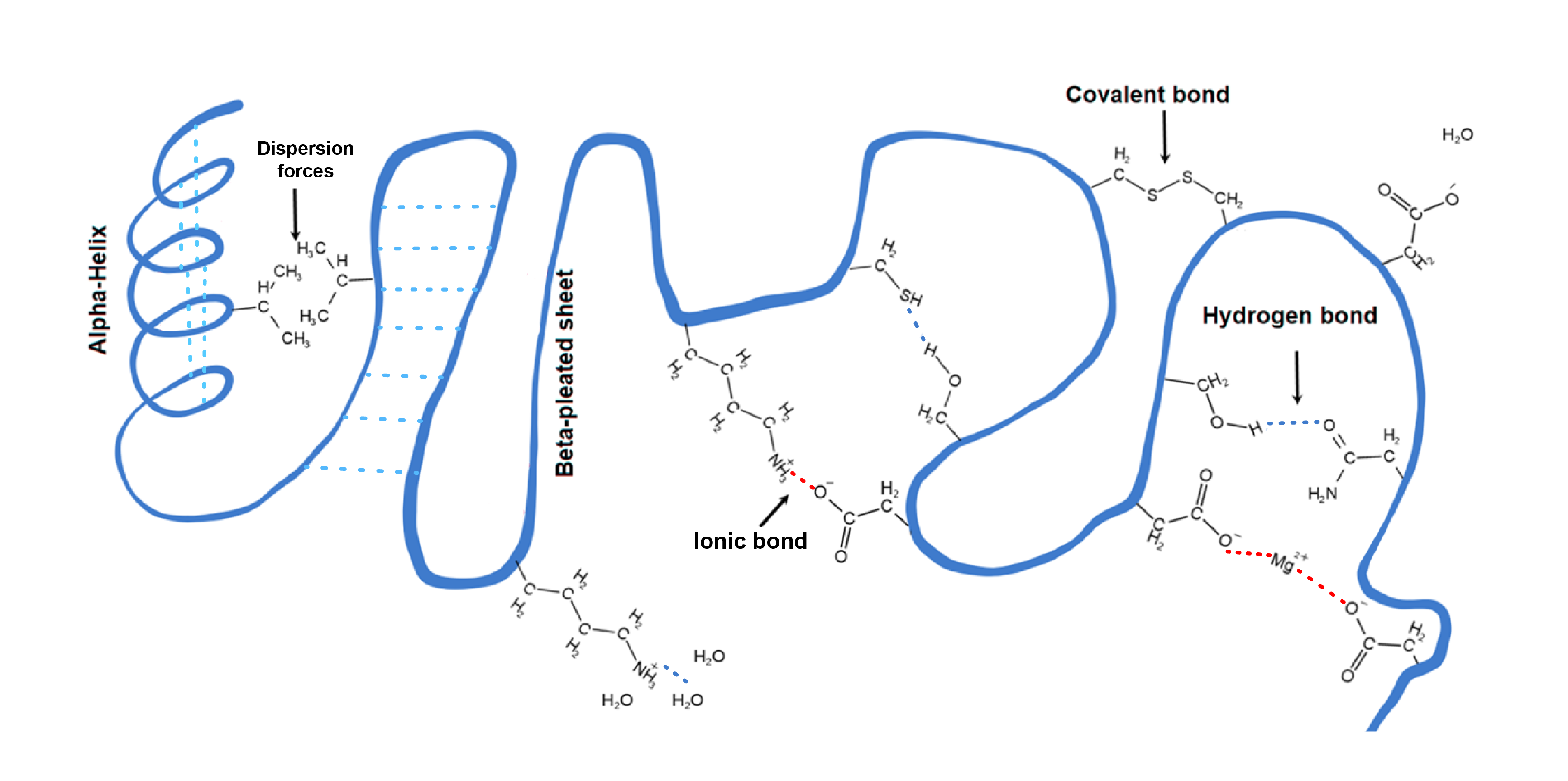
This diagram summarizes the major side-chain interactions that stabilize a folded polypeptide (hydrogen bonding, ionic bonding, hydrophobic/dispersion interactions, and disulfide/covalent bonds). It supports the idea that the primary sequence matters because it determines which side chains can meet and interact once the chain folds, thereby stabilizing a particular tertiary structure. Source
Hydrogen bonds between polar groups
Ionic bonds between oppositely charged side chains
Disulfide bridges between cysteine residues
Hydrophobic interactions, where nonpolar side chains cluster away from water
These interactions do not occur at random.
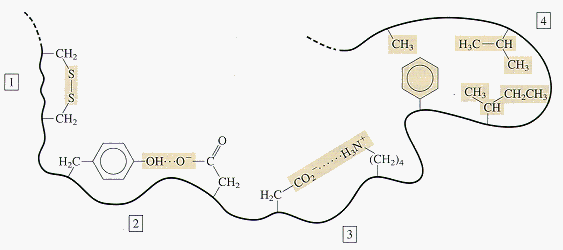
This figure organizes the four main forces that stabilize tertiary structure: disulfide linkages, hydrogen bonding, electrostatic (ionic) attractions, and hydrophobic clustering. It reinforces that folding is not random—specific side-chain chemistries drive predictable stabilizing interactions when the correct residues are positioned by the primary sequence. Source
They depend on which amino acids are present and where they are placed in the chain. For example, if several hydrophobic amino acids end up close together, they tend to move into the interior of the protein. If oppositely charged side chains are positioned suitably, ionic attraction may stabilize the fold.
How folding determines properties
A protein's properties arise from its final shape and from the chemical groups exposed on its surface. Once folded, the protein has a particular distribution of hydrophobic, hydrophilic, and charged regions. This affects:
Solubility in water
Stability of the molecule
Flexibility or rigidity
Ability to bind specifically to other molecules
The shape of any binding region
A protein with many hydrophilic groups exposed on the outside is usually more soluble in water. A protein stabilized by many internal interactions is often more resistant to changes in shape. If folding produces a very specific surface shape, the protein may interact only with particular molecules.
Surface chemistry is especially important because other molecules do not interact with the whole protein equally. They interact mainly with the outer, exposed regions. This means a change deep inside the protein can still matter if it alters how the surface is arranged.
The position of amino acids after folding also affects whether a protein is compact or more open in shape. A compact fold can increase stability, whereas a more flexible arrangement may allow movement needed for binding or shape change.
Why the sequence contains folding information
The linear sequence of amino acids contains the information needed for folding because every position in the chain affects the local chemical environment. A hydrophobic amino acid beside other hydrophobic residues promotes a different fold from the same amino acid placed among charged residues. In an aqueous environment, many proteins fold so that hydrophobic side chains are buried inside, while hydrophilic side chains remain exposed to water. The sequence therefore helps decide which parts of the protein are likely to be on the outside and which are likely to be in the core.
Position matters as much as identity
Not every amino acid contributes equally. Some lie in regions crucial for maintaining the overall fold, while others are in more flexible parts of the protein. An amino acid involved directly in a stabilizing interaction or in shaping a binding region is often especially important. This is why the effect of changing the sequence depends on both the type of amino acid altered and its position in the primary structure.
Effects of changes in primary structure
If the primary structure changes, the protein may fold differently. A changed amino acid may:
remove an interaction that would normally form
introduce a new charge
replace a hydrophilic side chain with a hydrophobic one
alter the position of a cysteine involved in a disulfide bridge
Any of these changes can alter the overall three-dimensional structure. Sometimes the effect is small, especially if the new amino acid has similar properties to the original one. In other cases, a single change can have a major effect on folding and therefore on the protein's properties.
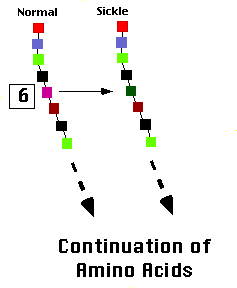
This schematic shows the single amino-acid substitution in sickle-cell hemoglobin (β-globin position 6: glutamic acid replaced by valine). It illustrates how a tiny change in primary structure can create new interaction patterns between protein molecules, leading to altered behavior and biological consequences. Source
A change in folding may make a protein less stable, less soluble, or unable to interact correctly with other molecules. It may also cause the protein to adopt an abnormal shape and lose its normal biological role. Some altered proteins are broken down rapidly because the cell recognizes that they have not folded properly. Changes in especially important regions of the sequence are more likely to have major effects than changes in less critical regions.
Practice Questions
Explain why the primary structure of a protein is important in determining its three-dimensional shape. (2 marks)
The primary structure gives the sequence/order of amino acids or the positions of R groups. (1)
This determines which interactions or bonds form during folding, producing the final three-dimensional structure. (1)
A protein differs from the normal protein by one amino acid in its primary structure. Explain how this change may alter the properties of the protein. (5 marks)
The new amino acid has a different R group or different chemical properties such as charge or polarity. (1)
This may change hydrogen bonds, ionic bonds, disulfide bridges, or hydrophobic interactions. (1)
The polypeptide may therefore fold differently / the tertiary structure may change. (1)
This can alter the shape of the exposed surface or a binding region. (1)
The protein may become less stable, less soluble, or unable to function normally. (1)
FAQ
A conservative substitution replaces one amino acid with another that has similar chemical properties, such as one nonpolar amino acid with another nonpolar amino acid.
Because the side chain behaves similarly, the effect on folding is often smaller. However, it can still matter if that amino acid had a very specific structural role.
Primary structure contains the folding information, but the inside of a cell is crowded and proteins can make incorrect temporary interactions.
Chaperones help by:
preventing unwanted interactions
giving the polypeptide time to fold correctly
sometimes helping partially misfolded proteins refold
They usually do not change the final structure favored by the amino acid sequence.
Disulfide bridges are strong covalent links that add extra stability to a protein's folded structure.
They are especially useful in extracellular proteins because these proteins may face:
changing conditions
mechanical stress
less controlled environments than inside the cell
This extra stability helps the protein keep its correct shape.
Some small proteins can refold if their primary structure is still intact and conditions return to normal. This shows that the amino acid sequence itself contains much of the information needed for the correct shape.
Other proteins do not refold easily because they aggregate, need chaperones, or depend on cellular conditions that are hard to reproduce.
An intrinsically disordered region is a stretch of amino acids that does not adopt one fixed three-dimensional structure on its own.
This can be useful because it allows:
flexibility
binding to multiple partners
rapid structural changes during cell signaling
Its behavior is still determined by primary structure, but the sequence favors flexibility rather than a single stable fold.
