

Edexcel Syllabus focus:
'Understand enzyme mechanism and specificity in terms of three-dimensional structure, and that enzymes reduce activation energy as biological catalysts.'
Enzymes make metabolic reactions fast enough for life by binding specific substrates and lowering the energy barrier to reaction. Their function depends on the precise shape of the active site.
Enzymes as biological catalysts
Enzymes are biological catalysts, meaning they increase the rate of reactions in living organisms without being used up. Most enzymes are globular proteins, so their function depends on the way the polypeptide chain folds into a precise three-dimensional structure.
Inside cells, many reactions would happen far too slowly at normal temperatures if they relied on random collisions alone. Enzymes solve this problem by providing a surface where the correct molecules can bind and react more easily. Because the enzyme is unchanged overall at the end of the process, it can be used again.
Specificity depends on three-dimensional structure
Each enzyme has an active site formed by the exact folding of its amino acid chain. The positions of the amino acid side chains in this region give the active site its specific shape and chemical properties.
Active site: The region of an enzyme with a specific three-dimensional shape that binds the substrate and is where the reaction is catalyzed.
A substrate is the molecule an enzyme acts on. Enzyme specificity means that an enzyme usually catalyzes only one reaction or a very small group of closely related reactions. This is because only substrates with a complementary shape and suitable chemical interactions can bind effectively to the active site.
Specificity is not just about overall shape. The active site must also have the correct arrangement of charges, polar groups, and bonding opportunities. If these do not match the substrate, binding is weak or does not occur at all.
A useful way to think about specificity is that the active site is not random. It is produced by the enzyme's tertiary structure, so even a small change in folding can alter which substrate fits. This is why enzyme function is closely linked to structure.
Enzyme-substrate complexes
When a substrate binds to the active site, an enzyme-substrate complex forms. This is temporary. The enzyme is not permanently joined to the substrate.
Many courses describe this with the lock-and-key idea, where the substrate fits the active site.
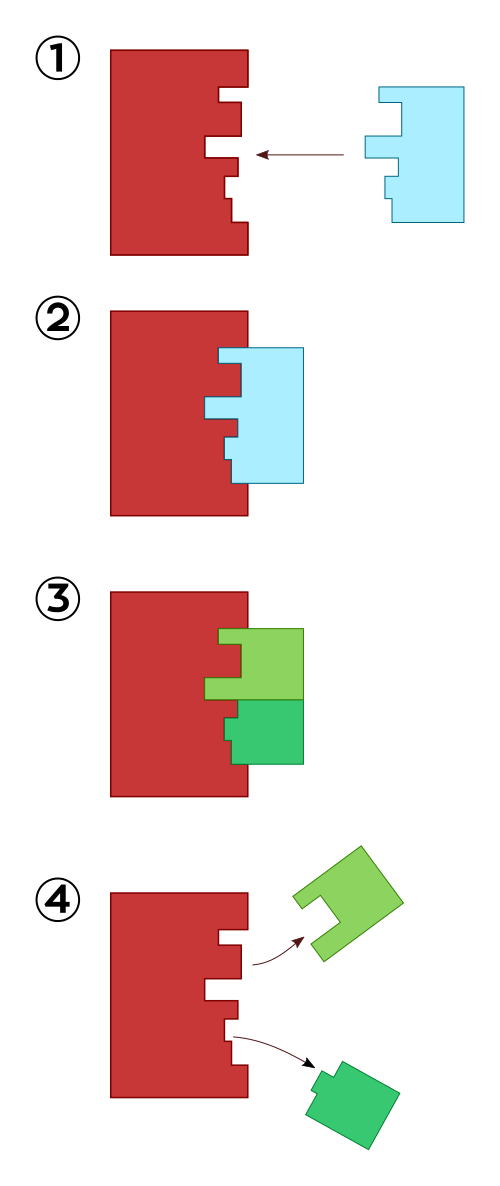
This diagram summarizes the lock-and-key model of enzyme specificity: only a substrate with a complementary shape fits the enzyme’s active site. It also shows the sequence of binding, reaction, and product release, emphasizing that the enzyme is not consumed. Use it to connect the idea of a precisely shaped active site to selective substrate binding. Source
In practice, the induced fit model often gives a better explanation. In this model, binding of the substrate causes a slight change in the enzyme's active site, making the fit even closer and helping the reaction proceed.
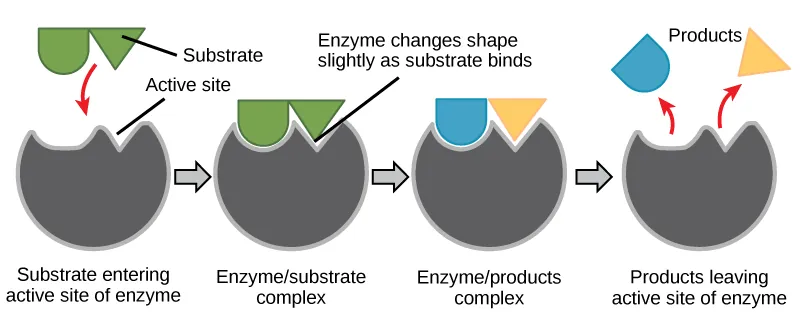
This induced-fit diagram shows that enzyme–substrate binding is dynamic: contact with the substrate triggers a small conformational change in the active site. The result is a better match to the transition state, helping the enzyme catalyze the reaction more efficiently. It complements (and modernizes) the simpler lock-and-key picture by emphasizing flexibility as part of specificity. Source
Enzyme mechanism
The mechanism of enzyme action can be described in stages:
substrate molecules collide with the enzyme
a substrate with a complementary shape binds to the active site
an enzyme-substrate complex forms
the active site may adjust slightly around the substrate
bonds in the substrate may be strained, or reactants may be held in the correct orientation
the reaction occurs and product molecules form
products leave the active site
the enzyme is free to catalyze another reaction
This mechanism explains why enzymes are both specific and efficient. Only certain substrates can bind, but once they do, the enzyme makes reaction much more likely.
Enzymes lower activation energy
For a reaction to start, reacting molecules must reach the activation energy.
Activation energy: The minimum energy that reacting molecules must have for a reaction to begin.
Enzymes speed up reactions by reducing activation energy.
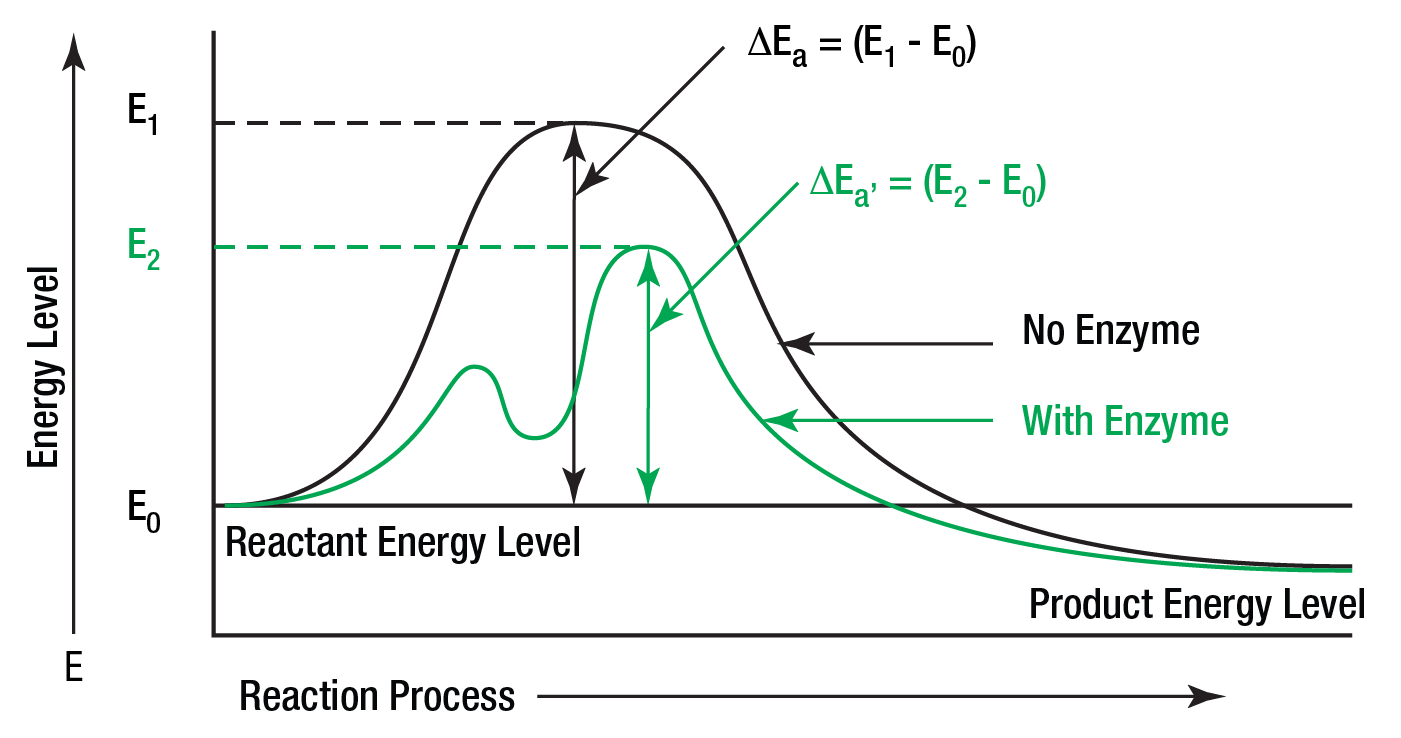
This energy-level diagram compares an uncatalyzed reaction pathway with an enzyme-catalyzed pathway, highlighting the reduced activation energy barrier in the presence of the enzyme. It reinforces that enzymes change the reaction pathway (lowering the peak energy required) rather than “adding energy” to the system. This is the key reason reaction rates increase at the same temperature. Source
They do not add energy to the reaction. Instead, they provide an alternative pathway in which less energy is needed for the reaction to proceed.
This happens because the active site can:
hold substrates close together
position them in the correct orientation
place strain on particular bonds
create a local environment that favors the reaction
As a result, a greater proportion of collisions become successful at the same temperature. The reaction rate increases, even though the temperature of the cell has not changed.
This is essential in living organisms. Cells cannot usually raise their temperature enough to make reactions fast by heat alone, because high temperatures would damage proteins and other cell components. Enzymes allow rapid reactions under mild biological conditions.
Why enzyme shape matters
Because enzyme action depends on the precise shape of the active site, any change to the enzyme's three-dimensional structure can affect its mechanism and specificity. If the active site changes shape, the substrate may no longer be complementary, so fewer enzyme-substrate complexes form.
A change in shape can:
reduce how often the substrate binds
weaken the interactions between enzyme and substrate
prevent the enzyme from lowering activation energy effectively
stop the reaction altogether
This shows that enzyme specificity is a direct consequence of protein structure. The order of amino acids determines how the protein folds, and the folding determines the active site. The active site then determines which substrate can bind and how the reaction is catalyzed.
Enzymes therefore link structure to function very clearly. Their three-dimensional form explains both why they are selective and how they act as biological catalysts. Without the correct active site shape, an enzyme cannot bind its substrate properly or reduce activation energy efficiently.
Practice Questions
Explain why an enzyme usually catalyzes only one substrate or a small group of closely related substrates. (2 marks)
1 mark: the enzyme has an active site with a specific three-dimensional shape
1 mark: only substrates with a complementary shape can bind / form an enzyme-substrate complex
Explain how an enzyme acts as a biological catalyst. Your answer should refer to specificity, the active site, and activation energy. (6 marks)
1 mark: enzyme has a specific active site with a complementary three-dimensional shape to the substrate
1 mark: substrate binds to the active site / enzyme-substrate complex forms
1 mark: induced fit may occur / active site changes slightly as substrate binds
1 mark: active site holds reactants close together / in the correct orientation / strains bonds
1 mark: activation energy is reduced
1 mark: products are released and the enzyme is unchanged / can be reused
FAQ
An enzyme lowers the activation energy for both the forward and reverse reactions. This means equilibrium is reached faster.
It does not change the energy of the reactants or products, so it does not change the final equilibrium position.
The transition state is a very unstable, high-energy arrangement of atoms between substrate and product. Reaching it is the hardest part of the reaction.
Enzymes work by stabilizing this state, which is why the activation energy becomes lower.
Some active sites are not fully functional on their own. A cofactor or coenzyme may be needed to complete the shape of the active site or help move chemical groups during the reaction.
Without the extra component, substrate binding or catalysis may be much less effective.
Yes, sometimes. Some enzymes are extremely specific, but others can act on several closely related substrates if they share key structural features.
The active site recognizes an overall pattern of shape and chemical properties, not always a single exact molecule.
A competitive inhibitor must fit into the active site well enough to compete with the substrate for binding.
It blocks substrate access without being converted into the normal product, so the reaction rate falls unless substrate concentration becomes high enough to outcompete it.

