

Edexcel Syllabus focus:
'Know the molecular structure of globular and fibrous proteins and understand how their structures relate to functions, including haemoglobin and collagen.'
Proteins have very different overall shapes, and those shapes strongly affect what they do. This topic compares compact transport proteins with long structural proteins and links molecular structure to biological function.
Protein shape and function
Globular proteins are a major group of proteins with tightly folded polypeptide chains.
Globular protein: A protein with a compact, folded, roughly spherical shape, usually with a specific metabolic, transport, or regulatory role.
Their shape is produced by folding that brings different parts of the chain close together and creates a precise three-dimensional structure.
By contrast, fibrous proteins are mainly used for strength and support.
Fibrous protein: A protein made of long polypeptide chains arranged into fibers or strands, usually providing structural support.
These two groups differ in shape, solubility, and function. Globular proteins are usually soluble and carry out active roles such as transport. Fibrous proteins are usually insoluble, very strong, and important in tissues that must resist stretching or wear.
Globular proteins
Globular proteins are folded so that the molecule becomes compact. This folding is important because it creates specific regions for binding or activity. In many globular proteins:
Hydrophilic side chains are more common on the outside, helping the protein interact with water
Hydrophobic side chains are often buried inside the molecule
the protein has a precise tertiary structure
some also have a quaternary structure, where several polypeptide chains join together
Because of this compact structure, globular proteins are well suited to functions that depend on movement, binding, or rapid interaction with other molecules. Their shape is closely related to function: a small change in the arrangement of amino acids can alter folding and therefore change what the protein does.
Hemoglobin as a globular protein
Hemoglobin is an important example of a globular protein. It is the oxygen-carrying protein found in red blood cells. Its structure makes this function possible.
Hemoglobin:
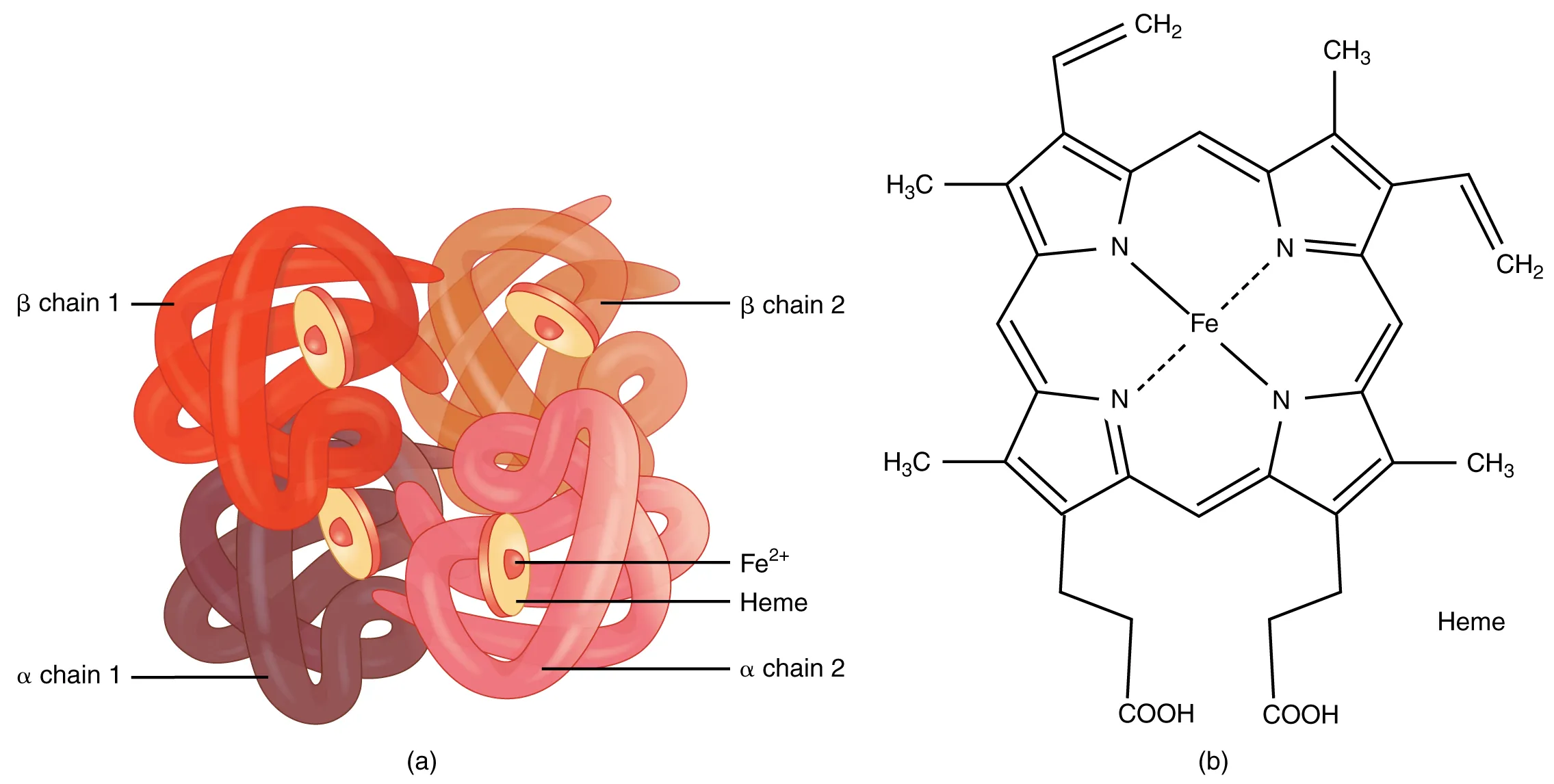
Hemoglobin is a tetrameric globular protein: four folded globin subunits assemble into a quaternary structure. Each subunit contains a heme prosthetic group with a central Fe ion, and each heme binds one O molecule, explaining the total capacity of four O per hemoglobin molecule. Source
is a globular protein, so it is compact
is made of four polypeptide chains
has a quaternary structure
contains four haem groups
each haem group contains an iron ion
each haem group can bind one oxygen molecule
This means one hemoglobin molecule can carry four oxygen molecules in total.
Its compact, globular shape is important because:
it makes the molecule suitable for transport inside cells
it is sufficiently soluble to be carried in the red blood cell cytoplasm
it has a specific three-dimensional arrangement that allows oxygen binding
The presence of haem groups is also essential. The protein part of hemoglobin holds each haem group in the correct position, while the iron ion within the haem group binds oxygen reversibly. This allows oxygen to be loaded where oxygen concentration is high and released where it is lower.
Hemoglobin shows clearly how protein structure determines function. Its multiple polypeptide chains and embedded haem groups allow it to act as an efficient transport protein rather than a structural one.
Fibrous proteins
Fibrous proteins have a very different molecular structure from globular proteins. Instead of being tightly folded into a compact shape, their polypeptide chains are arranged in long strands. These strands often run parallel to each other and are linked together.
Typical features of fibrous proteins include:
long, narrow shape
repetitive amino acid sequences
many bonds between chains
very high tensile strength
low solubility in water
These features make fibrous proteins ideal for structural roles. They are less suited to transport or catalysis, but very well adapted for forming tissues that need mechanical support.
Collagen as a fibrous protein
Collagen is a major fibrous protein in animals and is found in connective tissues such as tendons, ligaments, skin, cartilage, and blood vessel walls. Its molecular structure is specialized for strength.
Collagen has several levels of organization:
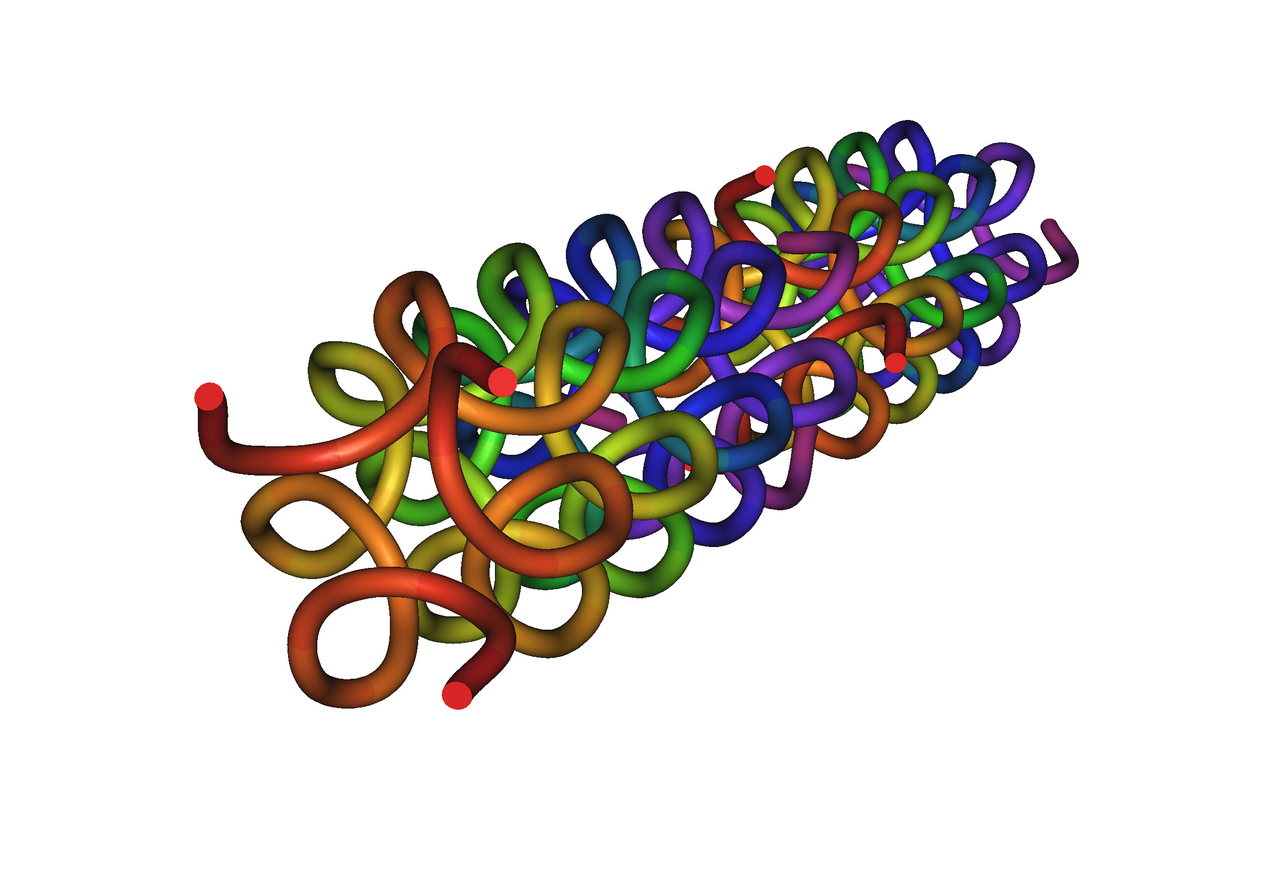
Collagen’s fundamental structural unit is a triple helix formed by three polypeptide chains tightly wound around one another. This rope-like geometry, stabilized by many inter-chain hydrogen bonds and close packing, underpins collagen’s characteristic tensile strength in connective tissues. Source
each collagen molecule is made of three polypeptide chains
these chains are wound around each other to form a triple helix
hydrogen bonds help hold the three chains together
many collagen molecules are then arranged side by side in a staggered way
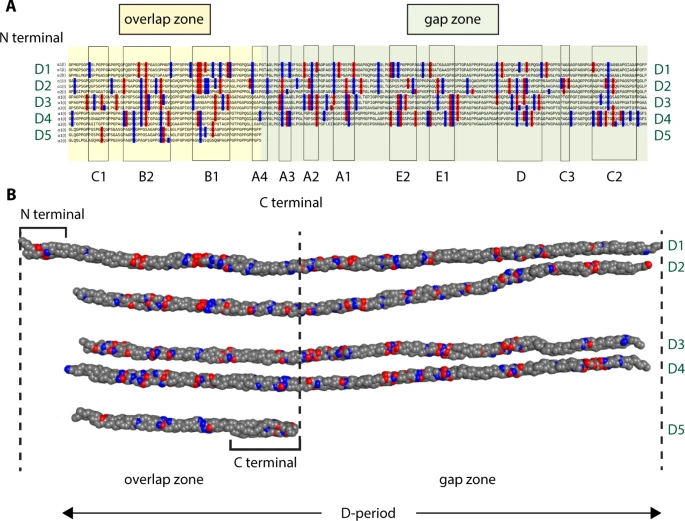
This schematic summarizes how collagen molecules are packed in a staggered, repeating pattern within a fibril, creating distinct overlap and gap regions along the fibril axis. The staggered packing helps distribute stress and contributes to the mechanical robustness of collagen-based tissues. Source
covalent cross-links form between molecules, producing fibrils
fibrils group together to form strong collagen fibers
This arrangement gives collagen its key properties:
high tensile strength, so it resists pulling forces
insolubility, so it remains stable in tissues
great strength because many molecules are packed together and cross-linked
resistance to stretching, which is important in supporting body structures
A notable feature of collagen is the close packing of its chains. This allows many bonds to form and contributes to the stability of the triple helix. The staggered arrangement of molecules in fibrils also helps avoid weak points, making the whole fiber stronger.
Relating structure to function
The contrast between hemoglobin and collagen shows the difference between globular and fibrous proteins very clearly.
Hemoglobin has a compact, soluble structure with haem groups, so it is adapted for transport
Collagen has long, cross-linked triple-helical molecules, so it is adapted for strength and support
In both cases, function depends on molecular structure. A protein is not simply a chain of amino acids: the way that chain is arranged in space determines whether the protein carries oxygen, supports tissues, or performs some other biological role.
Practice Questions
State two structural differences between a globular protein and a fibrous protein.(2 marks)
Globular proteins are compact / folded / roughly spherical, whereas fibrous proteins are long / extended / strand-like. (1)
Globular proteins often have a complex tertiary or quaternary structure, whereas fibrous proteins consist of parallel chains or fibers. (1)
Globular proteins usually have less repetitive amino acid sequences, whereas fibrous proteins often have repetitive sequences. (1)
Accept any two valid differences for a maximum of 2 marks.
Explain how the molecular structures of hemoglobin and collagen are related to their functions. (6 marks)
Hemoglobin is a globular protein / has a compact shape. (1)
Hemoglobin has four polypeptide chains / quaternary structure. (1)
Hemoglobin contains four haem groups. (1)
Each haem group binds one oxygen molecule / iron ions allow oxygen binding. (1)
Collagen consists of three polypeptide chains wound into a triple helix. (1)
Hydrogen bonds hold the chains together. (1)
Collagen molecules form fibrils / fibers by cross-linking. (1)
Cross-linking or fiber formation gives high tensile strength / resistance to stretching. (1)
Collagen is suitable for structural support in connective tissue. (1)
Award a maximum of 6 marks.
FAQ
Hemoglobin is called a conjugated protein because it contains both:
a protein part, made of polypeptide chains
a non-protein part, called a prosthetic group
In hemoglobin, the prosthetic group is haem. The haem group contains iron, and that iron is the part that binds oxygen.
Without the haem group, hemoglobin would still be a protein, but it would not carry oxygen in the same way.
Oxygen is only slightly soluble in water, and plasma is mostly water.
If oxygen were transported only dissolved in plasma:
the blood would carry far less oxygen
tissues with high oxygen demand would not be supplied effectively
Hemoglobin solves this problem by binding oxygen chemically rather than relying only on dissolution. This greatly increases the oxygen-carrying capacity of blood.
Gelatin is produced when collagen is heated in water for a long time.
During this process:
some bonds holding the collagen structure together are broken
the organized triple-helix structure is partly lost
the protein becomes a mixture of shorter, less ordered chains
That is why gelatin does not have the same strength as intact collagen. It comes from collagen, but its structure has been altered.
Scientists can use several clues:
shape seen from imaging methods or structural studies
solubility in water
whether the protein forms compact particles or long fibers
whether its role is mainly metabolic or structural
Methods such as X-ray-based techniques and electron microscopy can reveal overall arrangement. A compact, folded molecule suggests a globular protein, while long repeating strands suggest a fibrous protein.
No. Collagen is only one type of fibrous protein.
Other fibrous proteins have different molecular arrangements, for example:
keratin, which is important in hair and nails
silk proteins, which form strong fibers in a different way
What they share is not an identical structure, but the general pattern of:
long polypeptide organization
strength
low solubility
a mainly structural role
