IB Syllabus focus: 'Human behaviour is complex, so causality often involves interactions among several variables rather than one direct cause.'
Human behavior rarely results from a single cause. Psychological explanations are strongest when they show how biological, cognitive, social, and situational influences combine, overlap, and change one another.
Why single-cause explanations are limited
In psychology, it is tempting to search for one clear cause of a behavior, such as a hormone, a thought pattern, or a social pressure. However, most behaviors emerge from multiple influences operating at the same time. A person may act aggressively, develop anxiety, or remember information in a certain way because several variables are working together rather than because one variable acts alone.
Psychologists often describe this as multifactorial causation.
Multifactorial causation: An explanation of behavior that emphasizes several contributing variables rather than one single direct cause.
This idea matters because people bring prior experiences, personality, biology, relationships, and cultural expectations into every situation. Even when one variable seems important, its effect may be strengthened, weakened, or changed by other variables. As a result, causal explanations in psychology are often probabilistic rather than certain: a set of variables may increase the likelihood of a behavior without guaranteeing it.
How variables interact
Complexity does not just mean that many variables are present. It also means that variables may interact. An interaction happens when the effect of one variable depends on the presence, level, or timing of another variable. For example, stress may have a different impact on mood depending on social support, coping style, or previous trauma.
When the influence of one variable depends on another, this is an interaction effect.
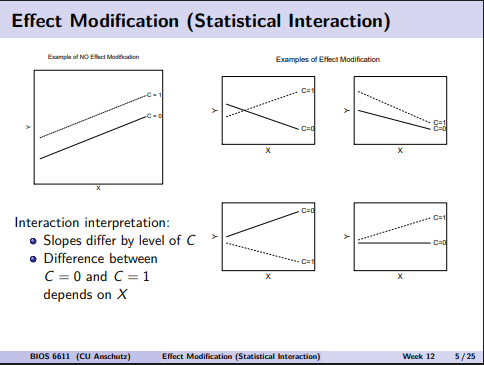
These interaction plots show how the relationship between an outcome and a predictor changes across levels of a third variable (a moderator, labeled ). Parallel lines indicate no interaction (the effect of is the same across ), while non-parallel or crossing lines indicate an interaction because the effect of depends on . Source
Interaction effect: A pattern in which the effect of one variable on behavior changes according to the level or presence of another variable.
This is different from a simple additive explanation. In an additive model, each variable contributes separately. In an interaction model, the variables change each other’s impact. That is why a single factor may produce different outcomes in different people, and why similar behaviors can arise from different combinations of causes. Psychological explanations therefore need to ask not only what variables matter, but also how they work together.
Common forms of interacting influences
Biological and environmental influences
Biological variables such as genes, hormones, arousal level, or brain activity do not act in isolation.
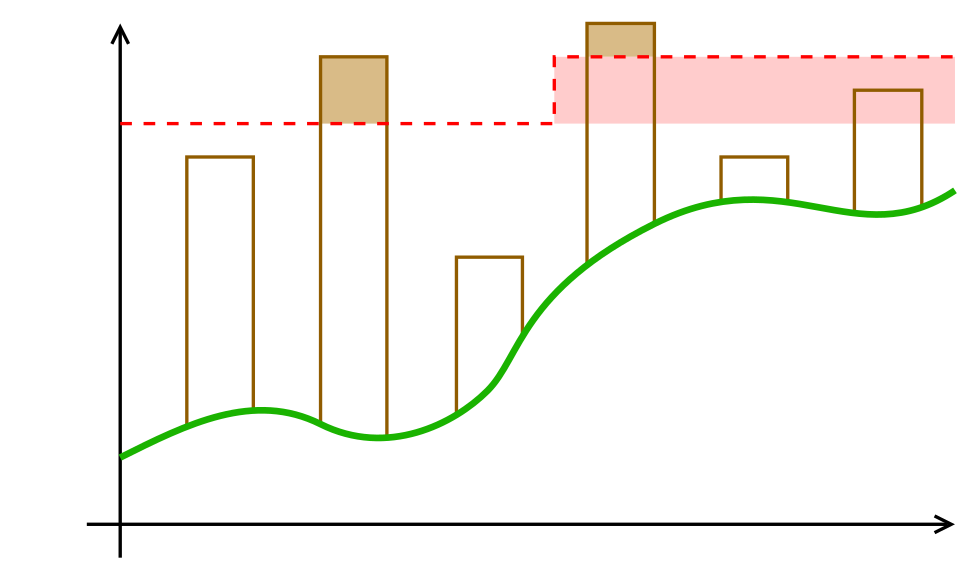
This graph illustrates the diathesis–stress model by plotting how increasing environmental stress relates to the likelihood/severity of an outcome for individuals with different levels of vulnerability (diathesis). The key feature is non-parallel response lines: the same stressor level can produce different outcomes depending on predisposition, and higher vulnerability requires less stress to reach high risk. Source
Their effects are shaped by the environment. A biological predisposition may remain weak unless it is triggered by chronic stress, poor sleep, substance use, or major life events. Likewise, a difficult environment may affect one person strongly and another person less strongly because their biological sensitivity is different. This shows why behavior cannot usually be reduced to “nature” or “nurture” alone.
Cognitive and social influences
Behavior is also influenced by the interaction between internal mental processes and the social world. A person’s interpretation of an event may depend on schemas, expectations, or attributional style, but these cognitive processes develop within families, peer groups, media environments, and cultural norms. The same comment from a teacher may motivate one student, embarrass another, and be ignored by a third because cognition and social context are interacting.
Developmental and situational influences
The effect of a variable may also depend on age, life stage, or immediate context. A stressful event can have different consequences in childhood, adolescence, and adulthood because developmental factors change emotional regulation, identity, and dependence on others. Situational factors matter too: crowding, time pressure, authority, and uncertainty can all alter how personality or beliefs are expressed.
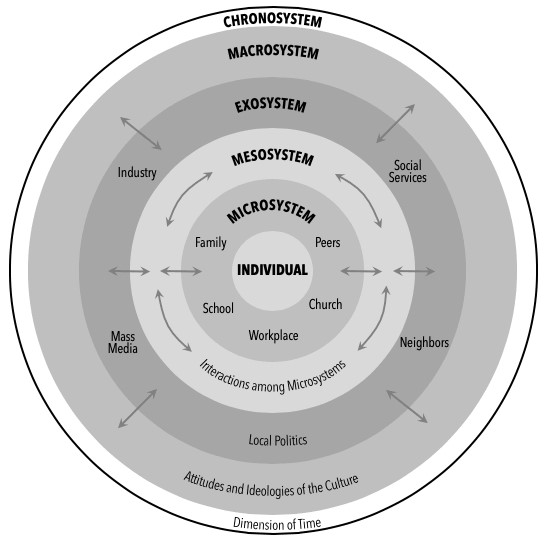
This diagram summarizes Bronfenbrenner’s ecological systems perspective by showing the individual embedded within nested environmental layers (microsystem through macrosystem, plus time/chronosystem). It visually reinforces that explanations of behavior often require mapping how influences at different levels of context can shape—and be shaped by—each other. Source
This means behavior often reflects a dynamic relationship between enduring characteristics and immediate circumstances.
What complexity means for causal explanations
Because variables interact, psychological causality is rarely linear. The same outcome may be reached through different pathways, and the same variable may lead to different outcomes depending on the surrounding conditions. This makes it difficult to claim that one direct cause fully explains a behavior.
Complex causality also means that risk is not destiny. A variable such as early adversity may raise the chance of later difficulties, but supportive relationships, effective coping, or positive environments may reduce that effect. Similarly, a protective factor may help in one context but have little effect in another. Psychologists therefore avoid overly deterministic statements and instead look at patterns of influence across several variables.
Why this matters in psychological research
Recognizing complexity changes the way psychologists design and interpret research. Instead of assuming one direct cause, researchers often examine how several variables are linked to the same behavior and whether one variable changes the effect of another. This encourages more careful interpretation of findings. If an apparent cause is studied without considering interacting variables, the explanation may be incomplete or misleading.
Complexity also helps explain why findings in psychology are sometimes mixed. Different studies may produce different results because participants differ in background, development, or context. A variable that looks powerful in one sample may be weaker in another because the surrounding conditions are different. The key idea is that human behavior usually reflects an interacting system of causes, not a single direct pathway.
Practice Questions
State what is meant by an interaction of variables in psychological causality. [2]
1 mark for stating that more than one variable influences behavior.
1 mark for stating that the effect of one variable depends on, or is changed by, another variable.
Explain one example of how human behavior may result from interactions among several variables rather than one direct cause. [6]
1 mark for identifying a relevant behavior or outcome.
1 mark for identifying at least two relevant variables.
2 marks for explaining how the variables each contribute to the behavior.
1 mark for clearly explaining how the variables interact rather than simply add together.
1 mark for linking the example to the idea that causality in psychology is complex and not reducible to one direct cause.
Accept any appropriate example, such as biological predisposition and environment, stress and social support, or cognition and social context.
FAQ
A moderator is a variable that changes the strength or direction of a relationship between two other variables.
For example:
stress may predict depression more strongly when social support is low
the same relationship may be weaker when social support is high
Moderators are useful because they help psychologists answer when, for whom, or under what conditions an effect occurs.
A mediator explains the process through which one variable affects another, while a moderator changes how strong that effect is.
A simple distinction is:
Mediator: explains the pathway
Moderator: explains the condition
For example, bullying may lead to anxiety through lowered self-esteem. Here, self-esteem is a mediator. If that effect is stronger for younger adolescents than older adolescents, age is acting as a moderator.
Interaction effects are often harder to detect than simple main effects because the pattern is more detailed and may be smaller.
Researchers usually need larger samples because they are comparing several combinations of variables, such as:
high stress with high support
high stress with low support
low stress with high support
low stress with low support
If each subgroup is too small, the findings may look unstable or may miss a real interaction.
Yes. A variable can function differently depending on timing, intensity, or surrounding conditions.
For example:
high arousal may improve performance on a simple task
the same arousal may impair performance on a difficult task
independence may be adaptive in one family setting but create conflict in another
This is one reason psychologists avoid labeling variables as universally “good” or “bad.”
Replication can be difficult because interaction effects are sensitive to differences in measurement, sample characteristics, and context.
Common reasons include:
small original samples
weak or inconsistent measures
restricted variation in one variable
cultural or developmental differences between samples
statistical models that are slightly different across studies
A failed replication does not always mean the original idea was wrong. It may mean the interaction only appears under specific conditions.