IB Syllabus focus: 'Students should understand correlation versus causation, bidirectional ambiguity and the limits of causal conclusions.'
Psychological research often finds relationships between variables, but interpreting those relationships requires caution. This topic focuses on what correlations show, what they do not show, and why causal claims can remain uncertain.
Correlation and causation
A correlation shows that two variables are related in a systematic way. As one variable changes, the other tends to change too. Correlations may be positive (both variables increase together), negative (one increases as the other decreases), or near zero (little clear relationship).
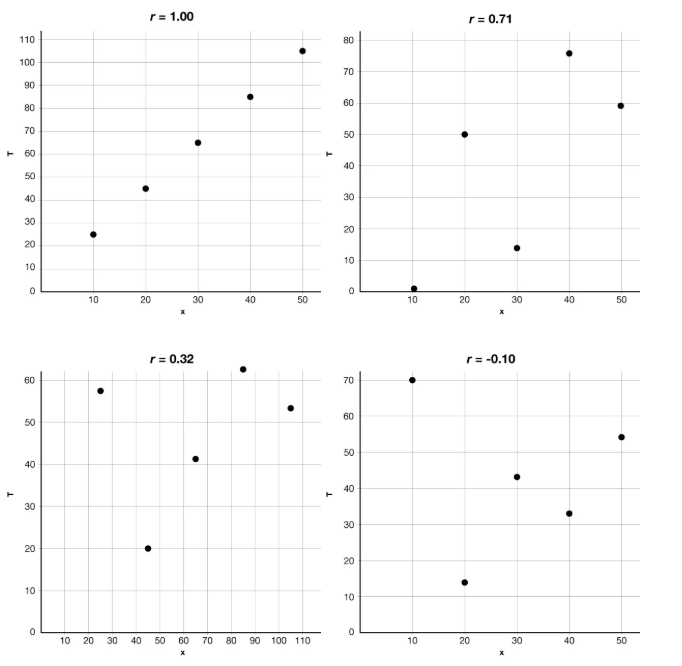
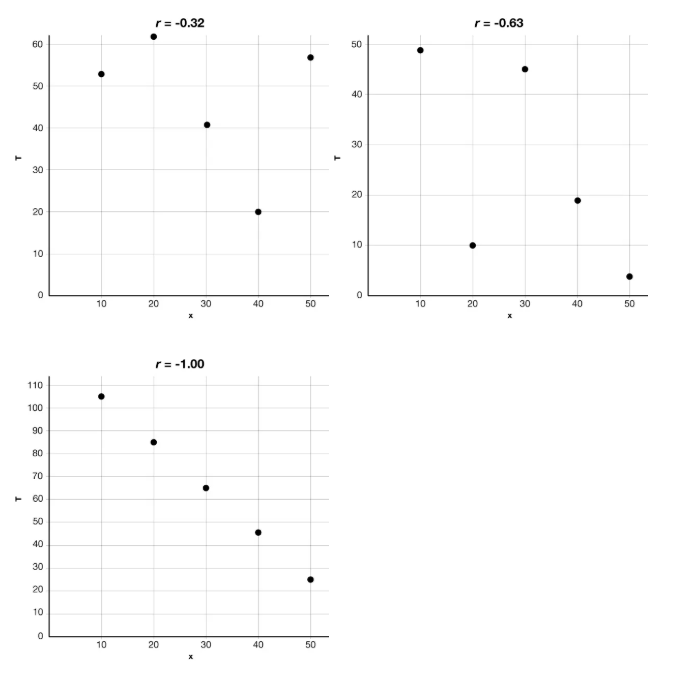
A set of scatter plots illustrating different directions and strengths of correlation, with each plot labeled by its correlation coefficient (r). It helps you connect what you see in a graph (tight upward or downward clustering versus scattered points) to the idea of “strength” and “direction” in correlational evidence. Source
Correlation: A statistical relationship between two variables, indicating that they vary together in a patterned way.
In psychology, correlations are useful because many important variables cannot easily or ethically be manipulated. For example, researchers may study links between stress and sleep, or between social support and well-being, by measuring naturally occurring differences.
A correlation can also vary in strength. A stronger correlation means the variables are more closely linked, but strength alone does not tell us why the relationship exists.
Causation: A relationship in which one variable directly produces a change in another variable.
Causation is a much stronger claim than correlation. If variable A causes variable B, then changes in A are responsible for changes in B. In psychology, this requires evidence that goes beyond simply observing that two variables occur together.
Why correlation does not equal causation
The phrase “correlation does not imply causation” is central in psychology. A correlational finding may suggest an important relationship, but it cannot by itself prove that one variable is the cause of another.
There are several reasons for this:
No clear direction of effect: Even if two variables are related, it may not be obvious which one came first.
Alternative explanations: Another variable may be influencing both measured variables.
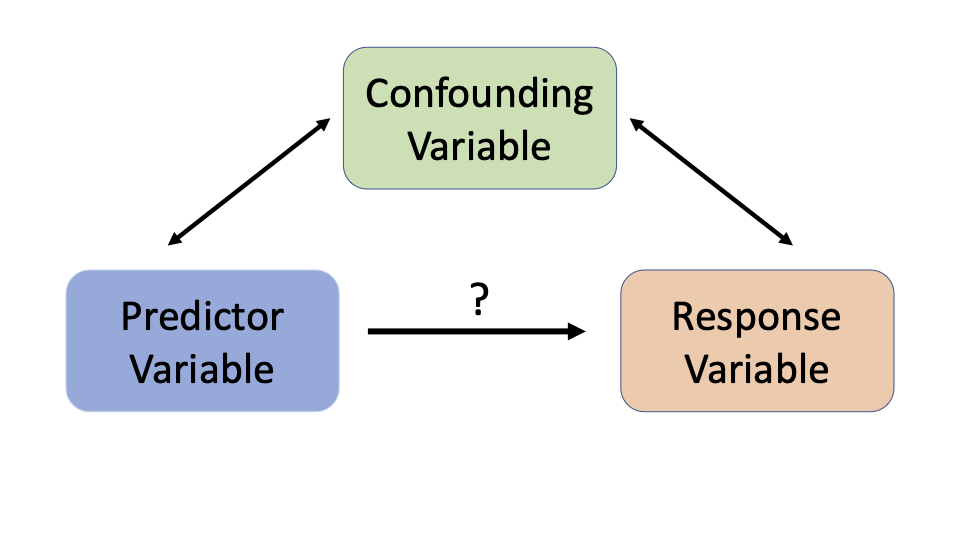
A confounding-variable (third-variable) diagram showing how an unmeasured factor can cause changes in both variables you measured. The key takeaway is that an observed correlation between A and B can arise because C influences both, so the A–B association may be real yet non-causal. Source
Lack of manipulation: In correlational research, the researcher measures variables rather than actively changing one of them.
This matters because causal conclusions require confidence that the supposed cause occurred before the effect and that other plausible explanations have been ruled out. Correlational studies are valuable for identifying patterns, making predictions, and generating hypotheses, but they are limited when the question is whether one factor causes another.
Bidirectional ambiguity
One major reason causal interpretation is difficult is bidirectional ambiguity. This means that when two variables are correlated, either variable could be influencing the other.
Bidirectional ambiguity: Uncertainty about the direction of a relationship, where variable A may influence variable B, variable B may influence variable A, or both may influence each other.
For example, if anxiety and poor sleep are correlated, several interpretations are possible:
Anxiety may lead to sleep problems.
Poor sleep may increase anxiety.
Both processes may operate together over time.
This ambiguity prevents a simple causal conclusion. A correlation identifies that a relationship exists, but not the direction of that relationship. In psychology, many variables are dynamic and can affect one another in ongoing cycles, making directional claims especially difficult.
Limits of causal conclusions
When psychologists interpret correlational findings, they must be cautious about the limits of causal conclusions. A relationship between variables can be real and statistically meaningful without showing cause and effect.
Temporal order
To support causation, the proposed cause must come before the effect. Correlational studies often measure variables at the same time, so the time order may be unknown. If temporal order is unclear, a causal claim is weakened.
Unmeasured variables
A correlation may reflect the influence of an unmeasured factor. For instance, two variables may appear linked because both are related to a third condition in the person or environment. This means the observed association may not represent a direct causal pathway.
Prediction is not explanation
A correlation can be useful for prediction without explaining why the relationship exists. If one variable predicts another, this does not automatically mean it produces it. In psychology, prediction and explanation are related but not identical goals.
Causal language can overstate findings
Researchers and students should distinguish between phrases such as:
“is associated with”
“is related to”
“predicts”
and stronger phrases such as:
“leads to”
“results in”
“causes”
The first group is appropriate for correlational evidence. The second group requires stronger support.
Interpreting correlational evidence in psychology
A good psychological interpretation asks careful questions about the evidence:
Were the variables only measured, or was one actually manipulated?
Is the direction of the relationship clear?
Could the effect work both ways?
Could another factor explain the association?
These questions help avoid overclaiming. In IB Psychology, it is important to show that correlational findings are informative but limited. They can reveal important patterns in human behavior and help researchers build theories, yet they do not by themselves establish cause and effect.
Understanding this distinction is essential when evaluating research reports, media headlines, and everyday claims about behavior. A convincing causal explanation requires more than the observation that two variables are related.
Practice Questions
(2 marks) Define bidirectional ambiguity and explain why it makes causal conclusions difficult.
1 mark for identifying bidirectional ambiguity as uncertainty about the direction of a relationship between two variables.
1 mark for explaining that if either variable could influence the other, the correlation cannot show which variable is the cause.
(6 marks) Explain the difference between correlation and causation, with reference to bidirectional ambiguity and one other limitation of correlational evidence.
1 mark for defining correlation as an association or relationship between variables.
1 mark for defining causation as one variable directly producing change in another.
2 marks for explaining bidirectional ambiguity as uncertainty over whether A causes B, B causes A, or both.
2 marks for explaining one other limitation, such as:
lack of clear temporal order
possible influence of an unmeasured third variable
correlational evidence allows prediction but not proof of causal explanation
FAQ
Yes. Strength does not equal causation.
A very strong correlation may still be misleading because:
a third variable affects both variables
the relationship is driven by a small unusual subgroup
the pattern is coincidental in a particular sample
Strong correlations deserve attention, but they still need careful interpretation. The main question is not only how strong the relationship is, but whether there is convincing evidence about direction and alternative explanations.
A spurious correlation is a relationship that appears meaningful but does not reflect a true direct connection between the two variables.
This can happen when:
both variables are influenced by another factor
the result occurs by chance
the sample is unusual or biased
Spurious correlations are important because they can produce persuasive but incorrect claims about behavior. They remind psychologists to be careful when moving from association to explanation.
Longitudinal research follows the same participants over time.
This can help because it may show whether one variable tends to appear before another. That reduces some uncertainty about direction.
However, it still does not fully prove causation. Even if A comes before B, another variable could still be responsible for both. So longitudinal evidence can strengthen causal arguments, but usually cannot settle them on its own.
No. A negative correlation can be just as informative as a positive one.
A negative correlation means that as one variable increases, the other tends to decrease. In psychology, that can be highly useful. For example, protective factors may be negatively related to symptoms or risky behavior.
What matters most is:
whether the relationship is reliable
how strong it is
whether it is interpreted appropriately
The direction of the correlation does not determine its value.
Media reports often simplify research to make headlines clearer and more dramatic.
Common reasons include:
causal statements sound more interesting
shorter articles leave out methodological limits
press releases may already use stronger wording than the original study
To read critically, look for phrases like “linked to,” “associated with,” or “related to.” If the original study was correlational, headlines using “causes” may be overstating what the evidence actually shows.