IB Syllabus focus: 'Psychologists investigate relationships between variables to determine cause-and-effect relationships in human behaviour.'
IB Syllabus focus: 'Psychologists investigate relationships between variables to determine cause-and-effect relationships in human behaviour.'
Understanding cause and effect is central to psychology because explanations of behavior become useful only when researchers can show that one factor helps produce changes in another.
Cause and effect in psychology
Psychologists investigate behavior by studying variables, or factors that can vary across people, situations, or time. A cause-and-effect question asks whether changes in one variable are followed by meaningful and systematic changes in another.
Variable: A factor that can change or take different values and can therefore be studied in relation to behavior.
When psychologists examine causality, they are asking whether one factor actually influences another, rather than simply appearing alongside it.
Causal relationship: A relationship in which a change in one variable produces, contributes to, or influences a change in another variable.
Establishing causality matters because psychology aims to explain behavior, not only describe it. If a researcher can identify a causal influence, that finding can support theory building, prediction, and better understanding of human action.
Forming a causal investigation
Identifying the possible cause and the outcome
A causal investigation begins with a focused question about a proposed influence on behavior. The researcher must decide what factor is expected to act as the cause and what behavioral response is expected as the effect. This makes the investigation specific and testable.
Psychologists also need to consider direction of influence. The proposed cause must come before the effect in time. If the order is unclear, a causal interpretation becomes much weaker because the outcome may have occurred before the supposed cause.
Good causal questions are narrow enough to be studied directly. Rather than asking whether “the environment affects behavior,” a psychologist would identify one particular environmental factor and one particular behavioral outcome. Clear causal questions make it easier to collect evidence that is relevant to the explanation being tested.
Research approaches used to investigate causality
The most direct way to investigate cause and effect is to create different conditions and compare behavioral outcomes across them.

A classical pretest–posttest control-group design diagram showing random assignment to experimental vs. control groups, a pretest measure, an intervention (treatment), and a posttest measure. The layout highlights how manipulation plus temporality (pre → treatment → post) strengthens causal inference. Source
In many studies, psychologists deliberately change one factor and then observe whether behavior changes in response. This makes it possible to test whether the proposed cause appears to produce a measurable effect.
Experimental approaches are especially useful because they are designed around causal questions. They allow researchers to separate a suspected influence from the outcome they want to observe and examine whether the effect occurs consistently.
Other research approaches can still contribute to causal understanding. Observational or survey findings may reveal patterns that suggest a possible causal link, and those patterns can later be investigated more directly. However, psychologists should be cautious about treating every observed pattern as proof of causation.
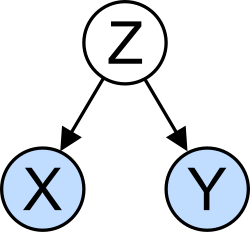
A simple causal diagram illustrating confounding: a third variable (the confounder) causally influences both the suspected cause (X) and the outcome (Y). This structure can produce an observed association between X and Y even when X does not cause Y. Source
Challenges of investigating human behavior
Investigating causality in psychology is difficult because human behavior is complex, variable, and shaped by context. The same factor may influence different people differently, and a behavior may change across settings, relationships, or life stages. As a result, a simple cause-and-effect statement may not fully capture what is happening.
Psychologists also face ethical and practical limits. Some possible causes of behavior cannot be created or changed by researchers because doing so would risk harm or violate ethical standards. In these cases, causal questions must be approached carefully, and claims should stay close to the evidence collected.
Another challenge is that causal effects in psychology are often probabilistic rather than absolute. A cause may increase the likelihood of a behavior without guaranteeing it. This is important because human action is rarely automatic or identical across all individuals.
Evaluating causal claims
What makes a causal claim more convincing?
A stronger causal claim usually includes:
clearly identified variables
a sensible time order, with the cause coming before the effect
systematic changes in behavior linked to the proposed cause
careful wording that matches the strength of the evidence
Psychologists look for patterns that are repeatable and coherent with the research question. A causal explanation is more convincing when the effect appears in a consistent way rather than as an isolated result.
Researchers also judge whether a causal explanation is specific enough. Statements such as “stress changes memory performance” become more useful when the kind of stress, the memory task, and the expected direction of change are clearly identified. Precision helps psychologists compare findings across studies and refine explanations of behavior.
Why causal investigation matters
Cause-and-effect research helps psychology move from description to explanation. By investigating how variables are related, psychologists can test ideas about why behavior happens and identify influences that matter. The goal is not to find one universal cause for every action, but to determine whether a specific factor contributes to a specific behavioral outcome.
Practice Questions
(2 marks): Define a cause-and-effect relationship in psychology.
1 mark for stating that one variable influences, produces, or contributes to a change in another variable.
1 mark for making clear that the relationship is about explaining behavior or a psychological outcome.
(6 marks): Explain how psychologists investigate cause-and-effect relationships in human behavior.
Award 1 mark for each relevant point, up to 6 marks:
Psychologists investigate relationships between variables.
They identify a proposed cause and a behavioral effect.
The proposed cause must come before the effect in time.
Researchers often compare different conditions or levels of the proposed cause.
They examine whether behavior changes systematically in response.
They interpret findings cautiously because human behavior is complex and causal effects may be probabilistic rather than guaranteed.
FAQ
People are not always fully aware of why they behave in a certain way. They may guess, simplify, or give socially acceptable answers rather than accurate ones.
Self-reports can still be useful for generating ideas, but on their own they are usually a weak basis for causal claims because they rely on memory, interpretation, and honesty.
A delayed causal effect happens when a factor influences behavior after a time gap rather than immediately.
This matters because a study may miss the effect if behavior is measured too soon. For some topics, researchers need follow-up observations over days, weeks, or longer to detect whether the proposed cause has had an impact.
A pilot study is a small trial run conducted before the main study. It helps researchers check whether the procedure is clear and whether the manipulation is strong enough to influence behavior.
Pilot studies can reveal practical problems such as:
confusing instructions
timing that is too short or too long
outcome measures that are not sensitive enough
This improves the quality of the main causal investigation.
Yes. A single causal factor may not produce the same outcome in every person.
Differences can arise because of:
prior experience
personality
developmental stage
the meaning a person gives to the situation
This is one reason psychologists avoid assuming that a causal effect will be identical across all individuals, even when the general pattern is supported by evidence.
A null finding means the study did not show the expected effect. This is still valuable because it prevents psychologists from overclaiming that a variable causes behavior.
Null findings can suggest that:
the proposed cause may not be important
the effect may depend on special conditions
the study method may need improvement
They help refine theories and guide better future investigations.