IB Syllabus focus: 'The biological, cognitive and sociocultural approaches examine how different factors influence human behaviour.'
Human behavior can be interpreted through several major perspectives. In IB Psychology, the biological, cognitive, and sociocultural approaches each emphasize different influences, helping explain why behavior varies across people and situations.
Understanding the three perspectives
A perspective gives psychologists a way to organize explanations of behavior by highlighting a particular set of influences. In this subsubtopic, the key idea is that different approaches focus attention on different causes, processes, and contexts.
Perspective: A general way of explaining behavior that emphasizes particular factors and patterns.
When comparing perspectives, ask what each one treats as the most important source of influence on behavior.
Biological perspective
The biological perspective examines how physical processes within the body contribute to behavior. It focuses on mechanisms such as the brain, genetic inheritance, hormones, neurotransmitters, and the nervous system.
Biological approach: An approach that explains behavior in terms of bodily processes such as brain activity, genes, hormones, and neurochemistry.
This perspective is useful when behavior is linked to:
Genetic influences, such as inherited vulnerability to certain traits
Brain structures and function, including areas involved in emotion, memory, or impulse control
Neurotransmitters and hormones, which can affect mood, arousal, stress, and aggression
Evolutionary influences, where some tendencies may have developed because they supported survival or reproduction
A biological explanation often asks, “What is happening in the body that may help produce this behavior?” It is especially helpful when behavior has clear physiological correlates. For example, changes in hormone levels may be associated with changes in mood or arousal, while differences in brain functioning may relate to memory or emotional regulation.
The biological perspective does not claim that behavior is caused by only one bodily factor. Instead, it directs attention to the body as a major level of explanation.
Cognitive perspective
The cognitive perspective examines internal mental processes that shape how people interpret and respond to the world.
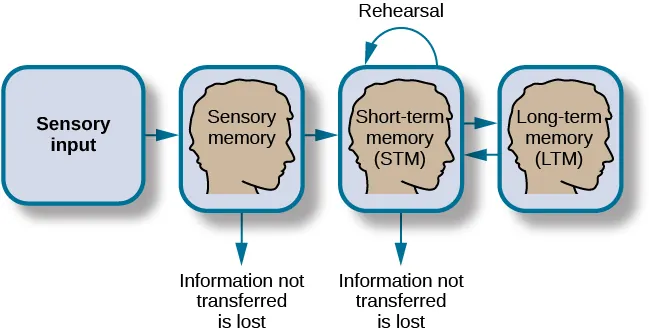
This diagram summarizes the Atkinson–Shiffrin (multi-store) model of memory, showing how sensory input enters sensory memory and can be transferred into short-term memory and long-term memory. The “rehearsal” loop highlights how repetition helps maintain information in short-term memory and supports transfer to long-term storage. The “information not transferred is lost” labels visually emphasize capacity and duration limits in early memory stores. Source
These processes cannot always be observed directly, but they can be inferred from what people remember, attend to, think, and decide.
Cognitive approach: An approach that explains behavior through mental processes such as perception, memory, attention, thinking, and decision-making.
Key cognitive factors include:
Perception, or how a person interprets sensory information
Attention, which affects what information is noticed or ignored
Memory, including how experiences are encoded, stored, and recalled
Schemas, which are mental frameworks that guide interpretation
Beliefs and appraisals, which influence emotion and action
A cognitive explanation often asks, “How is the person processing the situation?” Two people may face the same event but react differently because they interpret it differently. One person may see an ambiguous comment as a joke, while another may see it as criticism. The behavior that follows depends partly on how the event is mentally represented.
The cognitive perspective is especially useful when behavior depends on judgment, interpretation, problem-solving, or remembering.
Sociocultural perspective
The sociocultural perspective examines how behavior is shaped by other people and by the cultural world in which a person lives.
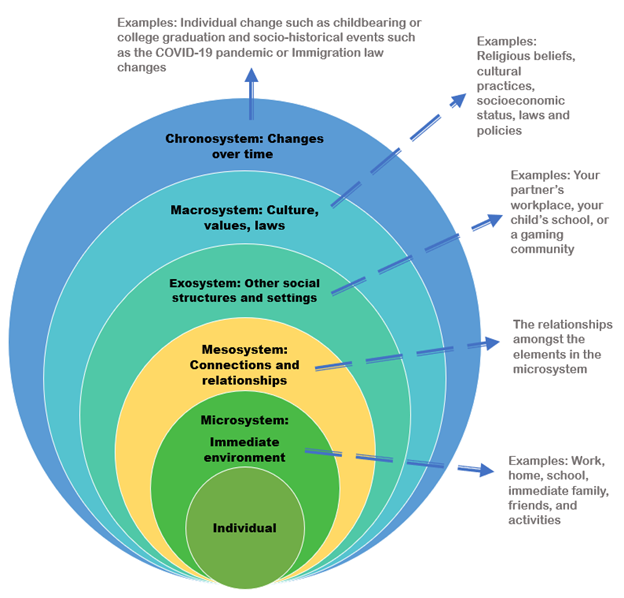
This figure illustrates Bronfenbrenner’s ecological systems model, placing the individual at the center and showing nested layers of environmental influence (microsystem through macrosystem), plus the chronosystem to represent change over time. The labeled examples make it easy to connect abstract sociocultural concepts (e.g., norms, institutions, and cultural values) to concrete contexts like school, work, and policy. It reinforces the idea that behavior is shaped by interacting social systems rather than a single isolated factor. Source
It highlights social influence, shared meanings, and expectations about what is normal or desirable.
Sociocultural approach: An approach that explains behavior through social relationships, group influences, and cultural norms, values, and practices.
Important sociocultural influences include:
Social norms, which guide accepted behavior
Roles, such as expectations linked to family, school, or work
Culture, including values, traditions, language, and belief systems
Group membership, which can affect identity, attitudes, and actions
Socialization, through which people learn how to behave in their community
A sociocultural explanation often asks, “What social or cultural forces are influencing this behavior?” This perspective is especially helpful when behavior varies across groups, settings, or cultural contexts. What is encouraged in one social environment may be discouraged in another.
The sociocultural perspective reminds psychologists that behavior does not occur in isolation. People act within relationships, institutions, and cultural systems that shape their choices and interpretations.
Comparing the perspectives
Different explanations for the same behavior
The same behavior can be examined from all three perspectives, but the explanation changes depending on the focus. Consider a person acting aggressively:
A biological explanation may emphasize hormones, brain functioning, or inherited predispositions.
A cognitive explanation may focus on hostile interpretations, expectations, or beliefs about threat.
A sociocultural explanation may examine peer norms, cultural acceptance of aggression, or group pressure.
Each perspective therefore selects a different level of explanation:
the body
the mind
the social and cultural environment
Why this matters in psychology
These perspectives help psychologists organize research questions and build explanations that match the factor being studied. If the main interest is brain chemistry, a biological explanation is likely to be central. If the focus is memory distortion or judgment, a cognitive explanation may be more relevant. If the issue concerns conformity, identity, or cultural practices, a sociocultural explanation may be more useful.
For IB Psychology, it is important to be able to:
identify which perspective is being used
describe the main factor it emphasizes
compare how the three perspectives differ in their explanation of behavior
apply the perspectives to a behavior without confusing their focus
Clear comparison depends on precise language. Biological explanations center on physical processes, cognitive explanations center on mental processing, and sociocultural explanations center on social and cultural influence.
Practice Questions
Question 1 (2 marks) State one factor emphasized by the biological perspective and one factor emphasized by the sociocultural perspective in explaining behavior.
1 mark for identifying a correct biological factor, such as genes, brain activity, hormones, neurotransmitters, or the nervous system.
1 mark for identifying a correct sociocultural factor, such as social norms, cultural values, roles, group membership, or socialization.
Question 2 (6 marks) Explain how the biological, cognitive, and sociocultural perspectives would offer different explanations for the same human behavior.
1-2 marks for explaining the biological perspective as focusing on bodily processes such as genes, hormones, brain function, or neurochemistry.
1-2 marks for explaining the cognitive perspective as focusing on mental processes such as perception, memory, schemas, beliefs, or decision-making.
1-2 marks for explaining the sociocultural perspective as focusing on social norms, culture, roles, group influences, or socialization.
Full marks require all three perspectives to be clearly distinguished and linked to the same behavior.
FAQ
Many psychological studies overlap because human behavior is complex. A study may be placed in one perspective because its main explanatory focus is biological, cognitive, or sociocultural, even if other influences are present.
For example:
a memory study may mainly be cognitive
but it could still mention culture or brain activity
When revising, classify the study by the factor it emphasizes most strongly.
Yes. Culture can influence what people think, while the cognitive perspective can explain how they process information.
For example, cultural background may affect:
attention to context
interpretation of social situations
memory priorities
A study may therefore include cultural influence but still be cognitive if its main interest is mental processing.
No. Biological influences are important, but they are not always permanent.
Examples include:
the brain can change through plasticity
hormone levels can vary across situations
gene expression can be affected by environmental conditions
This means a biological explanation does not automatically imply that behavior cannot change.
It helps explain why the same behavior may carry different meanings in different places.
This is useful for topics involving:
family expectations
communication styles
gender roles
attitudes toward authority
emotional expression
The sociocultural perspective is strong when behavior depends on shared rules and values rather than only on individual biology or thinking.
Look at the location of the cause.
If the explanation centers on interpretation, memory, attention, or belief, it is usually cognitive.
If it centers on norms, roles, identity, social pressure, or culture, it is usually sociocultural.
A quick check is to ask:
Is the cause mainly inside the person’s mental processing?
Or is it mainly in the social and cultural environment?