IB Syllabus focus: 'Each perspective is based on assumptions about behaviour and beliefs about suitable research methods.'
Understanding psychological perspectives requires more than memorizing theories. IB students should recognize that every approach begins with assumptions about human behavior, and those assumptions influence what researchers study, how they study it, and how findings are interpreted.
Why assumptions matter
A psychological perspective is a way of explaining behavior. Perspectives do not begin with neutral facts alone. They begin with ideas about what human behavior is, what causes it, and what counts as convincing evidence.
When psychologists adopt a perspective, they make choices about:
which variables matter most
what questions are worth asking
what evidence is trustworthy
how findings should be interpreted
These choices shape the entire research process, from the first research question to the final explanation.
An assumption is an underlying belief taken as a starting point for explanation or investigation.
In psychology, assumptions are often not directly tested at first. Instead, they guide the way researchers frame a problem. A perspective may assume, for example, that behavior is mainly influenced by biology, mental processes, or social context. That starting point affects everything that follows.
Assumptions about behavior
Different perspectives make different assumptions about the main influences on behavior. Some approaches emphasize biological processes such as genes, hormones, neurotransmitters, or brain structure. Others assume that behavior depends mainly on mental processes such as memory, attention, perception, or decision-making. Still others assume that behavior cannot be understood without social and cultural context.
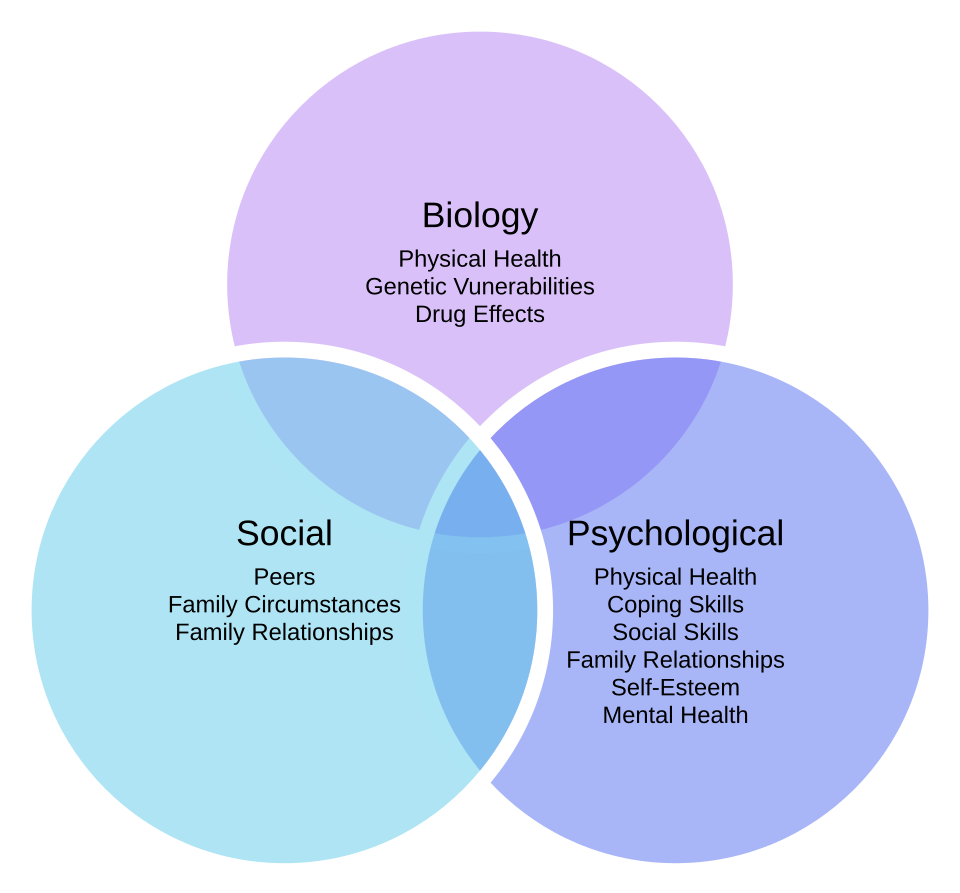
A biopsychosocial Venn diagram showing how biological, psychological, and social factors overlap to influence health and behavior. It supports the idea that different perspectives prioritize different explanatory levels, and that a fuller account often comes from considering how these levels interact rather than treating them as competing explanations. Source
These assumptions do not automatically make one perspective correct and the others incorrect. Instead, they direct attention to different levels of explanation. A researcher who assumes that behavior is strongly linked to physiology will probably ask different questions from a researcher who assumes that behavior is shaped mainly by social interaction or cultural meaning.
For IB Psychology, the key point is that assumptions are not just abstract ideas.
They influence:
the definition of the research problem
the operationalization of variables
what counts as a cause or explanation
the kinds of conclusions researchers feel justified making
Beliefs about suitable research methods
Perspectives also include beliefs about which methods are most appropriate for studying behavior. If a psychologist believes that important causes are measurable and can be isolated, highly controlled methods may appear most useful. If a psychologist believes that meaning, context, or lived experience is central, more open-ended methods may seem more appropriate.
A research method is the procedure used to collect and analyze evidence about behavior.
Beliefs about methods are closely tied to beliefs about what knowledge is possible.
Methods are chosen for a reason
A perspective that values control may prefer laboratory experiments because they allow researchers to manipulate variables and limit alternative explanations.
A perspective that values subjective meaning may prefer interviews, observations, or case studies because these methods can capture details that are difficult to reduce to numerical scores.
This does not mean that each perspective uses only one kind of method. In practice, psychologists often combine methods. However, perspectives usually show patterns in the kinds of evidence they trust most.
How assumptions and methods connect
The link between assumptions and methods can be understood as a chain:
assumptions suggest what causes behavior
those ideas shape the research question
the question influences method choice
the method produces a particular kind of data
the data support some interpretations more easily than others
For example, if researchers assume that brain activity is central to a behavior, they may use physiological measures or brain-based techniques. If they assume that personal interpretation is central, they may collect detailed verbal responses. If they assume that social setting matters most, they may study behavior in groups or real-world environments.
Because methods generate different kinds of evidence, they also have different strengths and limitations. Experimental methods may increase control, but they can simplify behavior. Naturalistic or interview-based methods may capture context, but they may make causal claims harder to support. What counts as a “good” method often depends on the assumptions behind the perspective.
Implications for interpretation and evaluation
When evaluating a study, IB students should ask not only “Was the method used well?” but also “Why was this method considered suitable?” That question leads back to the perspective’s assumptions.
Important evaluation points include:
whether the method matches the explanation of behavior
whether important variables may have been ignored
whether the evidence is strong enough for the claims being made
whether another perspective might interpret the same findings differently
This helps explain why psychological knowledge is often debated. Two researchers may study the same behavior but disagree because they begin from different assumptions and trust different forms of evidence. Their disagreement is not always about data alone. It may also reflect deeper beliefs about what behavior is and how it should be investigated.
What exam answers should show
Strong IB responses usually do three things:
identify the assumption behind a perspective or study
explain how that assumption influenced the research method
discuss how the method shaped the findings or interpretation
A simple description of a study is not enough. The focus of this subsubtopic is the relationship between ideas and methods. If you can show that perspectives guide both explanation and research design, you are addressing the central syllabus requirement.
Practice Questions
State one assumption about behavior and one belief about suitable research methods that may be held within a psychological perspective.
1 mark for stating a valid assumption about behavior, such as behavior being mainly influenced by biology, cognition, or social context.
1 mark for stating a linked belief about suitable methods, such as experiments, observations, interviews, or physiological measures.
Explain how assumptions within a psychological perspective can influence the choice of research methods.
1-2 marks: Basic understanding of either assumptions or methods. Limited explanation of the link between them.
3-4 marks: Some explanation of how assumptions affect method choice. May include a relevant example, but detail or clarity is limited.
5-6 marks: Clear explanation that assumptions shape research questions, influence what counts as valid evidence, and lead psychologists to prefer particular methods. A relevant example or illustration is used effectively.
FAQ
An assumption is a broad starting belief about behavior or knowledge. A hypothesis is a specific, testable prediction based on that belief.
For example:
an assumption might be that behavior is strongly shaped by cognitive processes
a hypothesis might predict that participants exposed to misleading information will recall an event less accurately
One assumption can lead to many different hypotheses.
Yes. Assumptions can change when:
new evidence repeatedly challenges old explanations
new technology allows behavior to be studied differently
researchers criticize the limits of an existing perspective
social and cultural changes shift what psychologists notice
This means perspectives are not fixed forever. They develop as the field debates what counts as the best explanation and the best evidence.
A method does not automatically belong to one perspective. Two researchers might both use an experiment, but for different reasons.
For example, one researcher might use an experiment to isolate a cognitive process, while another might use it to test a social influence in a controlled setting.
What matters is:
the assumptions behind the study
the variables chosen
how the findings are interpreted
The same method can support different perspectives.
No. Research beliefs are not just private preferences. They are usually shared ideas within a research tradition about what counts as strong evidence and which methods are most appropriate.
They are shaped by:
training
published research traditions
academic debate
journal standards
ethical and practical limits
A psychologist may still have personal preferences, but research beliefs usually reflect wider disciplinary habits, not just individual opinion.
Look for clues in the study design and wording.
Ask yourself:
What does the study treat as the main cause of behavior?
Which variables are measured, and which are ignored?
Does the study value control, lived experience, or social context most?
What kind of evidence is treated as convincing?
If you answer those questions, you can often infer the assumptions before you even evaluate the results.