IB Syllabus focus: 'Psychology studies complex human behaviour through multiple approaches that provide different interpretations and explanations.'
Psychology does not treat behavior as having one simple cause. It studies thought, emotion, and action through several viewpoints, each revealing different features of complex human behavior.
Why psychology is a multi-perspective discipline
Psychology tries to explain behavior, cognition, emotion, and human interaction. These are influenced by internal processes, physical systems, personal experiences, relationships, and wider environments. Because these influences operate at the same time, no single viewpoint can fully explain human behavior.
When psychologists use a perspective, they are using an organized way of asking questions about behavior and deciding what counts as convincing evidence.
Perspective: A framework for understanding behavior that emphasizes particular causes, concepts, and methods of investigation.
A multi-perspective discipline therefore accepts that different frameworks can produce useful, but incomplete, explanations. These explanations may overlap, complement one another, or sometimes disagree. This does not mean psychology lacks structure. It means the subject reflects the complexity of the behavior it studies.
Complexity of human behavior
Human behavior is complex because it is shaped by many interacting influences.
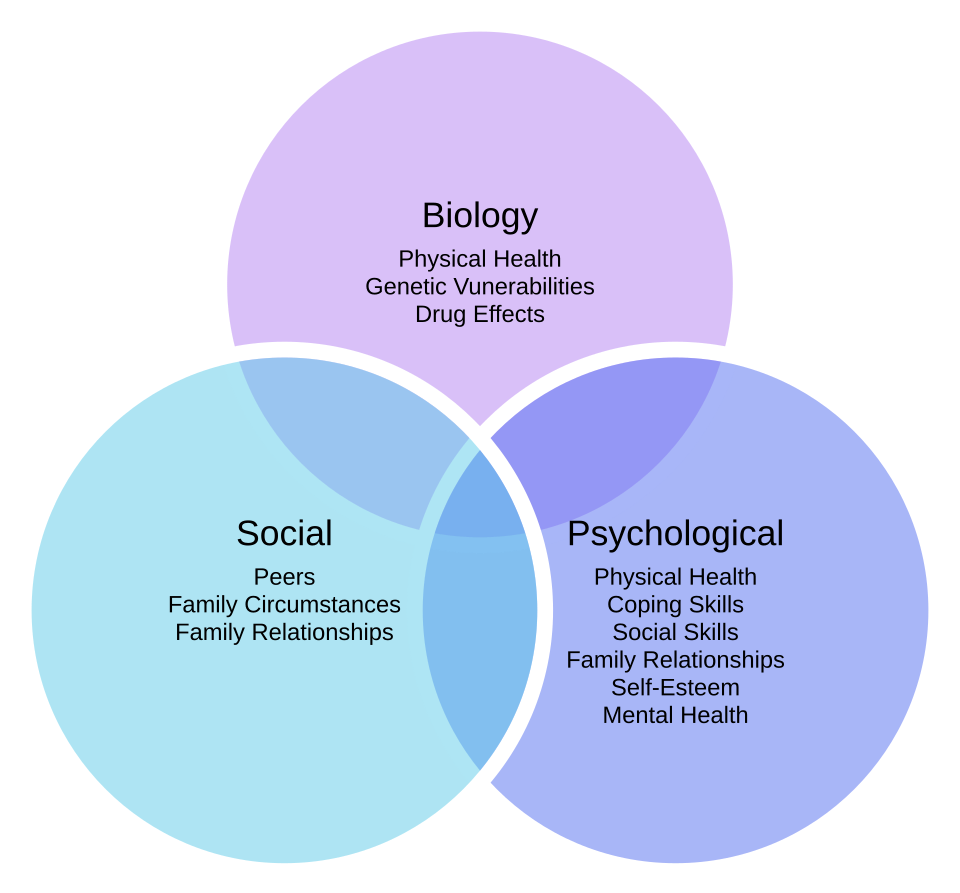
This biopsychosocial model diagram shows three overlapping domains—biological, psychological, and social factors—illustrating how real-world outcomes typically emerge from their intersection rather than a single cause. It reinforces the core IB idea that explanations are often partial unless multiple levels are considered together. Source
A single action may involve:
current thoughts and goals
emotional state
past learning
bodily processes
other people’s expectations
the immediate situation
If a psychologist studies only one of these layers, the explanation may be too narrow. A multi-perspective approach recognizes that behavior can be examined at different levels, and each level may reveal something important.
Different interpretations of the same behavior
Different perspectives do not just collect different facts. They often interpret the same behavior differently.
One psychologist may focus on how the situation influences a person’s response, while another may focus on internal mental processes. Both may study the same behavior, but they will ask different questions and build different explanations.
This matters because psychological knowledge is not just a list of findings. It also depends on the lens used to explain those findings. Understanding psychology means recognizing that interpretations are shaped by perspective.
What multiple perspectives contribute
A multi-perspective discipline gains strength from breadth. Different perspectives help psychologists:
identify a wider range of possible causes
ask different types of research questions
challenge oversimplified claims
compare competing explanations
develop richer theories of behavior
This is especially important in psychology because real human problems are rarely explained by one factor alone. More than one perspective is often needed to produce an explanation that is realistic and useful.
Influence on research
A perspective influences what a psychologist chooses to study and how that topic is investigated.
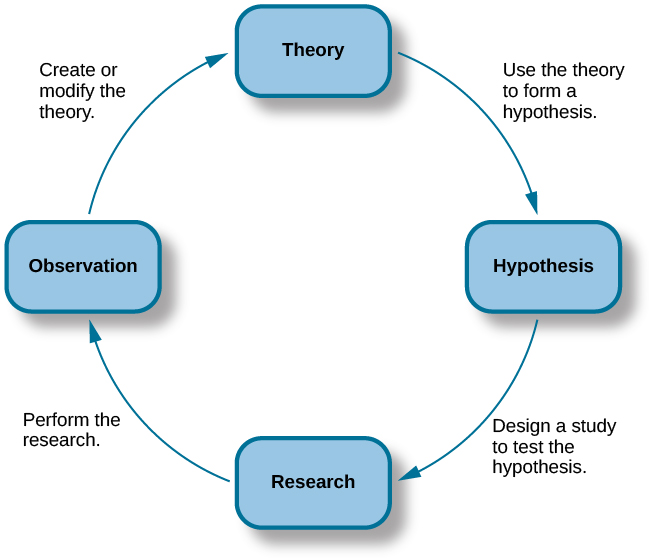
This diagram summarizes the scientific method as a cycle linking theory, hypothesis, research, and observation. It helps show why psychological explanations depend not only on conclusions, but also on how questions are framed and what evidence is collected and interpreted. Source
It affects:
which concepts are seen as important
what kinds of evidence are gathered
which methods are preferred
how results are interpreted
As a result, psychologists examining the same issue may produce different kinds of evidence. In a multi-perspective discipline, this is not automatically a weakness. Different methods may reveal different features of the same phenomenon.
Value of comparison
Comparing perspectives helps psychologists judge which explanation is more convincing in a specific context. A perspective may explain one part of behavior very well but leave another part unclear. Looking across perspectives encourages critical thinking and prevents students from assuming that the first explanation they learn is the complete one.
Why no single perspective is enough
No perspective can explain all human behavior equally well. Each one highlights certain factors while giving less attention to others. This is unavoidable because perspectives simplify reality in order to study it systematically.
That simplification is useful, but it can also create blind spots. An explanation may become incomplete if it ignores context, treats behavior as having one main source, or fails to consider how several influences work together. The multi-perspective nature of psychology helps protect the discipline from overly narrow explanations.
Complementary explanations
Perspectives are not always in competition. In many cases, they are complementary. One explanation may clarify underlying processes, while another explains how a setting or interaction changes the expression of those processes. Together, they can produce a fuller account of behavior than either could alone.
At the same time, perspectives may disagree about which causes matter most or what evidence should be prioritized. These disagreements are valuable because they encourage debate, new research, and refinement of theory. Psychology develops through comparing and testing different viewpoints.
What this means for IB Psychology students
Students should expect that:
behavior can be interpreted in more than one valid way
psychological explanations should be judged by evidence
stronger understanding often comes from comparison
disagreement in psychology often reflects complexity, not confusion
Building stronger psychological explanations
In IB Psychology, strong responses usually show awareness that psychology is not based on a single explanation of behavior. Instead, it is made up of multiple perspectives that offer different insights. This does not mean every explanation is equally strong. It means good psychological thinking identifies what a perspective explains well, what it leaves out, and why another perspective may add something important.
A discipline shaped by complexity
The idea of psychology as a multi-perspective discipline reflects the central challenge of the subject: humans are complicated. Thoughts, feelings, and behavior cannot usually be reduced to one cause or one way of studying them. Recognizing multiple perspectives is therefore not a weakness of psychology. It is an appropriate response to the complexity of human behavior.
Practice Questions
State what is meant by saying psychology is a multi-perspective discipline. [2]
1 mark for stating that psychology uses more than one perspective or approach.
1 mark for stating that these perspectives provide different interpretations or explanations of human behavior.
Explain how psychology benefits from being a multi-perspective discipline. [6]
1-2 marks: Explains that human behavior is complex and cannot usually be explained by one factor alone.
1-2 marks: Explains that different perspectives focus on different aspects of behavior and therefore generate different explanations.
1-2 marks: Explains that comparing or combining perspectives can produce broader, less narrow, and more useful understanding.
Full marks require clear psychological language and a focused explanation of benefit, not just a definition.
FAQ
A multi-perspective discipline contains different viewpoints within the same subject. In psychology, these are different ways of explaining behavior while still remaining part of psychology.
An interdisciplinary discipline goes further by combining ideas from different subjects, such as biology, sociology, education, or economics. Psychology can be both multi-perspective and interdisciplinary, but the two terms are not the same.
Psychology grew over time through different research traditions, practical problems, and philosophical debates. As new evidence appeared, no single theory was able to explain every aspect of human behavior well.
Different perspectives survived because each proved useful for certain questions. Instead of one grand theory replacing all others, psychology developed as a field where several frameworks continue to coexist and evolve.
Yes. A researcher may design a project that draws on more than one perspective, especially when one viewpoint alone seems too limited for the question being studied.
However, this requires clear planning. The researcher must define how the perspectives fit together, what each one contributes, and how evidence from each will be interpreted. Without that clarity, the project can become inconsistent rather than genuinely integrative.
Older perspectives often remain influential because they still answer certain questions effectively, have strong research traditions, or shaped major methods and concepts that psychology still uses.
A new perspective does not automatically erase an older one. In psychology, newer approaches often add to the field rather than replacing everything that came before. This helps explain why psychology stays multi-perspective across time.
It can make public communication harder because people often want one clear cause for behavior. Psychology usually offers more qualified answers, which may seem less simple but are often more accurate.
This is why good communication in psychology avoids headlines that suggest one explanation solves everything. A multi-perspective view encourages careful claims, acknowledgment of complexity, and greater caution when applying findings to real life.