IB Syllabus focus: 'No single perspective explains behaviour sufficiently; students should consider alternative explanations and interpretations.'
Psychology rarely offers one complete answer to why people think, feel, or act as they do.
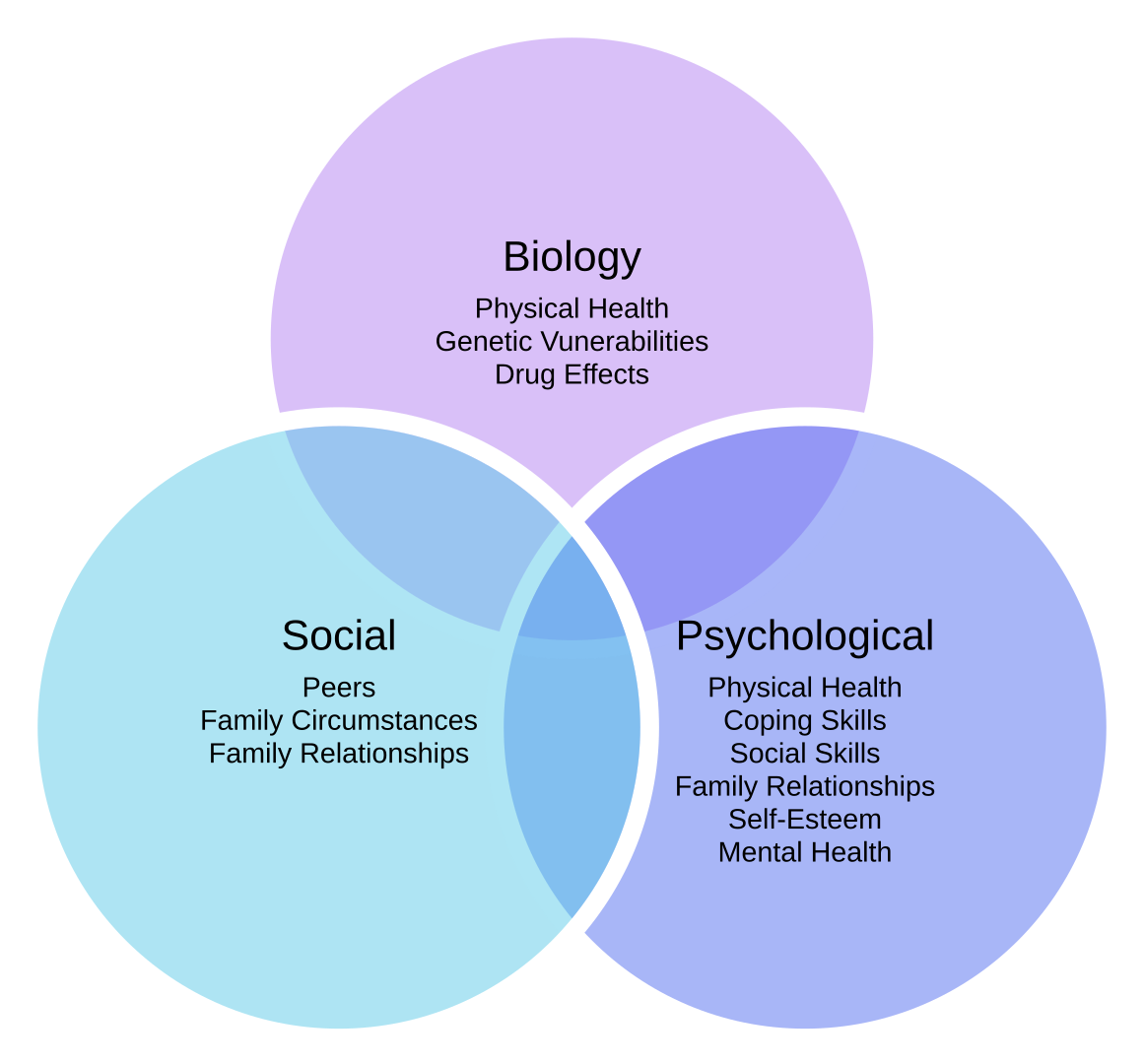
A diagram of the biopsychosocial model showing how biological, psychological, and social/sociocultural influences overlap to shape outcomes. It reinforces the IB idea that explanations are often complementary, not competing, because multiple levels of analysis can contribute simultaneously. Source
Strong analysis requires comparing possible explanations and judging what each interpretation can and cannot explain.
Why alternative explanations matter
Human behavior is complex, so the same finding can often be understood in more than one way. A researcher may explain stress, memory, aggression, or attachment using one preferred perspective, but that account may leave out other important influences. In IB Psychology, this means you should avoid treating any single explanation as fully sufficient. Instead, ask what else might explain the behavior, whether the evidence rules out competing accounts, and how much of the phenomenon the explanation actually covers.
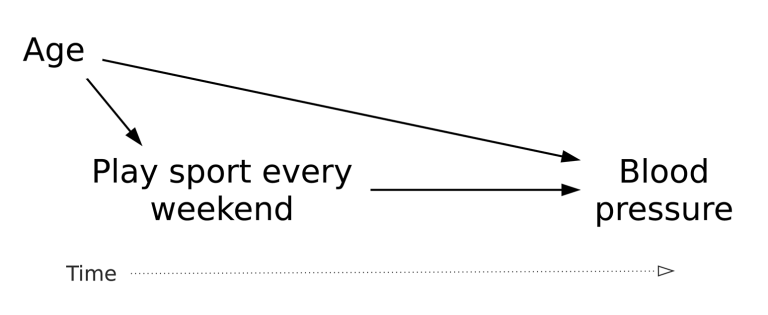
A simple directed acyclic graph (DAG) showing confounding: a third variable (age) influences both the presumed cause (playing weekend sport) and the outcome (blood pressure). The diagram makes it easier to see why a correlation can have more than one plausible explanation unless confounders are addressed. Source
Alternative explanation: Another plausible account of the same behavior or research finding, based on different assumptions, variables, or levels of analysis.
Considering alternatives is important because psychological evidence is often open to more than one meaning. For example, if a study finds a relationship between a thought pattern and a behavior, one interpretation may emphasize cognition, while another may emphasize social context, learning history, or biological vulnerability. The evidence may support part of each account. This does not make psychology weak; it reflects the fact that behavior usually has multiple contributing factors rather than one simple cause.
Explanation and interpretation are not identical
An explanation focuses on why a behavior occurs. An interpretation focuses on how findings should be understood. In practice, these overlap, but the distinction matters. Two psychologists may agree on the results of a study yet disagree about what those results mean. One may interpret the findings as showing a stable individual trait, while another may interpret the same findings as a response to a particular environment or cultural setting.
Interpretation: The meaning given to data or findings, including what the results are thought to show about behavior.
Interpretations differ because psychologists make assumptions about human nature, emphasize different kinds of evidence, and ask different research questions. A narrow interpretation may overstate what a study proves. For example, findings from one method or one sample may not justify broad claims about all people or all situations. This is why IB responses should show critical thinking: not just repeating a study’s main claim, but asking whether another reading of the results is also reasonable.
Criteria for comparing alternative accounts
When judging competing explanations, focus on the quality and scope of each one rather than choosing the most familiar perspective.
Questions to ask
What evidence supports it? A good explanation is grounded in research findings, not just common sense or intuition.
How much behavior does it explain? Some accounts explain only a small part of the phenomenon, while others address broader patterns.
What does it ignore? A perspective may explain internal processes well but neglect relationships, culture, or situational demands.
Is the interpretation too broad? Researchers sometimes generalize beyond the sample, context, or task that was actually studied.
Can two explanations both be partly true? In psychology, competing accounts are often complementary rather than mutually exclusive.
Does the explanation generate useful predictions? Strong interpretations help psychologists anticipate behavior in new settings, not just describe old findings.
Are there overlooked variables? An alternative explanation may point to factors the original account did not measure or discuss.
A strong comparison does not simply list different perspectives. It explains how and why the alternative account changes the meaning of the behavior or finding.
Applying this idea in IB Psychology
When discussing a theory or study, move beyond “this perspective says X.” Instead, build analysis by comparing claims. For instance, if one explanation emphasizes internal mental processes, an alternative interpretation might argue that the same behavior depends heavily on social expectations or context. The goal is not to force a single “correct” answer, but to show that psychological understanding improves when explanations are tested against rivals.
How to build analysis
Identify the main claim being made about behavior.
State one credible alternative explanation or interpretation.
Explain the difference in assumptions between the two accounts.
Link each account to the kind of evidence that would support it.
Evaluate which explanation seems more convincing, more limited, or more complementary.
This approach is especially valuable in essay questions. Examiners reward answers that show awareness of complexity, acknowledge uncertainty, and avoid absolute claims. Simply naming another perspective is not enough; the key is to explain what new insight it offers or what weakness it exposes in the original explanation.
Common errors
One common mistake is treating alternatives as if they automatically disprove the first explanation. Often, the better judgment is that the original explanation is useful but incomplete. Another mistake is presenting a false choice between only two accounts when behavior may result from several interacting influences. Students also sometimes confuse an alternative interpretation with mere disagreement. A valid alternative must still be plausible and evidence-based.
Another weak approach is to use alternatives superficially, adding them only at the end of an answer. In stronger writing, alternative explanations are woven into the analysis from the beginning. This shows that psychological knowledge is interpretive, evidence-based, and open to revision when better explanations emerge.
Practice Questions
State one reason why psychologists should consider alternative explanations of behavior.
1 mark for identifying a valid reason, such as:
human behavior is complex, or
no single perspective fully explains behavior, or
the same evidence can support more than one account
1 mark for brief elaboration showing why this matters, such as:
alternative explanations reveal overlooked factors, or
they prevent overly simple conclusions, or
they improve evaluation of research findings
Explain why considering alternative explanations and interpretations is important when evaluating psychological research.
Accurate explanation that an alternative explanation is another plausible account of the same finding
Accurate explanation that an interpretation concerns the meaning given to results
Recognition that the same research findings may be understood in more than one way
Recognition that no single perspective fully explains complex human behavior
Explanation that alternative accounts may identify overlooked variables, context, or assumptions
Explanation that comparing alternatives helps avoid overgeneralization or overly confident conclusions
Explanation that stronger evaluation judges evidence, scope, and limits of each account
Any other clearly relevant point showing why alternative explanations improve critical analysis
FAQ
An alternative explanation is a broader rival account of why a finding occurred.
A confounding variable is one specific unmeasured factor that may have influenced results. In other words, a confound can become the basis for an alternative explanation, but the two terms are not identical.
For example:
a confound might be participant age
the alternative explanation might be that age, not the proposed theory, better explains the behavior
Yes. In psychology, two explanations are often partly compatible rather than completely opposed.
This can happen when:
each explanation focuses on a different level of analysis
one explains short-term processes and the other explains long-term development
one describes vulnerability and the other describes triggers
A stronger interpretation may combine insights from both, as long as the combination is logically consistent and supported by evidence.
Replication can show whether an interpretation is stable across samples, settings, and methods.
If a result disappears in new contexts, the original interpretation may have been too broad. If it appears repeatedly under different conditions, confidence in that interpretation usually increases.
Replication can also reveal that:
an effect depends on culture or context
the effect is smaller than first claimed
a rival explanation fits the total evidence better
Language can make a claim seem stronger, narrower, or more certain than the evidence actually allows.
Watch for wording such as:
“proves” instead of “suggests”
“all people” instead of “this sample”
“causes” when the design only shows association
Headlines, abstracts, and discussion sections can push readers toward one interpretation even when the data allow several. Careful readers separate the results from the authors’ framing of the results.
A weak alternative explanation is usually speculative, vague, or unsupported.
Signs of weakness include:
it does not fit the data well
it cannot be tested
it ignores key evidence
it is so broad that it could explain almost anything
A strong alternative explanation is:
plausible
evidence-based
specific
clearly different from the original claim
able to account for the findings at least as well as, or better than, the first interpretation