

OCR Specification focus:
‘Describe precipitates with OH− and NH3 for Cu2+, Fe2+, Fe3+, Mn2+, Cr3+; note complexes formed in excess reagent.’
Precipitation reactions and complex formation reveal characteristic behaviour of transition-metal ions. Understanding their hydroxide precipitates, colour changes and responses to excess ammonia or hydroxide is essential for recognising metal ions in qualitative analysis.
Precipitation Reactions of Transition-Metal Ions
Precipitation reactions occur when aqueous transition-metal ions react with OH⁻ or NH₃, producing insoluble metal hydroxide precipitates. These precipitates often display distinctive colours, enabling reliable identification of common ions. When excess reagent is added, some metal hydroxides undergo further reaction to form soluble complex ions, each with characteristic coordination and colour.
General Process
Bullet-pointed guidance helps clarify the typical sequence in precipitation tests:
Add a few drops of aqueous sodium hydroxide or aqueous ammonia to the unknown metal ion solution.
Observe immediate formation of a metal hydroxide precipitate, noting its colour.
Add excess OH⁻ or excess NH₃ to test for further dissolution or formation of new complexes.
Record any colour changes or solubility differences, as they indicate the presence of specific ions.
A precipitate forms when the product of a reaction is insoluble in water.
Precipitate: A solid that forms from solution during a chemical reaction because the product is insoluble in water.
After observing the precipitate, chemists analyse its behaviour in excess reagent to determine whether it remains insoluble or forms a complex ion with different bonding features.
Cu²⁺, Fe²⁺ and Fe³⁺ Ions
These three ions exhibit some of the clearest and most characteristic precipitation patterns in OCR A-Level Chemistry.
Copper(II) Ion, Cu²⁺
With OH⁻: A pale blue Cu(OH)₂ precipitate forms.
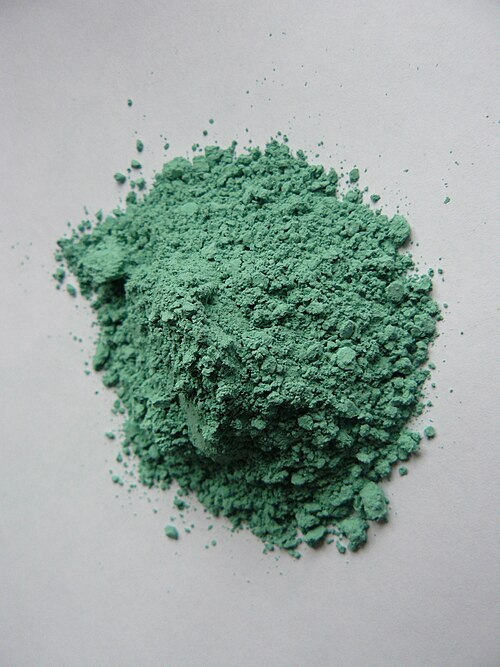
Copper(II) hydroxide, Cu(OH)₂, is a light blue solid formed when hydroxide ions react with aqueous Cu²⁺ ions. In qualitative analysis, this colour is diagnostic of copper(II) before further ligand substitution occurs. Source
With NH₃: The same pale blue precipitate initially forms.
In excess NH₃: The precipitate dissolves, giving a deep royal-blue solution containing the complex ion [Cu(NH₃)₄(H₂O)₂]²⁺.
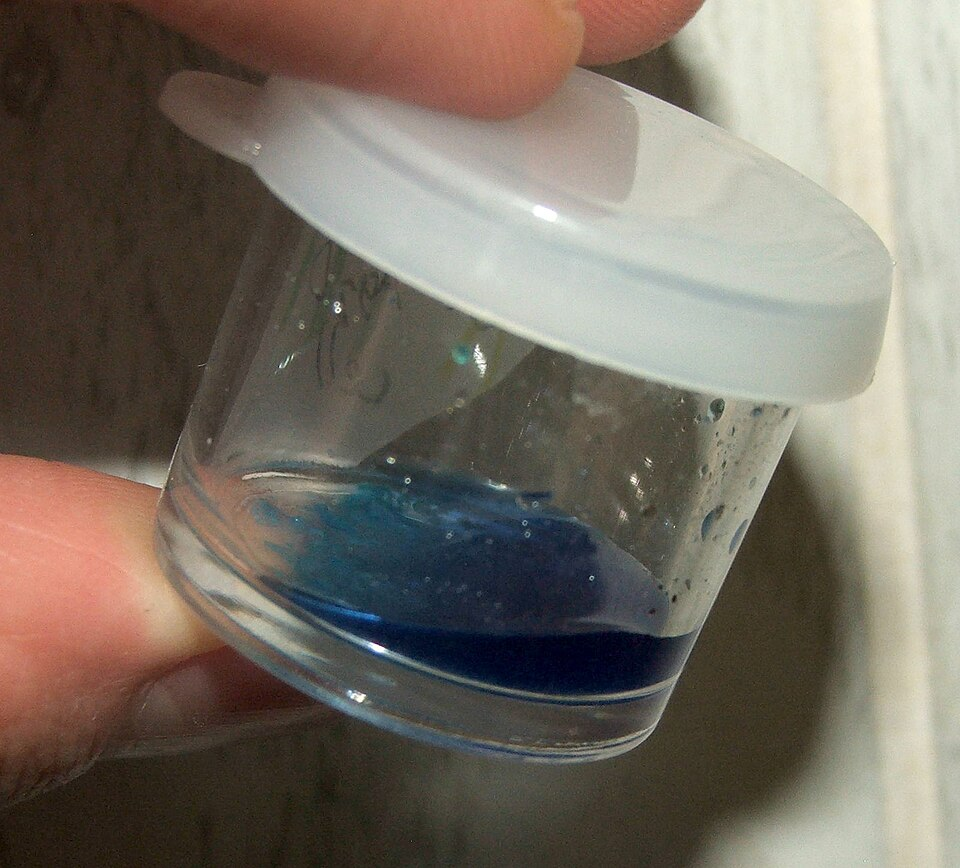
A deep blue tetraamminecopper(II) solution illustrates complex formation when ammonia ligands coordinate to Cu²⁺. This intense colour confirms dissolution of the hydroxide precipitate and formation of a soluble complex ion. Source
Complex ion: A species consisting of a central metal ion bonded to surrounding ligands through coordinate bonds.
The formation of the deep blue complex is a classic demonstration of ligand exchange, where water ligands are replaced by ammonia ligands.
Iron(II) Ion, Fe²⁺
With OH⁻: A green Fe(OH)₂ precipitate appears.
With NH₃: The same green precipitate forms.
Behaviour in excess reagent: The precipitate is insoluble in both excess OH⁻ and NH₃.
Exposure to air: Fe(OH)₂ gradually oxidises to brown Fe(OH)₃, an important observation in laboratory tests.
Fe²⁺ gives a green precipitate of Fe(OH)₂ with OH⁻, which slowly turns brown in air as Fe³⁺ species form.
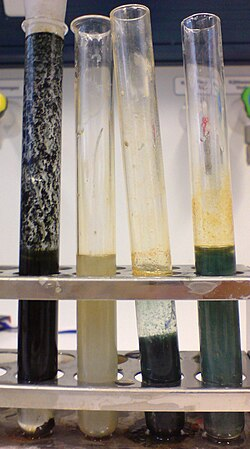
Test-tube reactions of iron(II) salts show formation of Fe(OH)₂ as a green precipitate that darkens on exposure to oxygen. The browning reflects oxidation, not complex formation, but aids identification in qualitative tests. Source
Iron(III) Ion, Fe³⁺
With OH⁻: Forms a brown Fe(OH)₃ precipitate.
With NH₃: A brown precipitate also forms.
Behaviour in excess reagent: The precipitate is insoluble in both excess OH⁻ and NH₃.
Fe³⁺ therefore demonstrates no complex formation under these standard test-tube conditions.
A brief sentence helps transition to the next metal ions, which show more distinctive solubility patterns and colour changes.
Mn²⁺ and Cr³⁺ Ions
Manganese(II) and chromium(III) ions extend the pattern of precipitation behaviour by introducing additional oxidation and complex-formation possibilities.
Manganese(II) Ion, Mn²⁺
With OH⁻: A light-brown Mn(OH)₂ precipitate forms, though often described as off-white before darkening.
With NH₃: A similar pale precipitate appears.
Behaviour in excess reagent: Insoluble in both excess OH⁻ and NH₃.
Oxidation: Mn(OH)₂ readily darkens on standing due to oxidation to brown MnO₂, a useful visual cue.
Chromium(III) Ion, Cr³⁺
Chromium(III) is the most chemically versatile of the common transition-metal ions encountered in precipitation testing, especially in its ability to form a soluble hydroxide complex in excess OH⁻.
With OH⁻: Produces a grey-green Cr(OH)₃ precipitate.
In excess OH⁻: The precipitate dissolves, forming a green solution of the complex ion [Cr(OH)₆]³⁻.
With NH₃: A grey-green precipitate also forms.
In excess NH₃: The precipitate dissolves more slowly than with OH⁻, forming a purple solution containing [Cr(NH₃)₆]³⁺, demonstrating ligand substitution.
Ligands play a vital role in complex formation, providing lone pairs for coordinate bonding.
Ligand: A species that donates a lone pair of electrons to a central metal ion to form a coordinate bond.
Between the hydroxide- and ammonia-based complexes, colour changes act as a key diagnostic tool for chromium(III).
Linking Precipitation Behaviour to Complex Formation
Understanding when precipitates form and when they redissolve is essential for predicting ligand-substitution reactions and identifying unknown metal ions. The transition-metal ions specified by OCR—Cu²⁺, Fe²⁺, Fe³⁺, Mn²⁺ and Cr³⁺—serve as cornerstone examples of precipitation behaviour.
Key Behaviour Patterns
Only Cu²⁺ and Cr³⁺ form characteristic soluble complexes in excess reagent.
Fe²⁺, Fe³⁺ and Mn²⁺ form precipitates that remain insoluble in excess OH⁻ or NH₃.
Colour changes (pale blue → deep blue for Cu²⁺; grey-green → green/purple for Cr³⁺) provide essential evidence for the identity of the metal ion.
Oxidation of Fe²⁺ and Mn²⁺ precipitates on standing is a helpful diagnostic feature but does not reflect complex formation.
These features collectively align with the OCR requirement to describe precipitation reactions with hydroxide and ammonia and note the complexes formed in excess reagent, providing essential knowledge for qualitative analysis in transition-metal chemistry.
Practice Questions
A student adds aqueous sodium hydroxide to separate solutions containing Cu²⁺(aq) and Fe³⁺(aq).
a) State the colour of the precipitate formed with each ion.
b) State one difference in their behaviour when excess sodium hydroxide is added.
a) Colours of precipitates
Cu²⁺ forms a pale blue precipitate of Cu(OH)₂. (1 mark)
Fe³⁺ forms a brown precipitate of Fe(OH)₃. (1 mark)
b) Behaviour in excess sodium hydroxide
Cu²⁺ precipitate remains insoluble in excess OH⁻, while Fe³⁺ precipitate also remains insoluble.
ORFe³⁺ does not form a complex in excess OH⁻, unlike some other transition metal ions. (1 mark, award only if part a has full credit)
Maximum 2 marks.
An unknown aqueous solution contains one of the following ions: Cu²⁺, Fe²⁺, Fe³⁺, Mn²⁺ or Cr³⁺.
The student adds aqueous ammonia dropwise, then in excess.
a) Describe the observations that would confirm the presence of Cr³⁺(aq).
b) Explain why excess ammonia causes a colour change for Cr³⁺ but not for Fe³⁺.
(5 marks)
a) Observations with aqueous ammonia
Formation of a grey-green precipitate on addition of a small amount of NH₃. (1 mark)
The precipitate dissolves in excess ammonia. (1 mark)
A purple solution is formed in excess ammonia. (1 mark)
b) Explanation
Cr³⁺ forms a soluble complex ion with ammonia ligands. (1 mark)
Ammonia acts as a ligand donating a lone pair to Cr³⁺ to form coordinate bonds. (1 mark)
Fe³⁺ does not form a stable ammonia complex, so its hydroxide precipitate remains insoluble. (1 mark)
Maximum 5 marks.
FAQ
This depends on the ability of the metal ion to form a stable complex with the excess ligand present.
Some transition-metal ions, such as Cu²⁺ and Cr³⁺, can accept additional ligands like NH₃ or OH⁻ to form soluble complex ions. This pulls the metal ion back into solution.
Other ions, including Fe²⁺, Fe³⁺ and Mn²⁺, do not form sufficiently stable complexes under these conditions, so their hydroxide precipitates remain insoluble even in excess reagent.
Ammonia has two relevant properties: it is a weak base and a neutral ligand.
Initially, NH₃ reacts with water to produce OH⁻, leading to formation of metal hydroxide precipitates.
In excess, NH₃ can donate a lone pair directly to certain metal ions, acting as a ligand and forming complex ions. Whether this happens depends on the metal ion’s charge density and electronic configuration.
Colour provides immediate visual evidence of the identity of a transition-metal ion.
Different metal ions form hydroxide precipitates with distinct colours due to differences in d-electron arrangements.
When complexes form, colour changes occur because ligand substitution alters the splitting of d orbitals. These colour differences allow chemists to distinguish ions even when their chemical behaviour is otherwise similar.
Both Fe²⁺ and Mn²⁺ are readily oxidised by oxygen from the air.
After precipitation, oxygen slowly reacts with the metal hydroxide, increasing the oxidation state of the metal ion.
This oxidation produces new solid species with darker colours, such as brown iron(III) hydroxide or manganese(IV) oxide, which is why freshly prepared precipitates are best for accurate identification.
Chromium(III) shows clear, observable changes in both solubility and colour.
It forms an insoluble hydroxide initially, then dissolves in excess OH⁻ or NH₃ to give differently coloured complex ions.
The contrast between grey-green precipitates and green or purple solutions makes chromium(III) an excellent example of how ligand type influences complex stability and appearance.


