

OCR Specification focus:
‘Outline Fe2+/Fe3+, Cr3+/Cr2O7²⁻, Cu2+/Cu+/Cu redox changes; construct and interpret unfamiliar redox and substitution reactions.’
Introduction
Redox interconversions within transition-metal systems are central to understanding variable oxidation states, electron transfer, and colour changes. This subtopic develops essential skills for predicting and interpreting unfamiliar inorganic reaction pathways.
Key Redox Interconversions in Transition-Metal Chemistry
Iron: Fe²⁺/Fe³⁺ Interconversions
Iron commonly cycles between Fe²⁺ and Fe³⁺, demonstrating the variable oxidation states characteristic of transition elements.
Oxidation of Fe²⁺ → Fe³⁺ occurs with oxidising agents such as acidified manganate(VII) or dichromate(VI).
Reduction of Fe³⁺ → Fe²⁺ is achieved using reducing agents such as iodide ions, which are oxidised to iodine.
Colour changes help track these transformations:
Fe²⁺ is typically pale green
Fe³⁺ forms yellow–brown solutions
Chromium: Cr³⁺/Cr₂O₇²⁻ Interconversions
Chromium provides some of the most important redox chemistry in the specification, particularly the interconversion between Cr³⁺, Cr₂O₇²⁻, and CrO₄²⁻ depending on conditions.
Oxidation of Cr³⁺ → Cr₂O₇²⁻ requires strong oxidising conditions, usually hot alkaline hydrogen peroxide or manganate(VII).
Reduction of Cr₂O₇²⁻ → Cr³⁺ uses Zn in acidic solution, giving a series of colour changes from orange dichromate(VI) to green chromium(III).
Further reduction may form chromium(II) under excess zinc.
Oxidation state: A number representing the theoretical charge on an atom, assuming fully ionic bonding.
Chromium systems help illustrate how pH influences equilibria.
In acidic solution, dichromate(VI) ions, Cr₂O₇²⁻, are orange and are reduced to Cr³⁺, which is typically green in aqueous solution.
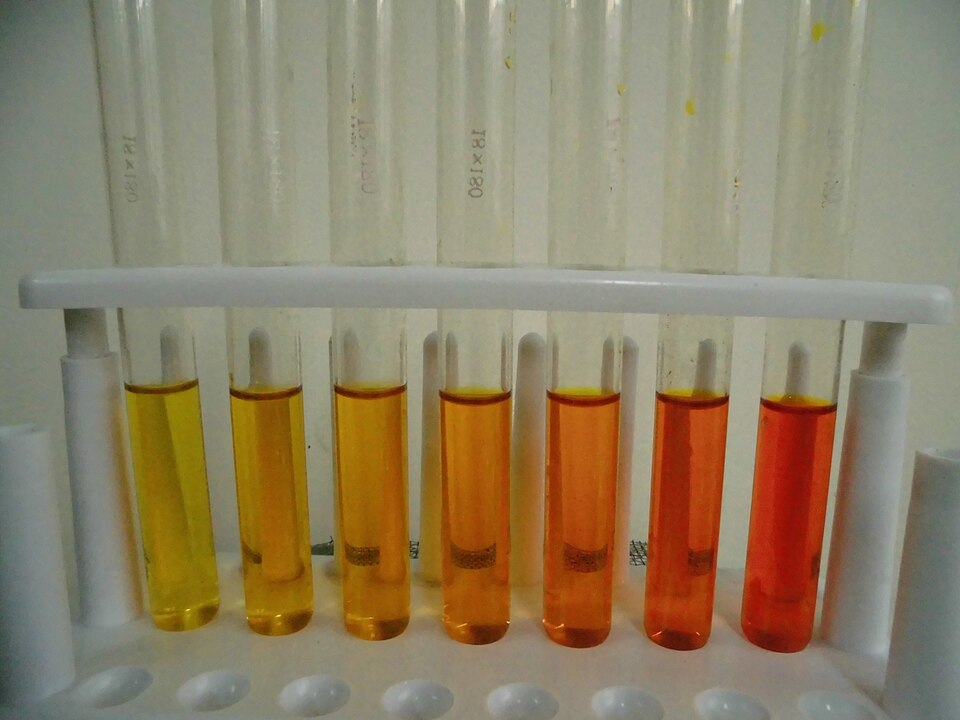
Potassium dichromate(VI) solutions showing the characteristic orange colour of Cr₂O₇²⁻ ions across a concentration range, reinforcing colour changes used to identify chromium redox interconversions. Source
Copper: Cu²⁺/Cu⁺/Cu Interconversions
Copper displays redox behaviour involving three oxidation states. The Cu²⁺ → Cu⁺ reduction commonly proceeds in the presence of halide ions, forming CuX precipitates such as CuCl (white) or CuBr (cream).
Key features include:
Cu²⁺ → Cu⁺ reduction by iodide ions, producing iodine and a white precipitate of copper(I) iodide.
Cu⁺ disproportionates readily in aqueous solution:
Some Cu⁺ is oxidised to Cu²⁺
Some Cu⁺ is reduced to Cu(s)
Colours guide reaction interpretation: deep blue Cu²⁺, white/cream CuX, and pink-brown solid copper.
A common route to Cu⁺ is reduction of Cu²⁺ by iodide, producing a white precipitate of CuI(s) while iodide is oxidised to iodine.
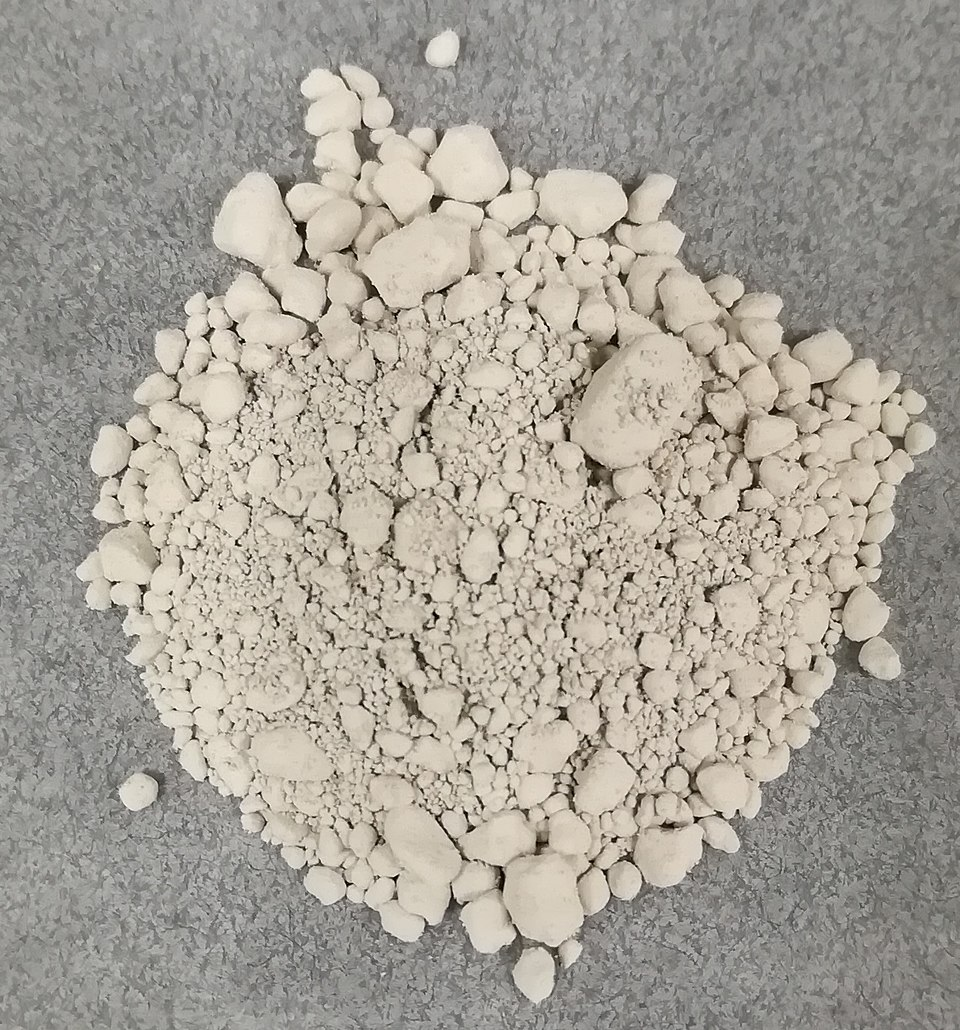
Copper(I) iodide, CuI, a white precipitate formed when Cu²⁺ is reduced to Cu⁺ in aqueous redox reactions involving iodide ions. Source
Equations and Redox Representation
Redox processes must be written using half-equations and combined into balanced overall equations. This is particularly important when facing unfamiliar reactions.
Half-Equation (Oxidation) = Species loses electrons
Electrons = Particles representing the loss of negative charge
When constructing redox equations, charge and mass balance must be maintained. This often requires adding H⁺, H₂O, or OH⁻ depending on the reaction medium.
Identifying Oxidising and Reducing Agents
Transition-metal ions frequently act as electron donors or acceptors. Identifying their roles relies on changes in oxidation state.
Reducing agent: A species that donates electrons and is itself oxidised.
These terms underpin interpretation of unfamiliar redox pathways.
Unfamiliar Redox and Substitution Reactions
This section of the specification assesses students’ ability to recognise patterns, deduce oxidation-state changes, and propose equations for reactions not previously encountered.
Recognising Redox Patterns
Unfamiliar reactions can often be interpreted by tracking:
Colour changes characteristic of specific ions
Formation or dissolution of precipitates
Electron transfer via oxidation-state changes
The effect of acidic, neutral, or alkaline media
For instance, a faded green solution turning brown is likely indicative of Fe²⁺ oxidising to Fe³⁺. Similarly, the appearance of an orange solution in a chromium system suggests formation of dichromate(VI).
Ligand Influence on Redox Behaviour
Ligands can stabilise particular oxidation states and modify redox tendencies. Substitution reactions may accompany redox changes when new ligands bind more strongly or alter electron density at the metal centre.
Ligand: A species that donates a lone pair to a metal ion to form a coordinate bond.
Because ligand fields change d-sub-shell splitting, they can shift redox equilibria or enable simultaneous redox and substitution processes.
Normal sentence: Ligand effects are especially relevant when interpreting reactions involving ammonia or chloride ions.
Constructing Redox Equations for Unfamiliar Reactions
Step-by-step reasoning (conceptual, without worked examples)
When writing equations for unknown reactions:
Assign oxidation states for all species.
Identify the species undergoing oxidation and reduction.
Write separate half-equations, ensuring electrons are added to the correct side.
Balance atoms other than oxygen and hydrogen first, then use H₂O, H⁺, or OH⁻ depending on conditions.
Balance charges using electrons, then combine the half-equations.
Always consider spectator ions if writing full ionic equations.
Substitution Reactions with Redox Components
In some unfamiliar reactions, ligand substitution accompanies electron transfer. This is common for Cu²⁺, where ligands such as water, ammonia, or chloride produce distinct complexes with different colours.
Important layered points:
Substitution may change stability, shifting redox equilibria.
Complex formation can alter the ease with which a metal ion is oxidised or reduced.
Some ligands (e.g., Cl⁻) may also act as reducing agents in specific contexts.
Normal sentence: These combined processes are commonly assessed through interpretation of precipitates, colour changes, and oxidation-state variations.
Using Colour, Precipitates and Conditions to Deduce Reaction Pathways
Students should note the following diagnostic features:
Colour cues
Green → brown (Fe²⁺ → Fe³⁺)
Orange → green (Cr₂O₇²⁻ → Cr³⁺)
Blue → white/cream (Cu²⁺ → Cu⁺ halide precipitate)
Precipitate formation adds clarity when identifying intermediate oxidation states.
Changes in pH dictate whether equilibria favour oxidation or reduction.
Disproportionation is especially relevant in copper systems.
Changes between Cr(VI) and Cr(III) are often accompanied by a distinct orange-to-green colour change, providing a practical indicator of chromium redox interconversion.
Understanding these patterns supports systematic interpretation of unfamiliar redox and substitution reactions, as required by the OCR specification.
Practice Questions
An aqueous solution containing Fe²⁺ ions is oxidised to Fe³⁺ ions.
a) State the oxidation-state change for iron.
b) Explain whether Fe²⁺ is acting as an oxidising agent or a reducing agent in this process.
(2 marks)
a)
Oxidation state increases from +2 to +3. (1 mark)
b)
Fe²⁺ acts as a reducing agent because it loses electrons / is oxidised. (1 mark)
A student investigates redox reactions of chromium and copper ions in aqueous solution.
a) Describe the colour changes observed when acidified dichromate(VI) ions are reduced to chromium(III) ions.
b) Write a balanced ionic half-equation for the reduction of dichromate(VI) ions in acidic solution.
c) Copper(II) ions react with iodide ions to form a white precipitate and a brown solution. Identify the oxidation states of copper before and after the reaction and explain the observations.
(5 marks)
a)
Orange solution changes to green. (1 mark)
b)
Correct half-equation:
Cr₂O₇²⁻ + 14H⁺ + 6e⁻ → 2Cr³⁺ + 7H₂O
(1 mark for correct species, 1 mark for correct balancing)
c)
Copper oxidation state changes from +2 to +1. (1 mark)
Cu²⁺ is reduced to Cu⁺, forming a white precipitate of CuI. (1 mark)
Iodide ions are oxidised to iodine, causing the brown colour in solution. (1 mark)
FAQ
The feasibility of a redox reaction often depends on the stability of the oxidation states involved.
In chromium systems, Cr(VI) species such as dichromate(VI) are stabilised in acidic solution, while chromate(VI) dominates in alkaline conditions. Changing pH shifts equilibria by altering proton availability, which directly affects half-equations and redox potentials.
This is why certain oxidations or reductions only proceed under specific pH conditions.
Copper(I) has a strong tendency to undergo disproportionation in water.
This occurs because Cu⁺ is less stabilised by hydration than Cu²⁺, making it energetically favourable for Cu⁺ to form Cu²⁺ and Cu(s).
The instability explains why Cu⁺ is often observed only as insoluble precipitates, such as CuI or CuCl, rather than as free aqueous ions.
Redox reactions involve a change in oxidation state, while ligand substitution does not.
To distinguish them:
Check whether oxidation states change
Look for electron transfer in half-equations
Consider whether colour changes could arise from new complexes rather than redox
If oxidation states remain constant, the process is substitution, even if a colour change occurs.
Halide ions act both as ligands and reducing agents in copper chemistry.
Iodide ions are particularly effective because they are easily oxidised, allowing them to reduce Cu²⁺ to Cu⁺. At the same time, halides stabilise Cu⁺ by forming insoluble precipitates, preventing further disproportionation.
This dual role makes halides especially important in copper redox systems.
Transition metals have partially filled d sub-shells with electrons close in energy.
As a result, both s and d electrons can be lost or gained during reactions. The small energy differences between oxidation states allow interconversion under mild conditions, making redox chemistry more varied and reversible than for s-block metals, which typically form only one stable oxidation state.


