

AP Syllabus focus: ‘You do not need to write electron configurations for elements that are exceptions to the Aufbau principle.’
These notes clarify a specific AP Chemistry boundary: which electron-configuration details are explicitly excluded. Knowing what is not tested helps you focus on testable patterns and avoid spending time memorising special-case configurations.
What the AP Exclusion Means
The AP Chemistry exam expects you to use the Aufbau principle as the standard model for writing ground-state electron configurations, but it explicitly removes a narrow set of “special-case” elements from what you must memorise.
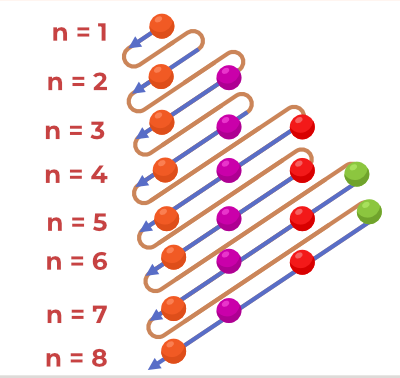
Diagonal (Aufbau) filling diagram showing how electron subshells are filled in order of increasing energy. The arrows encode the standard sequence (e.g., fills before ) that AP Chemistry typically treats as the default model for ground-state configurations. Source
You will not be assessed on recalling or generating electron configurations for elements whose true ground state deviates from the simple Aufbau filling order.
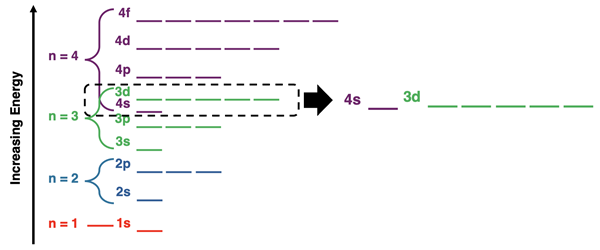
Energy-level diagram illustrating that the and sublevels lie very close in energy. This near-degeneracy helps explain why some transition-metal atoms can deviate from the simple Aufbau-predicted configuration (small stabilization can favor a different electron arrangement). Source
You may assume the usual subshell-filling patterns (the ones that match the periodic table blocks) without worrying about rare rearrangements.
The excluded category: “Aufbau exceptions”
Aufbau exception: An element whose experimentally observed ground-state electron configuration differs from the one predicted by straightforward Aufbau filling (often involving and subshells).
This exclusion is about writing configurations from memory. It does not prevent questions from mentioning these elements; it means you will not be required to know their non-Aufbau configurations as prerequisite knowledge.
How This Affects Exam Expectations
On AP-style questions, electron configurations are typically used to support reasoning about broad, testable ideas (for example, how many electrons occupy a subshell, or which subshell is being filled). With this exclusion in place:
If a question’s correctness would depend on a specific exception, the test will typically:
avoid that dependency, or
provide the needed configuration or a data representation (such as a diagram or spectrum), or
phrase the task so the Aufbau-predicted configuration is sufficient.
You should prioritise:
periodic-table-based filling order (e.g., then in the simple model),
block identification (, , , ),
recognising that subshell capacities follow the standard limits (2, 6, 10, 14).
What you should do if an exception appears anyway
If an element commonly associated with exceptions is mentioned in a prompt:
Do not assume you must recall a memorised “special” configuration.
Look for what the question provides (a configuration, a diagram, or wording like “according to the Aufbau principle”).
Use the model the question signals:
If it says “using the Aufbau principle,” follow Aufbau filling even if you know an exception exists.
If it provides an experimentally based configuration, use what is provided.
Common Misinterpretations to Avoid
Students often over-apply this exclusion. Keep these boundaries clear:
Excluded: memorising/writing the non-Aufbau configurations for the exception elements.
Not implied by this statement:
that electron configurations are unimportant (they remain a major representational tool),
that the periodic table filling pattern is optional (it is still the default model),
that you should ignore subshell structure (subshells remain central to what is tested).
Practical study guidance (time-efficient focus)
To align with the syllabus boundary:
Practise writing electron configurations using the standard filling order without worrying about special-case rearrangements.
When reviewing answer keys from other sources, note that some may include exception configurations; treat those as enrichment, not AP-required recall.
If you encounter conflicting configurations for the same element, defer to the AP rule: you are not responsible for exceptions unless the question supplies the needed information.
Practice Questions
(2 marks) A student says: “I must memorise the electron configuration of chromium because it is an Aufbau exception.” State whether this is required for AP Chemistry and briefly justify.
States it is not required to memorise/write configurations for Aufbau exceptions for the AP exam. (1)
Justification linked to syllabus boundary: exceptions are excluded; Aufbau-pattern configurations are the expected default unless information is provided. (1)
(5 marks) An exam question includes the element copper.
(a) Explain what the AP syllabus exclusion implies about needing copper’s exception configuration. (2 marks)
(b) If the prompt says “use the Aufbau principle,” describe how you should proceed when writing the configuration. (2 marks)
(c) State one situation in which a non-Aufbau configuration could still be used appropriately on the exam. (1 mark)
(a) Says you do not need to know/write the exception configuration from memory; exceptions are excluded content. (1)
(a) Adds that if an exception is necessary, the question would provide relevant information or avoid reliance on it. (1)
(b) States you should follow straightforward Aufbau filling as instructed by the prompt. (1)
(b) Applies this to the task: write the configuration according to the model requested, not based on memorised exceptions. (1)
(c) Example: the configuration is explicitly given in the question (or a data source/diagram is provided) and you use that provided information. (1)
FAQ
No list is required by the AP boundary.
If you learn common examples from other courses, treat them as background knowledge rather than examinable recall.
The underlying reason involves subtle energy differences between subshells and additional stability in certain arrangements.
This explanation is beyond what the AP requires you to use for written configurations of exceptions.
Only follow what the question asks.
If the prompt specifies “use the Aufbau principle,” using an exception may conflict with the instructed model and could be marked incorrect.
Use AP-aligned priorities:
learn standard filling and periodic-table patterns first
treat exceptions as optional enrichment unless your teacher explicitly uses them for conceptual discussion
It may mention an exception element, but it should not require memorised exception configurations to earn marks.
If an exception-specific detail matters, the needed configuration (or equivalent information) would be supplied.
