AP Syllabus focus:
'Renaissance visual arts reflected new ideas and were used to advance personal ambition, political authority, and religious goals.'
Renaissance art was more than decoration. It translated new intellectual currents into visible form and gave elites, governments, and church leaders a powerful language for shaping status, authority, and belief.
New Ideas in Renaissance Art
Humanism, observation, and realism
Renaissance visual art reflected a broader shift in European thought away from a purely symbolic, otherworldly view of life. Artists became more interested in the human body, the natural world, and the achievements of classical antiquity. Instead of presenting figures as flat and stylized, they aimed for lifelike form, believable space, and emotional depth.
One major influence was humanism, which emphasized human potential, dignity, and the study of classical culture. In art, this encouraged closer attention to individual features, movement, and personality. Portraits became more important because wealthy and powerful people wanted to be shown as distinct individuals rather than as anonymous religious donors.
Artists also studied anatomy, light, and geometry. Their work suggested that the visible world could be understood through careful observation and rational design. This made art a reflection of the same intellectual spirit that valued inquiry and the recovery of ancient knowledge.
When artists used linear perspective, they made painted space appear more realistic and ordered.

Diagram illustrating how linear perspective organizes space around vanishing points. This kind of construction shows how Renaissance artists could mathematically systematize depth, helping figures and architecture appear to recede convincingly in a single, coherent visual field. Source
Linear perspective: A technique that creates the illusion of depth by arranging lines and space so that parallel lines appear to meet at a single vanishing point.
This technique mattered because it visually expressed the Renaissance belief that the world was structured, measurable, and open to human understanding.
Classical influence and ideal beauty
Renaissance artists borrowed heavily from Greek and Roman models. They revived classical columns, arches, domes, drapery, and balanced proportions. Sculptors and painters often presented the human figure with idealized beauty, harmony, and controlled movement.
This classical revival had two important effects:
It linked Renaissance culture to the prestige of the ancient world.
It gave art a more secular and civic character, even when the subject remained religious.
A biblical figure might still be painted, but with the anatomy, poise, and dignity of a classical hero. In this way, Renaissance art blended Christian themes with classical form.
Art as a Tool of Patronage
Personal ambition and social prestige
Renaissance art was deeply shaped by patronage.
Patronage: Financial and social support given by a ruler, church leader, family, or institution to artists in exchange for works that served the patron’s aims.
Patrons commissioned paintings, sculptures, chapels, tombs, and palaces not simply because they admired beauty, but because art enhanced reputation. Wealthy families used art to display refinement, education, and success. Commissioning a famous artist signaled that a patron possessed both money and cultural authority.
Art could advance personal ambition in several ways:
Portraits presented patrons as intelligent, dignified, wealthy, or morally serious.
Private chapels and tombs linked a family’s name to piety and permanence.
Palaces and villas advertised taste, status, and connection to classical civilization.
Public commissions allowed families to dominate civic space and memory.
Art therefore functioned as a form of self-fashioning. Patrons shaped how others saw them, and they did so through carefully chosen images, materials, and locations.
The growing prestige of the artist
Renaissance art also served the ambitions of artists themselves. In the Middle Ages, many artists had been treated mainly as skilled craftsmen. During the Renaissance, leading figures increasingly claimed the status of creative intellectuals. Their mastery of perspective, anatomy, and classical learning raised their social position.
As a result, a successful artist’s name could add prestige to a commission. Patrons wanted works by renowned masters because artistic excellence reflected well on the patron as much as on the artist.
Art and Political Authority
Power made visible
Rulers and governments used Renaissance art to project political authority. Images in palaces, town halls, churches, and public squares made power visible to subjects and rivals. Art could communicate order, stability, military success, and legitimacy without the need for written explanation.
Political leaders often chose classical forms because they associated themselves with the glory of Rome. Monumental buildings and heroic statues suggested strength, permanence, and disciplined rule. Frescoes and civic decorations could also celebrate victories, wise leadership, or the unity of a city.
Art supported political authority by:
glorifying rulers and ruling families
linking present governments to admired ancient models
shaping public space to reflect hierarchy and control
presenting political power as natural, honorable, and beneficial
In this sense, Renaissance art was often a form of visual propaganda.
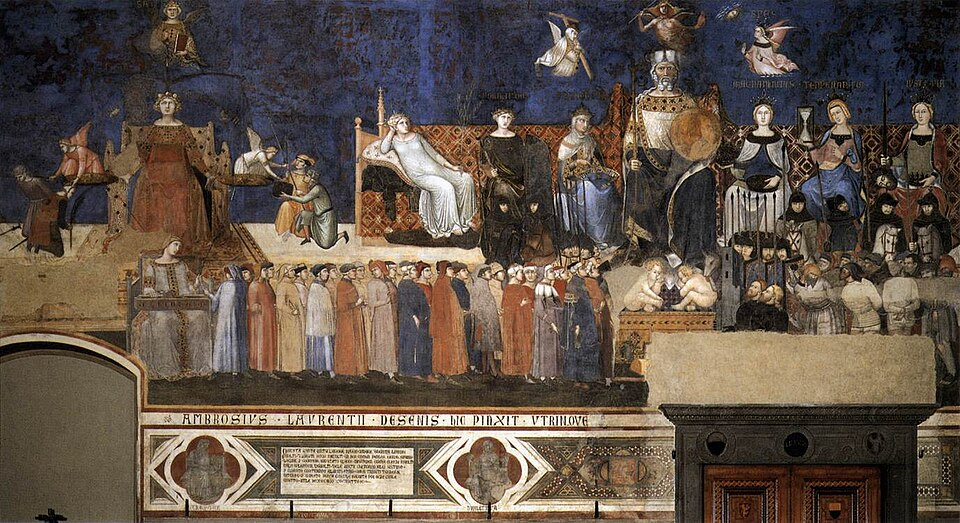
Ambrogio Lorenzetti’s fresco presents an idealized vision of good government, associating political stability with social harmony and prosperity. Placed in Siena’s town hall, the image functioned as a public lesson in civic virtue—demonstrating how visual art could legitimize authority and shape political values. Source
It helped persuade viewers that those in power deserved their position.
Art and Religious Goals
Devotion, teaching, and institutional power
Renaissance art also served religious goals, especially for the Church. Paintings, altarpieces, sculptures, and church architecture were meant to inspire devotion, teach sacred stories, and make spiritual truths emotionally compelling.
Even when religious themes remained central, Renaissance artists presented sacred figures in more human terms.
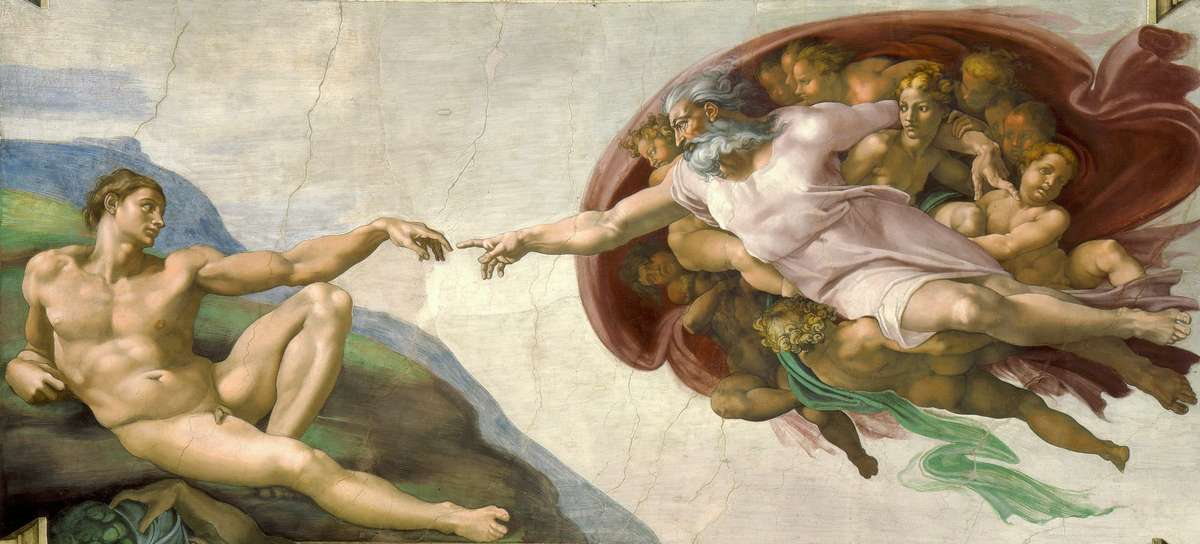
Michelangelo’s Creation of Adam (Sistine Chapel ceiling) exemplifies how Renaissance religious art humanized sacred narratives through idealized anatomy, dynamic gesture, and emotional immediacy. Commissioned for the papal chapel, it also demonstrates how major Church patrons used monumental art to project spiritual authority and cultural prestige. Source
The Virgin Mary, apostles, and saints often appeared with believable expressions, gestures, and bodies. This made religious scenes more immediate and relatable to viewers.
Church leaders valued art because it could:
instruct the faithful through images
encourage prayer and reverence
beautify sacred space
demonstrate the wealth and authority of religious institutions
Large commissions from popes, bishops, monasteries, and confraternities showed that art was not separate from religion; it was one of religion’s most effective public tools. Magnificent churches and richly decorated chapels communicated that the Church possessed both spiritual truth and earthly power.
Religious patronage also allowed church authorities to compete for prestige. A splendid chapel or altarpiece could honor God, but it could also elevate the donor’s reputation within the religious community.
Practice Questions
Identify and explain one way Renaissance visual art reflected new ideas in Europe between about 1400 and 1550. (3 marks)
1 mark for identifying a relevant feature, such as naturalism, linear perspective, classical influence, realism, or portraiture.
1 mark for explaining how that feature reflected new ideas, such as humanism, observation of nature, or renewed interest in Greece and Rome.
1 mark for using a specific example or extending the explanation clearly.
Evaluate the extent to which Renaissance art was used more to advance political authority than religious goals in the period circa 1400 to 1550. (6 marks)
1 mark for a clear thesis or line of argument that addresses both political and religious purposes.
1 mark for specific evidence showing art used to support political authority, such as public monuments, palace decoration, dynastic portraiture, or civic commissions.
1 mark for specific evidence showing art used to support religious goals, such as altarpieces, chapels, church decoration, or papal commissions.
1 mark for analysis explaining how art functioned as persuasion, propaganda, or devotion rather than mere decoration.
1 mark for comparison or evaluation of extent, showing which purpose was more important in a given setting or why the purposes often overlapped.
1 mark for a well-supported, historically accurate argument using relevant Renaissance context.
FAQ
Oil paint dried slowly, which allowed artists to blend colours gradually and create subtle shading, texture, and light. That made faces, fabrics, metals, and landscapes look more convincing.
This mattered because patrons wanted images that appeared rich, lifelike, and impressive. Oil painting was especially effective for portraits and devotional works that depended on realism and emotional impact.
Many major works were produced in workshops rather than entirely by one hand. A master designed the composition, supervised assistants, and completed the most important sections.
This system helped patrons in several ways:
it lowered cost
it increased speed
it ensured a recognisable house style
It also meant that famous artistic styles could spread widely, strengthening a patron’s cultural prestige.
Classical myths were often treated as moral, intellectual, or allegorical subjects rather than as pagan worship. Educated patrons saw them as signs of learning and refinement.
A mythological scene could suggest:
beauty
virtue
love
power
wisdom
For elite viewers, these works linked a patron to the authority of antiquity without necessarily challenging Christianity.
Women from elite families could commission chapels, portraits, devotional images, and tombs. Their patronage often focused on family memory, piety, marriage alliances, or household prestige.
Although women had fewer formal political opportunities, art could still help them shape public image and dynastic identity. Some also influenced artistic taste through court culture and collecting.
Nudity drew on classical ideals of beauty, proportion, and heroic virtue. Artists used the unclothed body to display technical skill and anatomical knowledge.
Its meaning depended on context:
in religious art, it might emphasise vulnerability or suffering
in mythological art, it could suggest ideal beauty
in political imagery, it might represent strength or civic virtue
For Renaissance viewers, the body could be both intellectually serious and symbolically powerful.