AP Syllabus focus:
'Most Europeans lived from agriculture, while new ideas about sovereignty and secular law shaped emerging political institutions.'
Early modern Europe was still overwhelmingly rural. Farming shaped daily life, social hierarchy, and economic security, while changing political ideas gradually altered how rulers claimed authority and organized government.
Agriculture and Rural Life
For most Europeans, agriculture was the foundation of existence. The vast majority lived in villages or on scattered farms, and their survival depended on the successful cultivation of grain, vegetables, and livestock. A good harvest meant food, rent payments, and social stability; a bad harvest could bring hunger, debt, and unrest. Because agricultural work followed the seasons, everyday life was organized around planting, harvesting, and storing food rather than around urban schedules or distant trade.
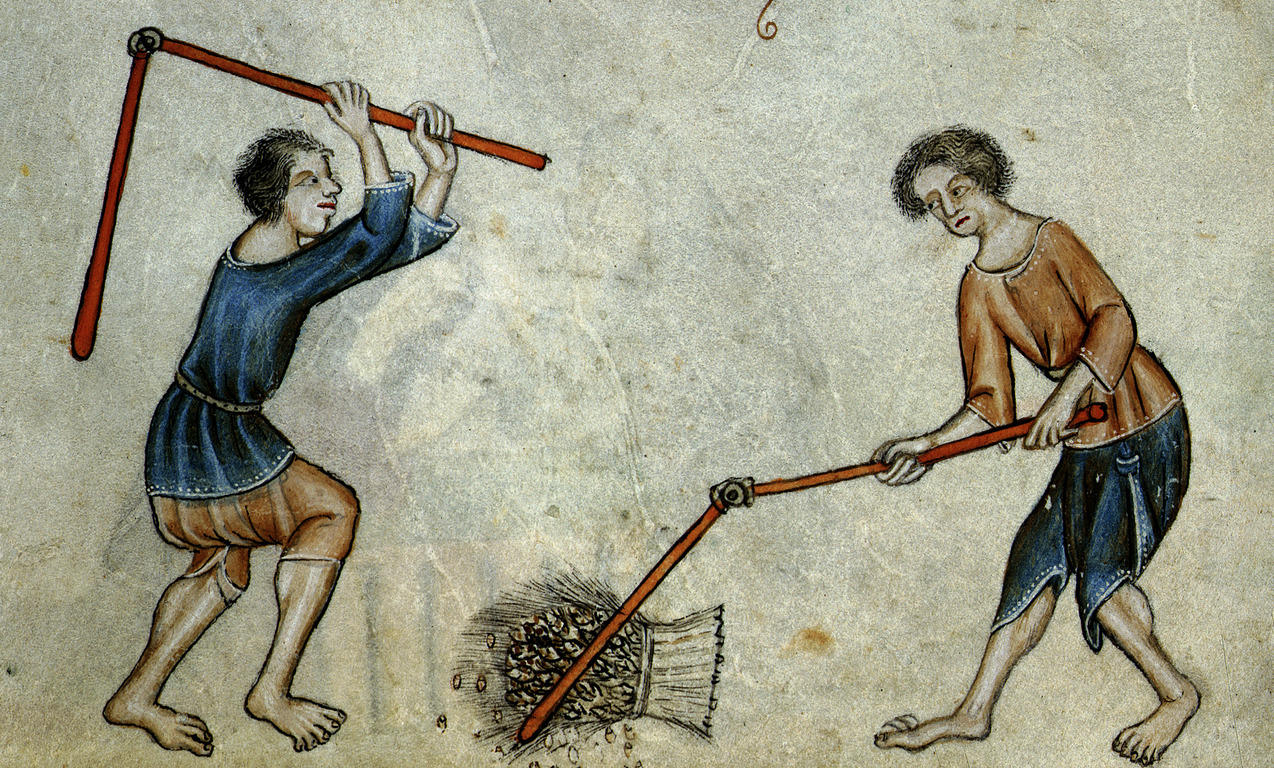
This manuscript illustration depicts peasants threshing wheat—one of the key post-harvest tasks needed to separate edible grain from stalks and chaff. It makes the agrarian “calendar” concrete by showing how much hand labor was required to turn a harvest into usable food and rent payments. Scenes like this also underscore how closely household survival depended on the success of grain cultivation. Source
Rural communities were shaped by hierarchy. Peasant families worked land they might own, rent, or hold through customary rights, while nobles and church institutions often controlled large amounts of property. Wealth and status were tied closely to land, so political power also remained strongly connected to control of the countryside.
Village Society and Obligations
Village life was collective as well as agricultural. Families depended on shared routines, local customs, and cooperation with neighbors. Fields, grazing land, and water sources often required communal management. At the same time, peasants faced obligations that limited their freedom. These could include rents, dues, or labor services owed to a landlord, as well as taxes and church tithes. Such demands show that rural life was not simply economic; it was embedded in a wider system of social authority.
Because most people lived this way, rulers and elites could not ignore the countryside. Any political order had to govern rural populations, protect harvests, and maintain peace in local communities. Agriculture was not a minor part of European society; it was its central reality.
Land, Power, and Social Order
In an agricultural society, land was the main source of wealth. Those who controlled land usually exercised influence over justice, military obligations, and local administration. This helps explain why political change in early modern Europe was gradual. Older feudal and customary structures still mattered because they rested on long-established relationships in the countryside. Rulers could claim wider authority, but they still depended on local elites to carry out many decisions.
The rural character of Europe also affected the pace of institutional development. Governments were not yet directing densely urban populations. Instead, they were dealing with dispersed villages, regional customs, and local privileges. As a result, political institutions had to grow in ways that could reach the countryside: through courts, officials, legal orders, and negotiations with landholding elites.
New Ideas About Authority
A major political development of the period was the growing importance of sovereignty.
Insert takeaways content here...
Sovereignty: the highest political authority within a territory, with the power to make and enforce laws.
This idea pushed against the older medieval pattern in which authority was divided among kings, nobles, towns, and the Church. If rulers claimed sovereignty, they were asserting that political power should be clearer, more unified, and more firmly attached to a territory. That did not mean older institutions disappeared immediately. It did mean that rulers increasingly justified their actions by appealing to the authority of the state rather than to a web of personal loyalties alone.
In practice, new claims of sovereignty encouraged rulers to expand their role in lawmaking, taxation, and justice. Political institutions began to reflect this shift. Royal councils, administrative offices, and higher courts became more important because they helped rulers present themselves as the chief source of public order.
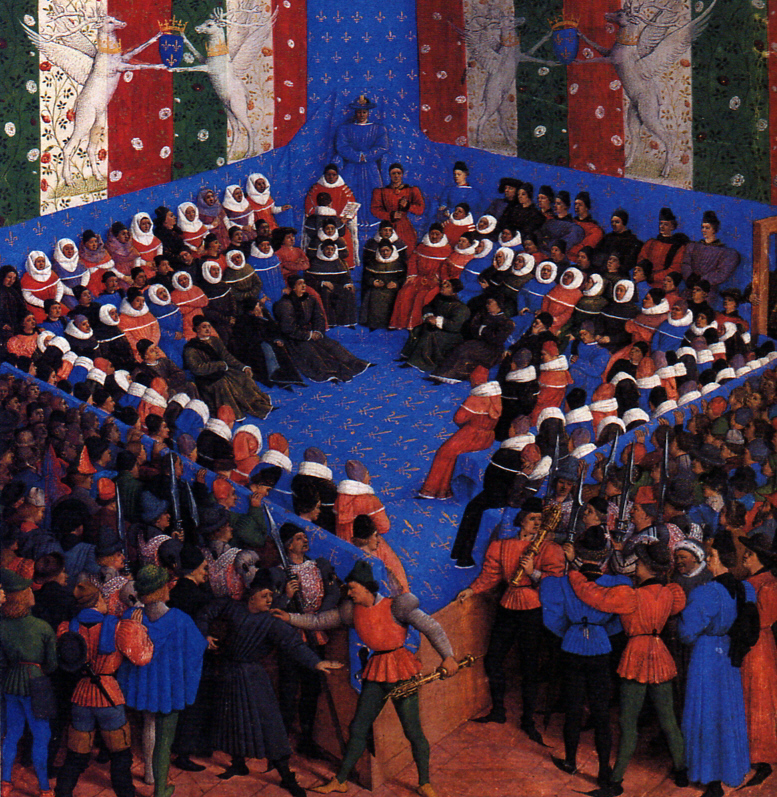
This illumination shows a royal session (a “lit de justice”) at the Parlement of Paris under Charles VII (c. 1450), highlighting the ceremonial and institutional face of justice. The image helps students see how law and governance were enacted through formal settings, officials, and hierarchical procedure rather than only through personal lordship. It also illustrates how rulers could project authority by presiding over, or acting through, central courts. Source
Secular Law and Emerging Institutions
Another important change was the growing influence of secular law.
Secular law: law created and enforced by civil authorities rather than by the Church.
As secular law gained importance, rulers and their advisers increasingly treated government as a practical, legal process. Political authority could be expressed through written laws, trained officials, and courts that operated in the name of the ruler or state. This helped strengthen institutions that were less dependent on religious authority and more tied to territorial government.
The rise of secular law did not eliminate religion from politics. Instead, it signaled that rulers were increasingly willing to ground their power in civil jurisdiction, legal procedure, and public administration. This was a major step in the development of more formal political institutions. When disputes over land, taxes, inheritance, or local authority were settled through secular courts, the reach of the ruler became more concrete in ordinary life.
Because most Europeans were rural, these legal changes mattered especially in the countryside. Law was not only about high politics; it shaped who collected dues, who judged conflicts, and who had the right to command obedience in local communities.
Why Rural Life and Political Change Were Connected
Agriculture and political development were closely linked because governing Europe meant governing rural society. States needed stable harvests, predictable revenues, and cooperation from landholders and villagers. Political institutions therefore emerged in response to practical needs in an agrarian world. Courts handled disputes rooted in land and custom. Officials gathered revenue from agricultural production. Rulers used law to define authority in places where older local rights remained strong.
This connection also explains why political change combined continuity and innovation. Rural life kept many traditional structures in place, since village customs and land-based hierarchy remained powerful. At the same time, ideas about sovereignty and secular law slowly changed how power was organized. The result was not an immediate break with the medieval past, but the gradual appearance of institutions that were more territorial, more legal, and more clearly associated with ruling states.
Practice Questions
Briefly explain ONE way the fact that most Europeans lived from agriculture shaped early modern European society. (2 marks)
1 mark for identifying that most Europeans lived in rural communities and depended on farming for survival.
1 mark for explaining one effect, such as land-based social hierarchy, seasonal patterns of life, or the importance of maintaining order in the countryside.
Evaluate how new ideas about sovereignty and secular law influenced emerging political institutions in Europe during the Renaissance era. (5 marks)
1 mark for presenting a defensible thesis that makes a historically plausible claim about political change.
1 mark for providing relevant context about Europe as a predominantly agricultural and rural society.
1 mark for using specific evidence about sovereignty, such as rulers claiming supreme territorial authority.
1 mark for using specific evidence about secular law, such as civil courts, written law, or officials acting in the name of rulers.
1 mark for explaining how these ideas influenced institutions, for example by strengthening councils, courts, or administrative offices.
FAQ
Common land gave villagers access to resources they could not easily provide on their own.
It could be used for grazing animals, gathering wood, collecting turf, or letting poorer households survive when private holdings were too small. Rights to use commons were often based on custom rather than formal ownership, which made them socially important and legally sensitive.
Women were essential to rural labour, even when records focused mainly on male landholders.
Their work often included:
tending gardens
caring for poultry and dairy animals
processing food
helping at harvest time
selling small goods in local markets
They also managed households and helped preserve family economies during illness, war, or poor harvests.
As government became more formal, rulers needed people who could read documents, draft laws, keep records, and apply legal procedure consistently.
These officials helped turn authority into something more organised and durable. Instead of depending only on personal loyalty, rulers could govern through paperwork, courts, and written decisions. That made institutions more stable across large territories.
Local custom came from long-standing village or regional practice, while royal law came from the ruler and central authorities.
In many places, both existed at the same time. A village might follow customary rules about land use or inheritance, but a royal court could still intervene in disputes. This overlap often caused tension, especially when rulers tried to make law more uniform.
Peasants were not powerless, even if their options were limited.
They could:
petition local authorities
bring cases to court
refuse payments
flee obligations
join collective protests or riots
Most resistance aimed to defend customary rights rather than to overturn society completely. Villagers often argued that rulers or landlords had broken accepted practice.