AP Syllabus focus:
'Commercial and agricultural change altered social patterns, even as medieval hierarchies and traditional economic structures continued.'
Economic life in Renaissance Europe was changing, but not uniformly. Trade expanded, farming adapted, and some people gained new opportunities, yet older ranks, obligations, and habits still shaped most Europeans’ lives.
Commercial Change and Social Patterns
One major development in early modern Europe was the broader reach of markets. More goods moved between town and countryside, and more people depended on exchange, credit, and sales rather than purely local subsistence. This commercialization did not transform all of Europe at once, but it did alter how wealth was made and displayed.
Commercialization: the increasing importance of markets, trade, and money in everyday economic life.
As commerce grew, merchants, artisans, and other urban groups became more visible in society. In some towns, successful business families accumulated enough wealth to influence government, patronage, and social life. Money became a more important marker of status, even in a culture that still respected birth and inherited privilege. Commercial expansion also encouraged stronger links between regions, making local economies less isolated than in the medieval past.
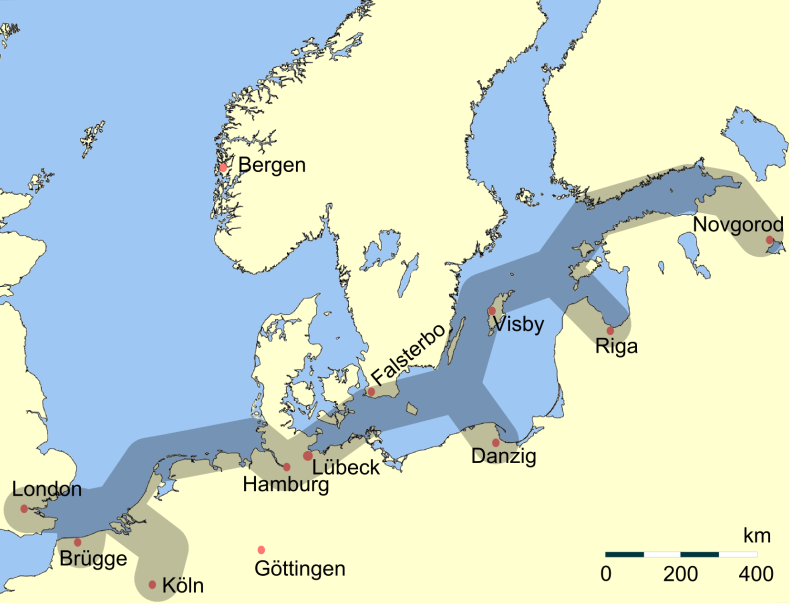
This map traces the main trading routes associated with the Hanseatic League, highlighting how maritime and overland corridors connected ports and commercial cities across northern Europe. It helps explain why merchants and urban producers gained visibility and influence: durable routes and networks reduced isolation and expanded market reach. In study terms, it is a concrete example of commercialization creating wider regional linkages. Source
These shifts affected social patterns in several ways. Urban centers offered some room for social mobility, especially for merchants, shopkeepers, and skilled producers. Families that profited from trade could improve housing, education, and marriage prospects. At the same time, commercial growth also widened inequality. Not everyone benefited equally, and many laborers, small producers, and poorer townspeople remained economically insecure.
Important social effects of commercial change included:
a stronger merchant elite in some cities
a greater use of cash and credit in transactions
more economic ties between rural producers and urban markets
sharper differences between wealthy commercial families and the urban poor
Even where trade expanded, however, commercial success did not automatically erase older social values. Wealthy families often sought respect by imitating noble lifestyles, buying land, or entering elite marriage networks. This shows that new wealth mattered, but traditional hierarchy still carried enormous weight.
Agricultural Change in a Mostly Rural Society
Although commerce was significant, Europe remained overwhelmingly agricultural. Most people still lived in the countryside and depended on farming for survival. Because of this, changes in agriculture had major social consequences. Landlords, peasants, tenants, and rural laborers all experienced economic change through shifting patterns of production, rents, and market involvement.
In some areas, agriculture became more closely tied to market demand. Instead of producing only what a household needed, some farmers increasingly produced surplus crops or specialized goods for sale. This could benefit those with enough land, tools, and access to transport. Better-positioned rural families could gain from selling grain, wine, wool, or other products. Agricultural change therefore created opportunities for certain groups to rise above simple subsistence.
But these gains were uneven. Many peasants still worked under inherited customs and local obligations. Lords often retained legal and social power over rural communities, and many village households remained vulnerable to debt, bad harvests, or rent pressures. The countryside was not simply moving toward a modern free market; it was changing inside an older framework.
Manorial obligations: customary rents, dues, or labor services owed by peasants to a lord.
These obligations remind us that traditional economic structures continued.
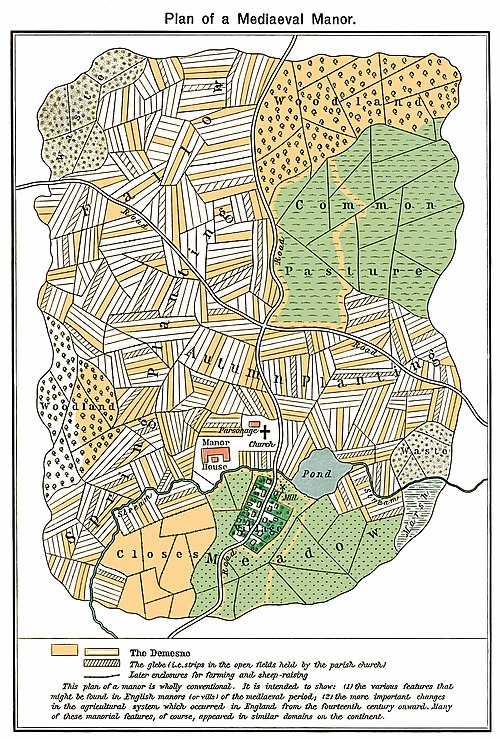
This diagram visualizes the layout and landholding patterns of a typical medieval manor, including the lord’s demesne, church-held glebe strips, common pastures, and the nucleated village. It makes concrete how customary rights and obligations were embedded in the physical landscape, shaping peasants’ daily work and limiting “free market” choice. Use it to connect manorial obligations (rents, dues, labor services) to the institutional geography of rural life. Source
Even where money payments became more common, many rural relationships were still defined by custom rather than pure market freedom. Social standing in the countryside still depended heavily on landholding, seigneurial authority, and inherited position. Rural change could therefore increase pressure as well as opportunity.
Agricultural change altered social patterns by:
rewarding some larger landholders and better-off peasants
exposing smaller farmers to greater economic risk
connecting village production more closely to outside markets
preserving dependence through rents, dues, and lordly authority
Continuity Beneath Change
The key historical point is that this period combined change and continuity. Europe was not simply leaving the medieval world behind in one sudden shift. New commercial practices, wider markets, and changing agriculture reshaped society, but medieval hierarchies remained powerful. Nobles still enjoyed prestige based on birth, clergy retained influence, and peasants still formed the majority of the population. Economic innovation operated within a society that remained deeply unequal.
Traditional structures also adapted rather than disappearing. Urban guilds, village customs, and lord-peasant relationships often survived because they still organized work, regulated production, and maintained social order. In many places, the market did not replace older institutions; instead, it existed alongside them. A merchant might use modern accounting and long-distance exchange while still seeking noble status. A peasant might sell produce in a market while still owing rents or services under customary law.
This combination helps explain why social change was gradual. Economic life was becoming more dynamic, but power still rested heavily on land, privilege, and inherited rank. Wealth could open doors, yet it usually worked best when attached to existing authority. For AP European History, this subsubtopic is best understood as a transitional moment: commercial and agricultural change mattered greatly, but they did not yet sweep away the social and economic order inherited from the medieval past.
How to Frame This Historically
When studying this topic, focus on both sides of the development:
Change: more market activity, stronger commercial groups, greater rural-urban connections
Continuity: enduring hierarchy, customary obligations, and traditional institutions
Historical significance: European society was becoming more economically flexible without becoming socially equal
Practice Questions
Identify ONE way commercial change altered social patterns in European society during the Renaissance period, and identify ONE traditional economic structure that persisted. (2 marks)
1 mark for identifying one valid social change caused by commercial change, such as the rise of merchant elites, increased use of cash, stronger urban influence, or greater social mobility for some groups.
1 mark for identifying one valid continuity, such as guilds, manorial obligations, lord-peasant relationships, inherited privilege, or the dominance of land-based status.
Evaluate the extent to which commercial and agricultural change transformed European society in the period c. 1450-c. 1600. (5 marks)
1 mark for a clear thesis that addresses both transformation and continuity.
1 mark for describing one significant commercial or agricultural change.
1 mark for explaining one effect of that change on social patterns.
1 mark for identifying one important continuity from the medieval period.
1 mark for explaining why traditional hierarchies or economic structures continued despite change.
FAQ
Land was usually seen as safer, more respectable, and more politically useful than commerce alone.
Owning estates could:
reduce the risks of unstable trade
improve marriage prospects
provide local influence
help a family imitate or join the landed elite
In many places, landownership still carried more honour than business success. Buying land was therefore not only an economic decision but also a social strategy.
Inheritance rules could either preserve property or break it into smaller pieces. That mattered greatly in a society where land remained the main source of security.
If land was divided among heirs, families might struggle to maintain viable holdings. If it passed mainly to one heir, the estate stayed intact, but younger children often had to seek work elsewhere.
This helped shape migration, marriage choices, and social mobility.
Common lands gave poorer households access to grazing, wood, fuel, and other resources that reduced dependence on cash.
Without them, families might find it harder to:
keep a few animals
survive poor harvests
avoid debt
remain independent
Because margins were often narrow, access to commons could make the difference between stability and poverty. That is why changes to their use could cause tension within villages.
Many relied on informal or local credit rather than large financial institutions.
Common sources included:
neighbours and kin
merchants
landlords
urban moneylenders
religious or charitable bodies in some towns
Credit was essential for buying seed, tools, raw materials, or food in difficult seasons. It could support opportunity, but it also created vulnerability if harvests failed or sales were poor.
Towns depended on the countryside for food and raw materials, while rural producers needed urban markets for selling surplus and obtaining manufactured goods.
This relationship strengthened as exchange increased, but it did not make town and country separate worlds. Instead, they were economically interdependent.
That interdependence helped spread change, though unevenly, because urban demand could reshape rural production without removing older village structures.