AP Syllabus focus:
'Europeans explored and settled overseas territories, where they encountered and interacted with indigenous populations.'
From the late fifteenth century onward, European expansion overseas created new zones of contact. These encounters were not uniform: they involved trade, settlement, negotiation, conflict, and ongoing struggles over land, authority, and cultural influence.
The Nature of Overseas Expansion
European overseas expansion brought Europeans into sustained contact with indigenous populations. Voyages of exploration were quickly followed by forts, trading posts, and, in some regions, permanent settlements. This meant Europeans were entering lands already inhabited by societies with their own political systems, economies, and cultural traditions.
Indigenous populations: The original peoples of a region who lived there before foreign conquest, migration, or settlement.
Encounters therefore began in places that were never empty. Europeans often depended on local food supplies, guides, translators, and knowledge of geography. Indigenous communities, in turn, had to assess unfamiliar newcomers and decide whether to resist them, negotiate with them, or use them for local advantage.
Because overseas territories differed greatly, the pattern of contact also varied.
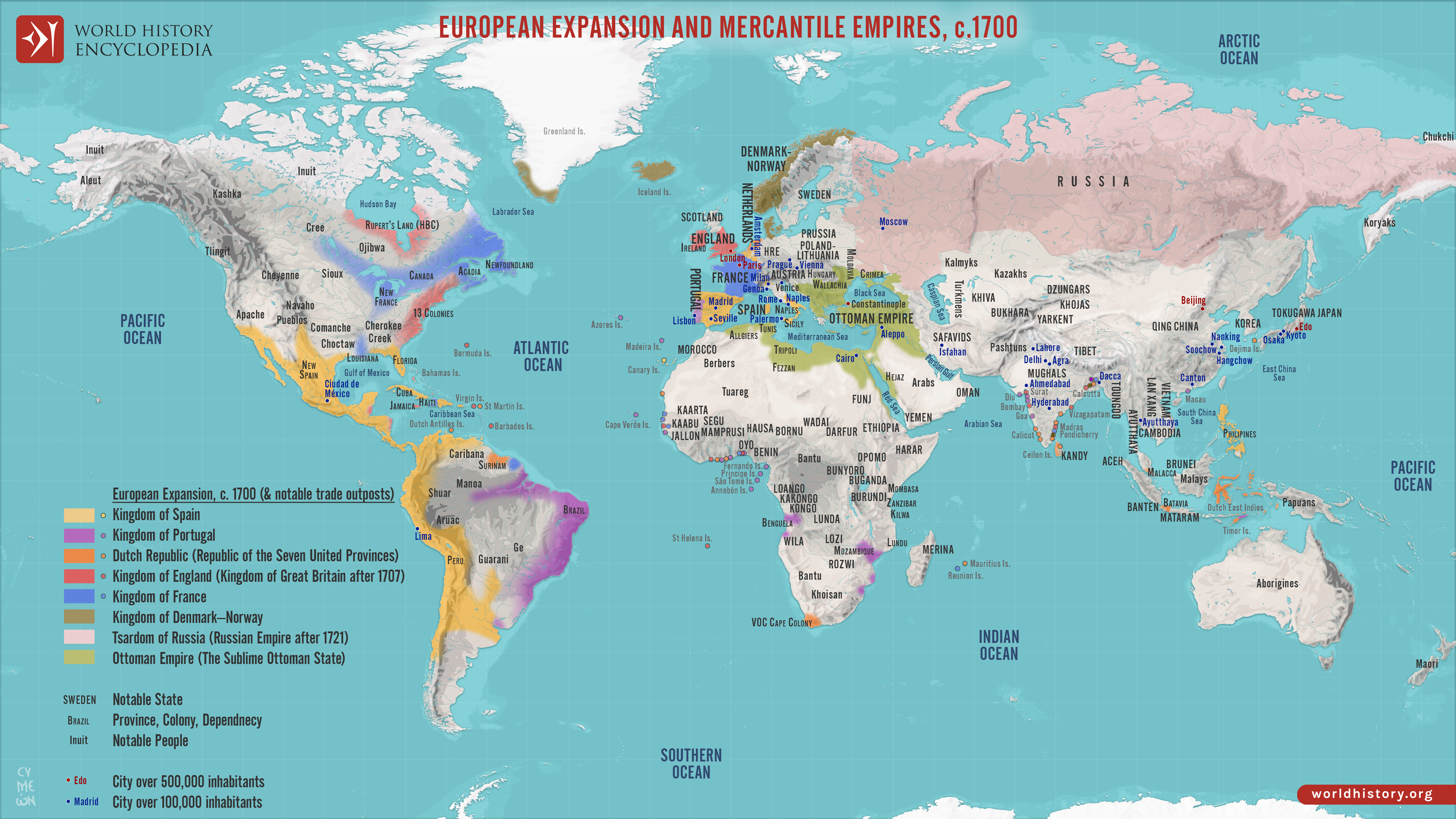
This map shows the global distribution of major European overseas empires and key trade outposts around c. 1700. It helps explain why encounters ranged from settler colonialism (especially in parts of the Americas) to port-based commercial influence and strategic coastal control in Africa and Asia. The broad geographic spread also underscores that expansion was a long process of competition, negotiation, and coercion across multiple regions. Source
In parts of the Americas, Europeans increasingly claimed land and created settler communities. In many parts of Africa and Asia, Europeans were initially more dependent on existing rulers and commercial networks. Overseas expansion did not follow a single model; it produced different kinds of interaction in different places.
Main Forms of Encounter
Trade and Exchange
Trade was often the earliest form of interaction.
Europeans exchanged manufactured goods for local products and for access to regional markets. These exchanges could be peaceful, but they were rarely equal in power or intention. Europeans often sought lasting control over routes, ports, and resources, while indigenous communities sometimes used trade to strengthen their own position or gain an advantage over rivals.
Trade also created regular contact. Repeated exchanges forced both sides to learn something about the other’s customs, expectations, and political structures. Even when relations began commercially, they could later turn diplomatic or military.
Diplomacy and Alliance
Encounters also involved diplomacy. European newcomers were usually too few at first to dominate large territories on their own, so they relied on treaties, gifts, interpreters, and alliances. In the Americas, small European forces often depended heavily on indigenous allies when confronting more powerful local states or rival groups.
Indigenous leaders were not passive observers. Many judged Europeans pragmatically, sometimes welcoming them as useful allies, sometimes restricting their movement, and sometimes playing one European power against another. These decisions could shape settlement patterns, military campaigns, and the balance of regional power.
Conflict and Coercion
Conflict quickly accompanied many encounters. Competition over land, labor, tribute, and political authority often led to warfare. Europeans sometimes used fortified positions, firearms, and alliances with local enemies of existing powers to expand their control. Where settlement increased, tensions usually became sharper because settlers wanted permanent access to land and resources.
For indigenous peoples, this could mean loss of autonomy, forced submission, or displacement. Yet resistance remained constant. Some communities fought immediately; others resisted after periods of negotiation or limited cooperation. This reminds us that European expansion was contested from the beginning and that conquest was never automatic.
Cultural and Social Interaction
Overseas encounters were also cultural encounters. Europeans observed unfamiliar languages, beliefs, and customs, often interpreting them through their own assumptions. Misunderstandings were common, especially when each side tried to fit the other into existing political or religious categories.
At the same time, daily contact produced adaptation. Some people crossed cultural boundaries as translators, guides, spouses, converts, or intermediaries. These individuals played an important role because they connected societies that did not initially share language, law, or social expectations. Encounter, therefore, was not only military or political; it was also personal and social.
Indigenous Agency and Regional Variation
A key idea for AP European History is indigenous agency: local peoples shaped events rather than simply receiving European actions. They made alliances, redirected trade, defended territory, and used local knowledge to influence outcomes. European success often depended on local divisions and local cooperation, not just on European strength.
Regional context mattered greatly. In places with dense populations and strong political structures, Europeans could face real limits and had to bargain with established authorities. In areas where they created settler communities, conflict over land became more direct and destructive. This helps explain why overseas expansion created a wide range of relationships, from negotiated coexistence to violent conquest.
Historical Significance
These encounters mattered because they laid the groundwork for later colonial societies. Patterns established early—trade partnerships, alliance-making, missionary contact, intermarriage, coercion, and land seizure—shaped how European authority developed in overseas territories.
They also changed European understanding of the wider world. Contact with indigenous peoples confronted Europeans with societies, political systems, and cultural practices beyond the traditional boundaries of Europe. For historians, the essential point is complexity: overseas expansion was not a simple story of Europeans arriving and immediately dominating. It was a process of interaction in which Europeans and indigenous populations continually shaped one another’s choices, opportunities, and conflicts.
Practice Questions
Identify one way Europeans interacted with indigenous populations in overseas territories, and briefly explain why that interaction mattered. (2 marks)
1 mark for identifying a valid interaction, such as trade, military alliance, negotiation, intermarriage, missionary contact, or conflict over land.
1 mark for explaining its significance, such as helping Europeans survive, gain territory, establish settlements, or provoking indigenous resistance.
Evaluate the extent to which encounters with indigenous peoples shaped European overseas expansion in the period c. 1450–1650. (6 marks)
1 mark for a clear, defensible argument that makes a judgment about the extent.
1 mark for explaining how trade or cooperation supported expansion.
1 mark for explaining how diplomacy or alliances shaped settlement or conquest.
1 mark for explaining how conflict, coercion, or resistance affected outcomes.
1 mark for using specific and relevant historical evidence.
1 mark for showing complexity, such as regional variation or indigenous agency.
FAQ
Interpreters were more than language tools. They explained customs, mediated disputes, and helped shape trade, diplomacy, and military alliances.
Because they controlled information, they could also influence outcomes. A capable interpreter might reduce tension, while a biased or frightened one could deepen mistrust.
The Requerimiento was a Spanish declaration asserting the authority of the Crown and the Church over newly encountered peoples.
It matters because it shows how conquest was given a legal and religious justification, even when it was read to audiences who could not understand it. Historians use it to highlight the gap between imperial claims and indigenous realities.
Indigenous women often acted as mediators in first encounters. They could serve as translators, advisers, marriage partners, or links between communities.
Their roles were especially important where trust was fragile. Through kinship ties and local knowledge, they could help create alliances, ease negotiations, or shape how Europeans understood local politics.
Europeans often looked for permanent, exclusive possession of land. Many indigenous societies had more flexible systems based on shared use, seasonal movement, or overlapping rights.
Because both sides understood land differently, agreements could be interpreted in completely different ways. What Europeans saw as a transfer of ownership might be viewed locally as temporary access or alliance-building.
Renaming places was a symbolic act of possession. A new name could honour a monarch, a saint, or a European homeland, and it helped place distant territories into European maps and political claims.
This practice also mattered culturally. It could weaken the visibility of existing indigenous names and suggest that Europeans had the authority to define the land.