AP Syllabus focus:
'Religious pluralism challenged the idea of a unified Christian Europe and reshaped religious authority across the continent.'
During the sixteenth and seventeenth centuries, Europeans stopped assuming that one church could unite the continent. Competing confessions divided communities, altered state power, and forced rulers and believers to rethink religious authority.
From Christendom to Division
For much of the late medieval period, many western Europeans imagined themselves as part of a single Christian commonwealth. The Roman Catholic Church, led spiritually by the papacy, provided shared rituals, a common Latin liturgy, and a universal moral framework. Even when rulers fought each other, the ideal of Christendom suggested that Europe belonged to one faith.
Christendom: The idea that European society formed a single Christian community under broadly shared beliefs and the spiritual leadership of the church.
This unity was never complete; Jews, Muslims, and Orthodox Christians remained outside Latin Christendom. Still, in western and central Europe, the expectation of one dominant church shaped politics, education, law, and culture. When religious reform fractured that expectation, Europeans were not simply adding new churches. They were challenging one of the basic organizing ideas of society.
The Growth of Religious Pluralism
By the sixteenth century, criticism of church practices and authority helped produce permanent religious divisions. Instead of one recognized western church, Europe contained multiple confessions: Catholic, Lutheran, Reformed, Anglican, and smaller radical groups. These communities disagreed over worship, church government, and the source of religious truth.
Religious pluralism: The condition in which more than one organized religious group exists within the same society or region.
Religious pluralism did not mean full religious freedom in the modern sense. Most governments still wanted religious conformity. However, the mere existence of multiple organized faith communities made it impossible to restore the older assumption that all Europeans belonged to a single Christian body.
Pluralism spread unevenly:
In some territories, rulers adopted a new confession and expected subjects to follow.
In others, nobles, city governments, or local communities pushed reform from below.
In several regions, competing confessions survived side by side, creating lasting tension and negotiation.
As different churches developed their own clergy, schools, catechisms, and forms of worship, religion became more territorial, local, and politically contested.
The End of a Unified Christian Europe
The rise of multiple confessions weakened the idea that the pope or any single church could speak for all of Europe. The older dream of universal Christendom gave way to a continent divided by confessional identity. A person’s faith increasingly shaped political loyalties, marriage patterns, education, and social belonging.
This change had several major effects:
Diplomacy was no longer based on a common religious framework alone.
Civil conflict often overlapped with disputes about authority and obedience.
Minorities within states became more visible and more vulnerable.
Tolerance, where it emerged, was often a political compromise rather than a principled embrace of diversity.
Religious pluralism also created a new map of Europe.
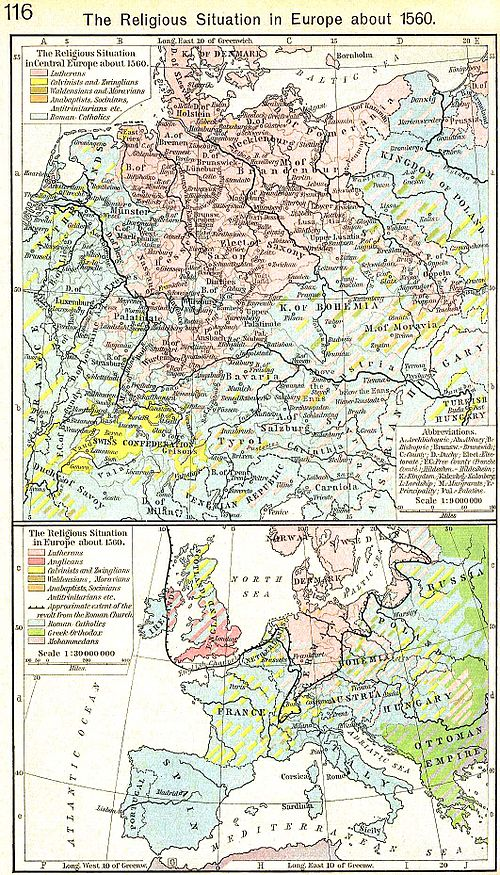
This historical atlas map visualizes Europe’s major confessional alignments around 1560, using color-coding to distinguish Catholic and multiple Protestant traditions across different regions. It helps explain how religious identity became increasingly territorial, with rulers and communities aligning with particular confessions. Seeing the patchwork distribution also clarifies why coexistence often produced tension, negotiation, and periodic conflict rather than a quick return to religious unity. Source
States and regions increasingly identified themselves by confession, and rulers treated religion as a matter tied to political order. Shared Christianity no longer erased competition among kingdoms, princes, and cities.
Reshaping Religious Authority
Decline of universal papal authority
One of the greatest changes was the weakening of the papacy’s claim to universal religious leadership in western Europe. In Protestant lands, believers and rulers rejected the pope as the final earthly authority in religion. Even in Catholic regions, reform pressures encouraged tighter supervision of clergy and a stronger emphasis on discipline and instruction.
Rise of rulers and territorial churches
Religious pluralism often increased the role of the state in church life. Princes, monarchs, and city councils claimed the right to organize worship, appoint or supervise clergy, and enforce religious practice. This shifted authority away from a single international church toward territorial churches closely tied to political power.
In this environment, rulers increasingly saw religious unity within their own lands as a tool of stability. Yet the presence of multiple confessions also meant they had to bargain, compromise, or repress more actively than before.
Authority of scripture, clergy, and conscience
Pluralism changed authority at the local level as well. Many reform movements elevated scripture and preaching, which increased the importance of educated ministers and vernacular religious instruction.
Ordinary believers were encouraged to think more directly about doctrine, worship, and moral discipline. That did not create full equality, but it did make religious life less dependent on a single centralized chain of command.
Competing confessions also forced Europeans to ask difficult questions:
Who had the right to define true belief?
Could rulers command religious obedience?
Did communities have the right to resist religious changes they rejected?
Was peace possible without complete religious uniformity?
These questions mattered because religious authority was no longer self-evident. It had to be defended through law, institutions, persuasion, and sometimes force. Across the continent, bishops, ministers, magistrates, monarchs, and laypeople all participated in the struggle to decide who would guide Christian life in a divided Europe.
Practice Questions
Identify one way religious pluralism challenged the idea of a unified Christian Europe, and identify one way it reshaped religious authority. (2 marks)
1 mark for identifying that Europe became divided among multiple confessions instead of one dominant western church.
1 mark for identifying that authority shifted away from universal papal control toward rulers, territorial churches, local clergy, or equivalent.
Evaluate the extent to which religious pluralism transformed religious and political authority in Europe in the period 1517 to 1648. (6 marks)
Thesis/claim (1 mark): Presents a defensible argument about how far religious pluralism changed authority.
Contextualization (1 mark): Describes the broader setting of late medieval Christendom or the early Reformation.
Evidence (2 marks): Provides specific relevant evidence such as weakening papal authority, emergence of multiple confessions, growth of territorial churches, or confessional conflict within states.
Analysis and reasoning (2 marks): Explains how the evidence supports the argument and shows the extent of change and/or continuity, including nuance such as pluralism strengthening some states while weakening universal church authority.
FAQ
Not completely.
In western and central Europe, Latin Christianity was dominant, but unity was always imperfect. Orthodox Christians lay outside papal authority, and Jewish and Muslim communities remained present in several regions.
What changed after the Reformation was not the existence of difference itself, but the breakdown of the expectation that western Europe should belong to one church.
Its political structure was highly decentralised. Emperors had to share power with princes, bishops, imperial cities, and local estates, so no single authority could easily impose one confession everywhere.
This meant local rulers had unusual room to choose, defend, or negotiate religious change. That made the empire one of the clearest examples of pluralism becoming a political fact.
The phrase meant that the ruler of a territory could determine its official religion. Subjects were generally expected to conform or move elsewhere.
In practice, this reduced some conflict but did not create modern tolerance. It recognised the power of rulers over religion and treated confession as a territorial matter rather than a universal one.
Many towns relied on practical compromise rather than harmony.
They might:
assign different churches to different groups
regulate public processions carefully
separate schooling by confession
restrict mixed marriages or shared offices
These arrangements could preserve order, but they also kept confessional boundaries highly visible in daily life.
Refugees carried beliefs, books, skills, and networks across borders. When they settled elsewhere, they helped new confessional communities grow faster and connect with co-religionists abroad.
Their movement also reminded rulers that religion could affect trade, labour, and urban prosperity. As a result, pluralism was shaped not only by ideas and laws, but also by migration.