AP Syllabus focus:
'Colonial expansion created a global exchange of goods, plants, animals, and people, while increasing European dominance and the slave trade.'
European overseas expansion did more than add territories. It created a connected exchange system that moved commodities, crops, animals, and human beings across oceans while strengthening European imperial power.
A Global Exchange Emerges
The expansion of European colonies after 1492 linked the Americas, Europe, Africa, and eventually Asia in a new web of exchange. This system was global because movement across the Atlantic affected trade, labor, and consumption far beyond a single region. European merchants, monarchies, and settlers increasingly stood at the center of these connections, directing routes and profiting from them.
Historians often call this process the Columbian Exchange.
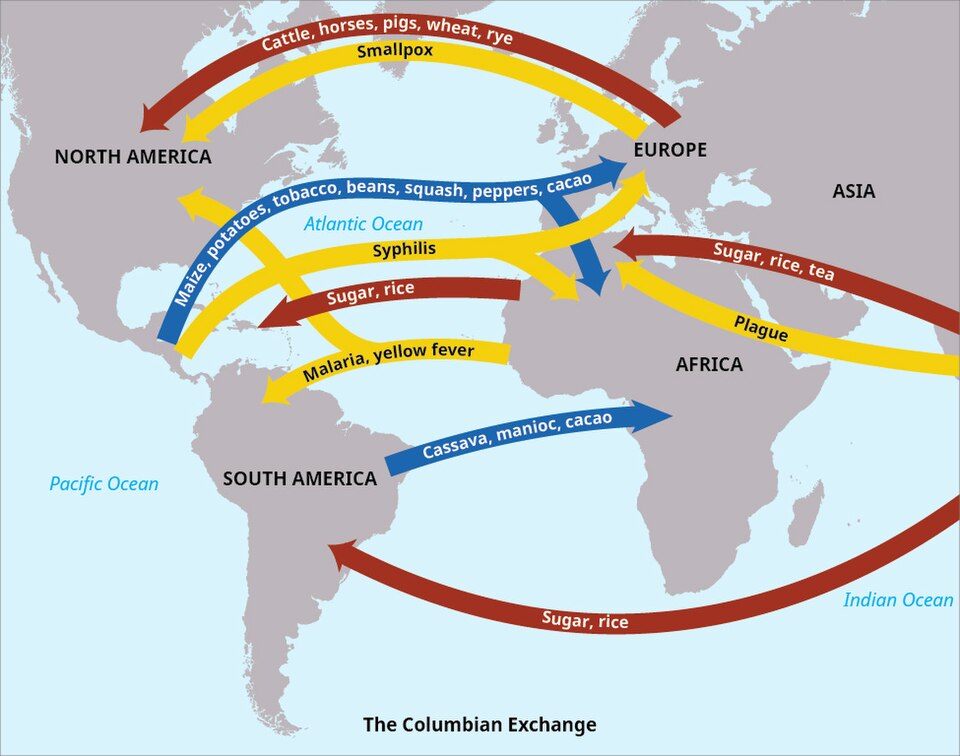
This diagram summarizes the Columbian Exchange by listing representative crops, domesticated animals, and diseases that moved between the Old World and the New World after 1492. By organizing transfers by direction, it helps clarify how ecological change and imperial expansion were intertwined in the early modern Atlantic world. Source
Columbian Exchange: The transfer of goods, plants, animals, and people between the Eastern and Western Hemispheres after European overseas expansion.
Although exchange moved in multiple directions, it was not equal. Europeans gained growing control over shipping, colonial administration, and the legal rules of trade. That gave European states and investors a stronger position in world commerce, even when they still depended on local labor and regional trade partners.
What Moved Across the Oceans?
Goods and Commodities
Colonial expansion brought a widening flow of goods across oceans. American products such as sugar, tobacco, and precious metals became highly valuable in European markets. In return, Europeans sent manufactured items, metal tools, cloth, and weapons to overseas colonies and to trading partners involved in Atlantic commerce. These exchanges made colonies central to imperial wealth.
Such commodities changed patterns of consumption. European consumers encountered new tastes and habits, while rulers and merchants saw overseas trade as a major source of revenue and influence. The value of imported goods helped justify further conquest, settlement, and investment overseas.
Plants and Animals
Colonial expansion also moved plants and animals on a massive scale. Crops from the Americas, including maize, potatoes, and tomatoes, reached Europe and other parts of the Old World. From Europe and the broader Eastern Hemisphere came crops and animals such as wheat, sugarcane, horses, cattle, pigs, and sheep.
These transfers reshaped agriculture and daily life. New foods improved variety in diets and could support population growth in some regions. Imported animals changed transport, farming, and patterns of land use in the Americas. Colonies were therefore not just places of political control; they were also sites of environmental and economic transformation that benefited European empires.
The Movement of People
The global exchange was also an exchange of people. European settlers, missionaries, soldiers, administrators, and merchants crossed the Atlantic to build and maintain colonial societies. Their movement spread European political authority and created permanent links between overseas possessions and the home states that claimed them.
At the same time, millions of Africans were transported by force through the transatlantic slave trade.
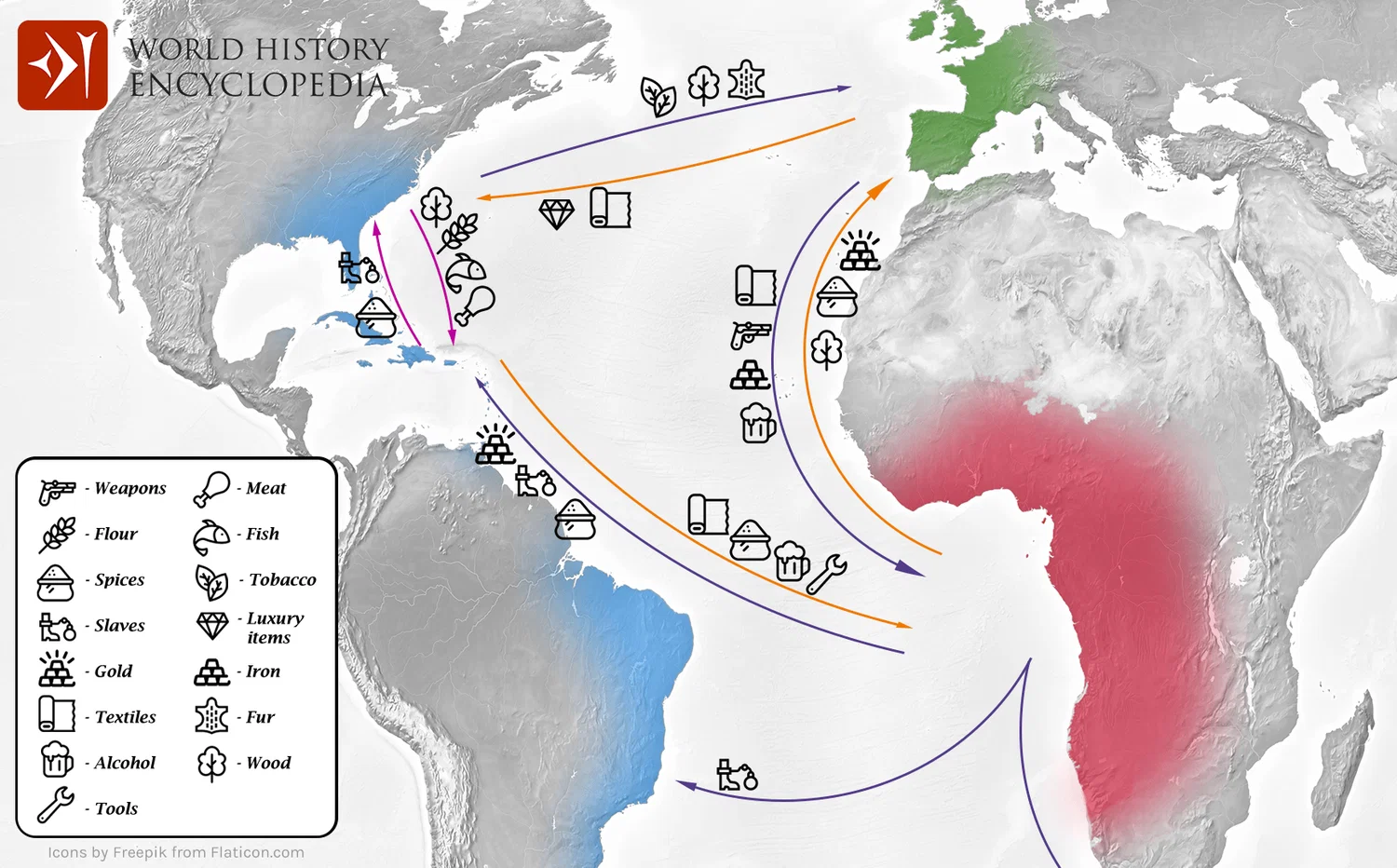
This map depicts the three-legged trading system linking Europe, Africa, and the Americas, highlighting how manufactured goods, enslaved Africans, and plantation commodities circulated through Atlantic routes. It reinforces the idea that coerced labor and commodity exports were structurally connected, not separate stories. Source
This was not a side effect of empire but one of its foundations. Forced migration supplied labor for plantations and other colonial enterprises, turning human beings into commodities within an expanding Atlantic economy.
Expanding European Dominance
Economic and Imperial Power
The exchange created profits that strengthened European power. Colonies produced export crops and valuable raw materials that enriched merchants and increased state revenues. Control over these goods encouraged European governments to defend sea routes, support colonial administration, and compete for overseas possessions.
European dominance grew because colonial systems were organized mainly to serve European interests. Land, labor, and trade were increasingly directed toward the needs of imperial markets. Even when Europeans relied on indigenous or African intermediaries, they sought to control the terms of exchange and claim the largest share of the profits.
Why the Exchange Increased Power
Colonial exchange increased European dominance in several connected ways:
it gave European states access to valuable resources unavailable at home
it helped merchants and investors accumulate wealth from long-distance trade
it tied overseas territories to European political authority
it made commercial expansion and imperial expansion reinforce one another
The Slave Trade within the Global Exchange
The growth of the slave trade showed the coercive side of this global system. As plantation agriculture expanded, European empires demanded a large, controllable labor force. Enslaved Africans were transported across the Atlantic in rising numbers and forced to produce profitable crops for export.
This trade increased European dominance because it linked labor, land, and commerce under imperial control. Plantation output enriched colonial elites and metropolitan economies, while shipping networks connected Europe, Africa, and the Americas more tightly than before. The movement of people was therefore as central to empire as the movement of goods.
Practice Questions
Identify ONE example of something moved by the global exchange created by colonial expansion, and explain ONE way this movement increased European power. (2 marks)
1 mark for identifying a valid example such as sugar, tobacco, potatoes, horses, European settlers, or enslaved Africans.
1 mark for explaining a valid effect, such as increasing imperial wealth, supplying labor, supporting plantation production, or strengthening control over colonies and trade.
Evaluate the extent to which the global exchange created by colonial expansion strengthened European dominance from the late fifteenth to the seventeenth century. (5 marks)
1 mark for a historically defensible thesis making a clear claim about the extent of European strengthening.
1 mark for accurate discussion of the movement of goods, plants, animals, or people between hemispheres.
1 mark for specific evidence, such as sugar, tobacco, precious metals, potatoes, horses, or enslaved Africans.
1 mark for explaining how this exchange increased European economic or political power.
1 mark for complexity, such as showing that European dominance expanded through unequal control of labor and trade rather than through equal exchange.
FAQ
It produced many calories from a small plot and could grow in soils where grain was less reliable. That made it attractive to poorer households and to landlords seeking dependable food supplies.
In regions such as Ireland and parts of central Europe, it supported population growth and reduced the risk of grain failure in some years. Its importance also made some societies more vulnerable when the crop later failed.
Much silver mined in Spanish America did not remain in Europe. It moved through European trade and through the Pacific, especially via Manila, to pay for Asian goods such as silk and porcelain.
This mattered because it let Europeans participate more deeply in long-distance commerce even when Asian producers did not want many European manufactures. Silver became a bridge linking American extraction to global exchange.
European traders usually lacked the power to seize captives far inland. Coastal forts and ships were important, but African rulers, merchants, and brokers controlled many of the political and commercial networks that supplied captives.
This did not make the trade balanced or benign. Europeans created strong external demand and profited from oceanic transport, while the trade intensified violence and instability in many African regions.
Old World animals altered environments as well as economies. Cattle and sheep changed grazing patterns, while pigs could damage crops and local ecosystems. Horses increased mobility for colonists and, in some areas, for Indigenous peoples who adopted them.
These animals also encouraged new forms of landholding, fencing, and ranching. Colonial power was therefore expressed not only through governments and armies, but through everyday control of land and animal resources.
No. European power expanded unevenly and depended on circumstance. Colonists often needed local allies, translators, merchants, and existing trade routes to survive and profit.
In many places, European authority was strongest near ports, plantation zones, and major settlements. Distance, climate, resistance, and rival empires limited how far control could reach. Dominance grew over time, but it was never as simple as total command from the start.