AP Syllabus focus:
'The exchange of goods shifted Europe’s economic center from the Mediterranean to the Atlantic states and an expanding world economy.'
From the late fifteenth century onward, long-distance exchange redirected wealth, investment, and political influence toward Europe’s Atlantic coast, transforming trade networks, urban development, and the balance of power within Europe.
The Economic Shift from the Mediterranean to the Atlantic
For centuries, Mediterranean cities such as Venice and Genoa had occupied a central place in European commerce. They connected Europe to eastern luxury goods through older overland and maritime routes. In the early modern period, however, the most dynamic flows of trade increasingly moved away from the Mediterranean basin and toward the Atlantic seaboard.
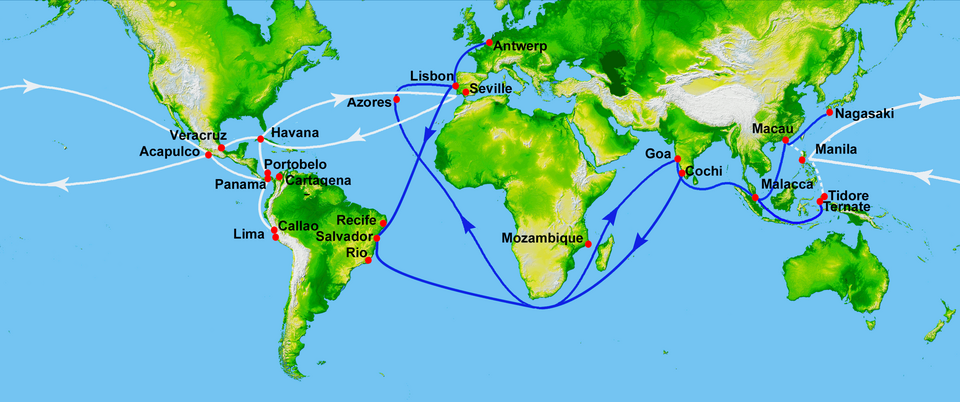
This map plots the major 16th-century Portuguese and Spanish sea routes that connected Atlantic Europe to West Africa, the Americas, and onward to Asia. It helps illustrate how maritime corridors—not older Mediterranean relay networks—became the backbone of high-volume, long-distance exchange in the early modern period. The dense route structure also clarifies why states with Atlantic access could capture outsized profits in shipping, port services, and imperial logistics. Source
This shift did not mean Mediterranean commerce disappeared. Instead, it meant that the greatest opportunities for profit, shipping, finance, and state revenue increasingly lay in Atlantic trade. Ports facing the Atlantic became better positioned to participate in the circulation of goods between Europe, Africa, the Americas, and Asia, making them central nodes in a new world economy.
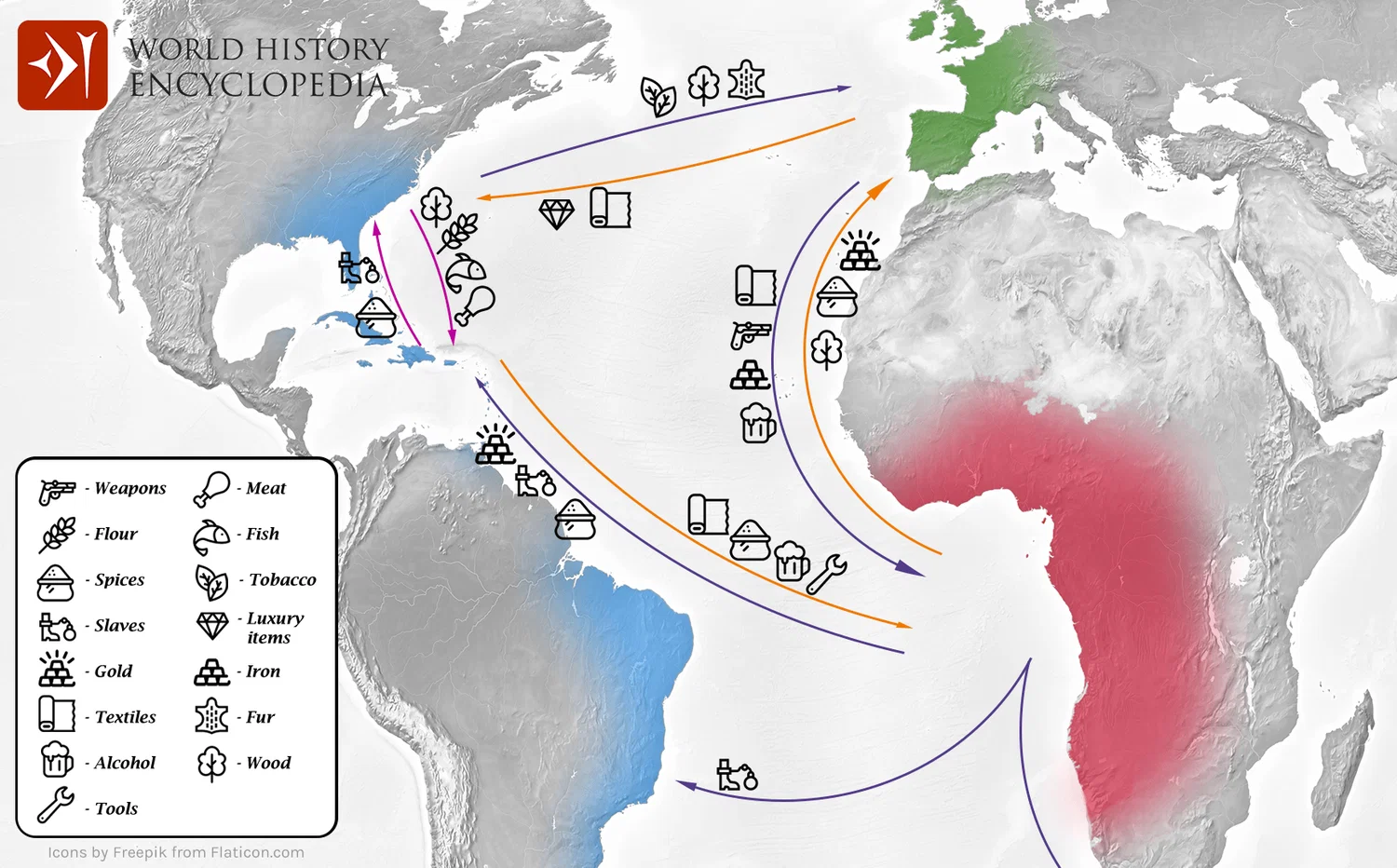
This diagram summarizes the transatlantic “triangular” pattern of exchange linking European ports, West African coasts, and American plantation zones. It demonstrates how Atlantic commerce integrated multiple regions into a single circuit of shipping, credit, and redistribution, rather than a one-directional trade flow. As a study aid, it reinforces the idea that Atlantic port cities grew powerful by coordinating multi-leg routes and handling high-value cargoes across the ocean basin. Source
Why the Atlantic States Gained Importance
Access to Oceanic Trade Routes
Atlantic states held a major geographic advantage. Their ports opened directly onto oceanic routes, allowing merchants and rulers to participate in exchange on a much larger scale than before. Instead of depending mainly on Mediterranean intermediaries, Atlantic merchants could profit from maritime links that connected Europe to multiple regions at once.
As overseas exchange expanded, the Atlantic coast became the entry point for valuable commodities:
Precious metals that increased liquidity and purchasing power
Colonial goods that created new consumer demand
Asian luxury products arriving through global sea routes
Raw materials that supported manufacturing and re-export trade
Because these goods passed through Atlantic ports, commercial wealth increasingly accumulated there rather than in older Mediterranean centers.
Control of Re-export Trade
Atlantic states also benefited from re-export trade, in which imported goods were processed, redistributed, or sold onward to other European markets. A port did not have to produce a commodity itself to become rich from handling it. What mattered was control over shipping, warehousing, insurance, and distribution.
This helped certain Atlantic cities become major commercial hubs. They served as collection points where goods from overseas were unloaded and then sent across Europe. As a result, profits flowed not only to merchants but also to shipowners, financiers, urban governments, and monarchies that taxed trade.
Effects on European Economic Geography
Decline in Mediterranean Centrality
The Mediterranean had once been the main crossroads of European long-distance trade. As oceanic commerce expanded, that role weakened. Italian commercial influence remained important, especially in finance and regional trade, but it no longer dominated the most rapidly growing sectors of the European economy.
The key change was relative, not absolute. Mediterranean merchants still operated successfully, yet the center of gravity moved westward. Economic leadership increasingly belonged to states whose ports could connect directly to Atlantic shipping lanes and global markets.
Rise of Atlantic Port Cities
The shift in economic power can be seen clearly in the growth of Atlantic port cities. Cities such as Lisbon, Seville, Antwerp, Amsterdam, and later London illustrate this trend. These urban centers expanded because they handled larger volumes of goods, attracted merchants from different regions, and created opportunities in shipping, banking, and related trades.
Atlantic ports often developed:
Larger merchant communities
More specialized financial services
Stronger links between trade and state policy
Greater influence over national economic priorities
As these cities prospered, they helped reshape domestic economies. Investment moved into commerce, shipbuilding, dock facilities, and overseas ventures, further reinforcing Atlantic dominance.
The Expanding World Economy
Europe in a Larger Commercial System
The phrase expanding world economy refers to a broader system in which European markets became more tightly connected to production and exchange across several continents.
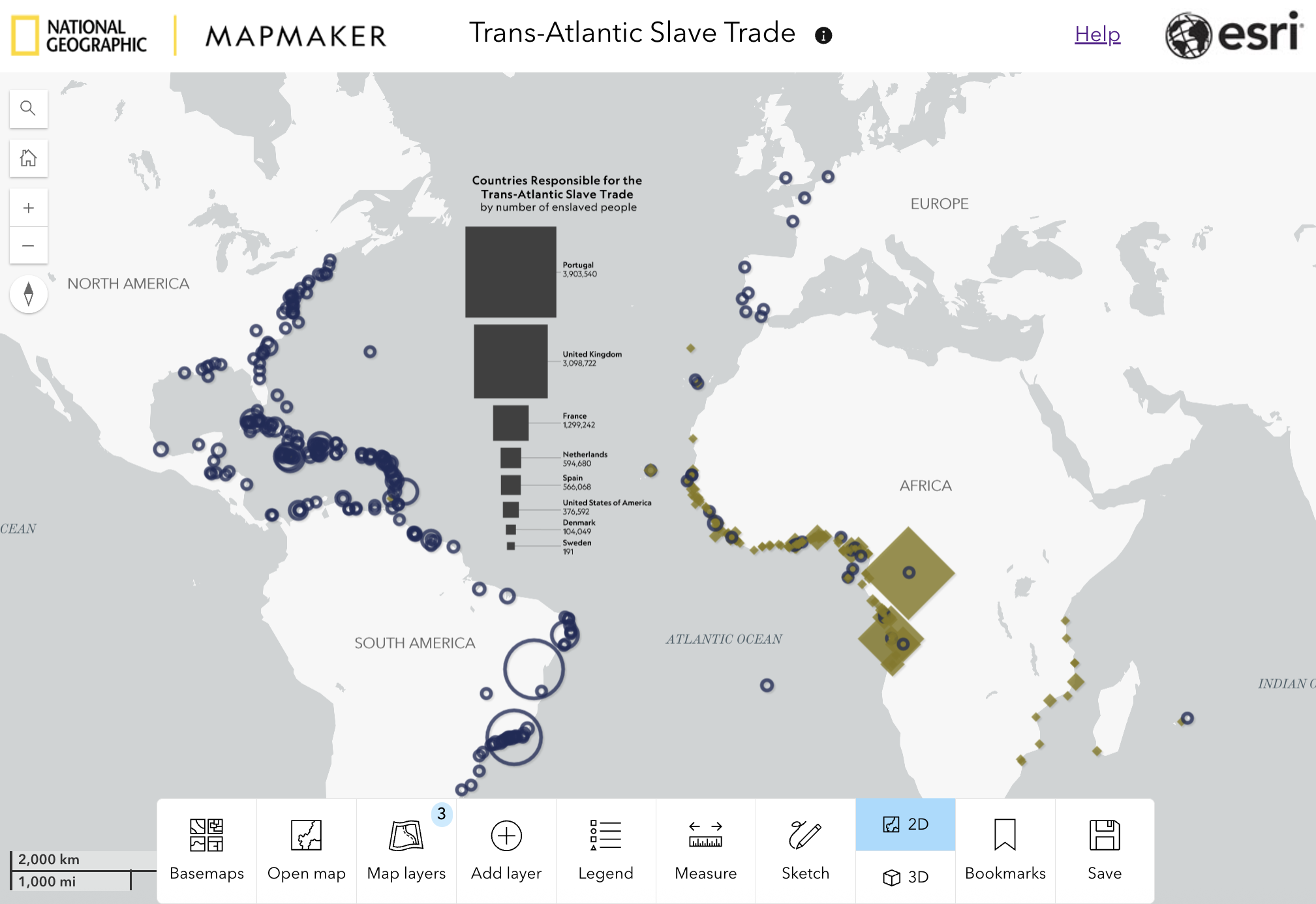
This National Geographic resource visualizes transatlantic and intra-American slave-trade routes using a large historical dataset (SlaveVoyages), emphasizing the networked, intercontinental character of early modern Atlantic exchange. Its mapping approach helps students see how repeated routes, ports, and corridors created durable commercial infrastructures across ocean space. Used alongside your notes, it provides an evidence-based example of how Atlantic systems tied European markets to coerced labor regimes and long-distance redistribution. Source
European economic life was no longer centered primarily on internal trade or Mediterranean exchange. Instead, it became increasingly tied to intercontinental circulation.
In this larger system, the value of goods often depended on long chains of exchange. A commodity might be produced in one region, shipped through an Atlantic port, financed in another city, and consumed elsewhere in Europe. This made economic power less dependent on local production alone and more dependent on managing networks of transport, credit, and distribution.
New Patterns of Wealth and Competition
As Atlantic trade expanded, wealth flowed to the states best able to organize maritime commerce and protect it. This strengthened the political and fiscal importance of commercial activity. Governments had strong incentives to support ports, merchants, and naval capacity because international trade could increase tax revenues and national power.
The expanding world economy therefore changed competition within Europe. Atlantic states gained advantages that older Mediterranean powers found harder to match:
Access to growing overseas markets
Greater control over shipping networks
Increased customs revenue
Stronger commercial ties to emerging global exchanges
These developments contributed to a new hierarchy within Europe, in which Atlantic powers became increasingly influential in economic affairs.
Broader Significance Inside Europe
The shift toward the Atlantic affected more than foreign trade. It changed the distribution of wealth within Europe itself. Regions connected to Atlantic commerce often experienced faster urban growth, stronger merchant classes, and deeper involvement in long-distance finance. Economic opportunity became increasingly concentrated in areas linked to maritime exchange.
This also encouraged a reorientation of European priorities. Commercial success depended less on controlling traditional Mediterranean routes and more on participating in global circulation. As a result, the Atlantic coast became the most dynamic zone of European economic development.
The overall transformation was one of re-centering. Europe’s economic heartland moved from the Mediterranean toward Atlantic states that could profit from oceanic exchange and position themselves within an increasingly interconnected world market.
Practice Questions
Briefly explain ONE reason the economic center of Europe shifted from the Mediterranean to the Atlantic states in the early modern period. (2 marks)
1 mark for identifying one accurate reason, such as direct access to oceanic trade routes, control of overseas imports, or growth of Atlantic port cities.
1 mark for explaining how that factor redirected wealth, commerce, or state revenue away from Mediterranean centers and toward Atlantic states.
Evaluate the extent to which the growth of overseas exchange transformed the balance of economic power within Europe from 1450 to 1700. (5 marks)
1 mark for a defensible thesis that addresses the extent of change.
1 mark for specific evidence showing Mediterranean prominence before the shift.
1 mark for specific evidence showing the rise of Atlantic states or ports through overseas trade.
1 mark for explaining how control of shipping, re-export trade, or customs revenue changed the European balance of power.
1 mark for nuanced analysis, such as recognising continuity, uneven regional effects, or the fact that Mediterranean trade remained important even as Atlantic commerce grew faster.
FAQ
Antwerp rose because it linked Atlantic commerce to the rich inland markets of north-western Europe. Merchants could move goods from the sea into the Rhine basin and other commercial regions with unusual efficiency.
It also became a meeting place for international traders, financiers, and shippers. Portuguese spices, English cloth, German metal goods, and southern European finance all passed through the city, making it one of the earliest great exchange points of the Atlantic age.
Many adapted rather than disappearing. Some Italian merchants shifted capital into banking, credit, shipping services, and state finance, even when their home ports no longer dominated long-distance trade.
Genoese financiers are a good example. They became deeply involved in lending and moving money for larger monarchies. Venice, meanwhile, remained commercially active in regional and eastern Mediterranean trade. The shift to the Atlantic reduced Mediterranean centrality, but it did not erase Mediterranean commercial skill or influence overnight.
Atlantic trade required ways to move money, reduce risk, and organise large ventures over long distances. Financial tools became increasingly important because voyages were costly and uncertain.
Key developments included:
bills of exchange, which eased long-distance payment
marine insurance, which spread risk
organised exchanges, where merchants could arrange credit and deals
partnerships and later joint forms of investment, which pooled capital
These tools made Atlantic trade more manageable and helped commercial leadership move towards ports with strong financial institutions.
Atlantic ports depended on inland regions for far more than customers. They needed grain, timber, textiles, metals, labour, and transport connections to sustain large-scale trade.
River systems, road networks, and market towns linked harbours to wider hinterlands. Without those inland connections, imported goods could not be redistributed efficiently across Europe.
So although the commercial centre shifted westwards towards the Atlantic coast, inland producers, carriers, and consumers remained essential to the success of Atlantic trading systems.
Some imported goods gradually moved from elite luxuries to more familiar items in urban life. Sugar, tobacco, coffee, tea, and certain textiles altered habits of eating, drinking, dressing, and socialising.
This encouraged new forms of consumer behaviour:
more specialised shops
greater interest in fashionable goods
new public spaces such as coffeehouses
stronger links between status and consumption
These cultural effects mattered because they helped sustain demand for overseas commerce, reinforcing the economic importance of Atlantic ports and trading networks.