AP Syllabus focus:
'The Columbian Exchange helped Europeans subjugate and destroy some indigenous peoples, especially in the Americas.'
The movement of pathogens across the Atlantic was one of the most destructive consequences of European expansion, reshaping the balance of power and devastating indigenous societies before or during direct conquest.
Disease in the Columbian Exchange
The Columbian Exchange did not only transfer crops and animals. It also moved pathogens from Afro-Eurasia into the Americas, where indigenous peoples had no previous exposure to many of them.
Columbian Exchange: The transatlantic transfer of plants, animals, people, diseases, and ideas after 1492.
Diseases such as smallpox, measles, influenza, and later typhus spread rapidly through populations connected by trade, tribute, migration, and warfare.
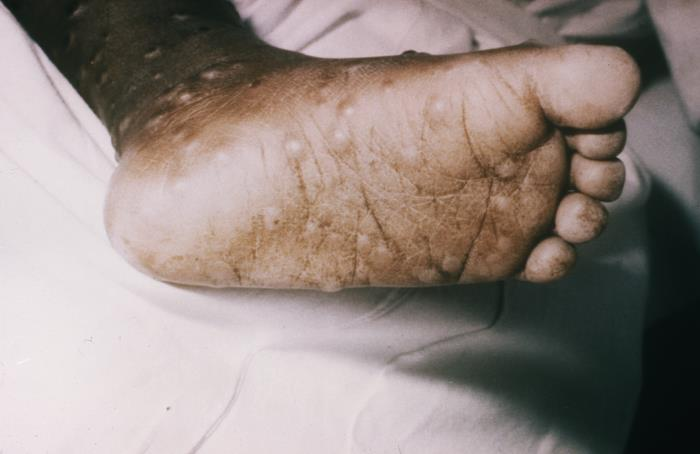
This CDC Public Health Image Library photograph shows the characteristic smallpox rash (maculopapular lesions) on a patient’s foot. Seeing the distinctive lesions helps explain why outbreaks were terrifying and highly disruptive, especially in populations with no prior exposure and no effective early containment. Source
Because these illnesses could pass from one community to another before European armies fully occupied a region, disease often preceded conquest.
In some cases, indigenous communities encountered epidemic disease through trade routes or travelers before they experienced sustained face-to-face contact with Europeans. As a result, the human consequences of overseas expansion could begin before formal colonial rule was established.
Why mortality was so high
Indigenous peoples in the Americas faced a catastrophic immunological disadvantage. Over centuries, many Europeans, Africans, and Asians had developed some resistance to epidemic diseases because those diseases circulated repeatedly in large Old World populations. In contrast, many American societies had not encountered these pathogens before.
Several conditions increased the death toll:
no inherited or acquired immunity to major Old World epidemic diseases
little time to isolate outbreaks or develop effective responses
dense urban centers and imperial road networks that accelerated transmission
famine and social disruption after first epidemics, which weakened survivors
Demographic Collapse
The impact was not a normal wartime loss. In many regions, epidemic disease caused a demographic collapse, meaning a sudden and severe reduction in population over a relatively short time. Estimates vary, but historians agree that mortality was extraordinarily high in many parts of the Americas.
Demographic collapse: A rapid and massive decline in population, often caused by repeated epidemics, warfare, and social disruption.
Mortality was also cumulative. Survivors of one outbreak often faced another within a generation. Children born after the first epidemic remained vulnerable, and shortages of food and care increased the lethality of later disease waves.
This collapse mattered because indigenous societies lost:
farmers who produced food
artisans and laborers who kept cities and villages functioning
political leaders who organized resistance
priests and healers whose authority helped preserve social order
family networks that cared for children, the sick, and the elderly
As communities lost large numbers of people, they became less able to wage war, collect tribute, defend cities, or recover from additional shocks. Disease therefore weakened resistance not only physically but institutionally.
Major examples
Disease shaped some of the most important early encounters between Europeans and indigenous empires.
In the Aztec Empire, smallpox entered central Mexico in 1520 and killed large numbers of people during a moment of military crisis.
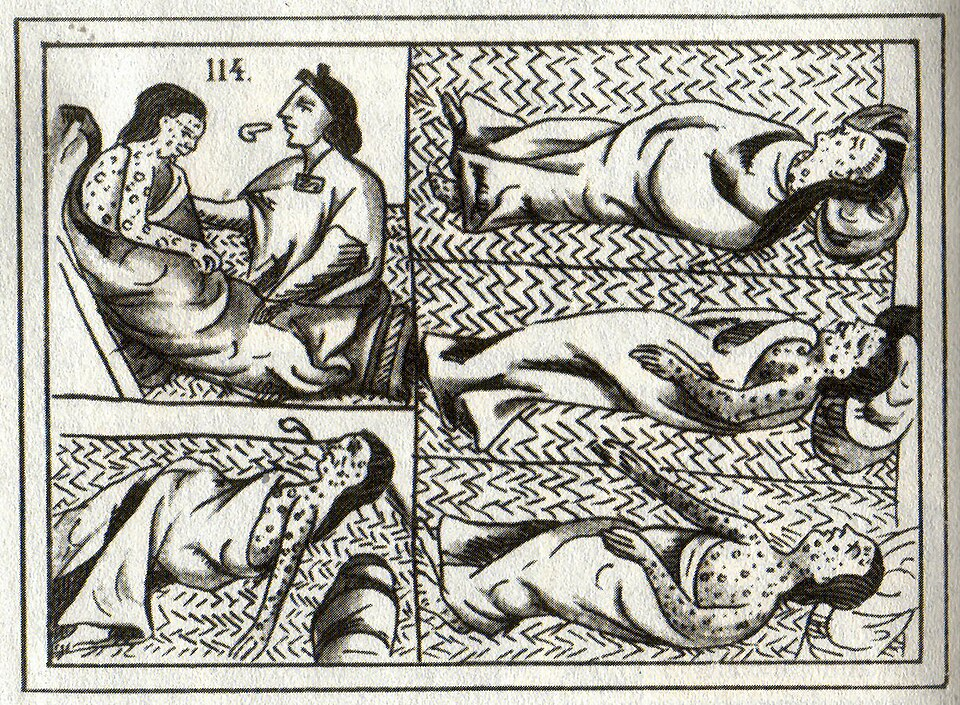
This Florentine Codex illustration depicts people suffering from smallpox during the early conquest period in central Mexico. As a contemporaneous indigenous-source visual record (produced in the 16th century), it helps students connect epidemic disease to social breakdown and heightened vulnerability during military crisis. Source
It contributed to instability in Tenochtitlán and reduced the empire’s capacity to resist Spanish forces and their indigenous allies.
In the Inca Empire, epidemic disease appears to have spread before Francisco Pizarro arrived. The deaths of rulers and nobles worsened a succession struggle, making the empire more vulnerable to Spanish intervention.
These cases show that disease was often a force multiplier: it amplified European advantages and indigenous weaknesses at crucial moments.
Disease and Subjugation
Disease alone did not conquer the Americas, but it made subjugation easier by disrupting the societies Europeans sought to dominate. Europeans exploited epidemic conditions in several ways.
Political and military effects
When leaders died, succession disputes became more likely. When soldiers and porters died, armies shrank. When tribute systems failed, states struggled to feed urban populations and maintain authority. These weaknesses allowed relatively small European forces to impose control more effectively than their numbers alone would suggest.
European conquerors also benefited because:
epidemics could strike indigenous enemies repeatedly
surviving populations were sometimes forced into negotiation from positions of extreme weakness
shattered communities had fewer resources for long-term resistance
colonial authorities could more easily reorganize labor, tribute, and settlement after depopulation
After major outbreaks, colonizers often dealt with smaller, fragmented populations rather than large, intact polities. That shift did not guarantee European victory, but it made domination far more achievable.
Social and psychological effects
Epidemics were terrifying because they were sudden, unfamiliar, and difficult to explain within existing religious or medical frameworks. Repeated outbreaks could undermine confidence in rulers, priests, and traditional rituals if those figures seemed unable to stop the disaster.
The destruction of communities also had cultural consequences. Oral knowledge, ritual leadership, and local memory could be interrupted when elders and specialists died. This made colonial domination more damaging and more permanent, since conquest was no longer only military; it also involved the breakdown of social continuity.
Interpreting Disease in European Expansion
The effect of disease should not be reduced to a simple story of European superiority. The crucial issue was the exchange of pathogens between previously separated worlds.
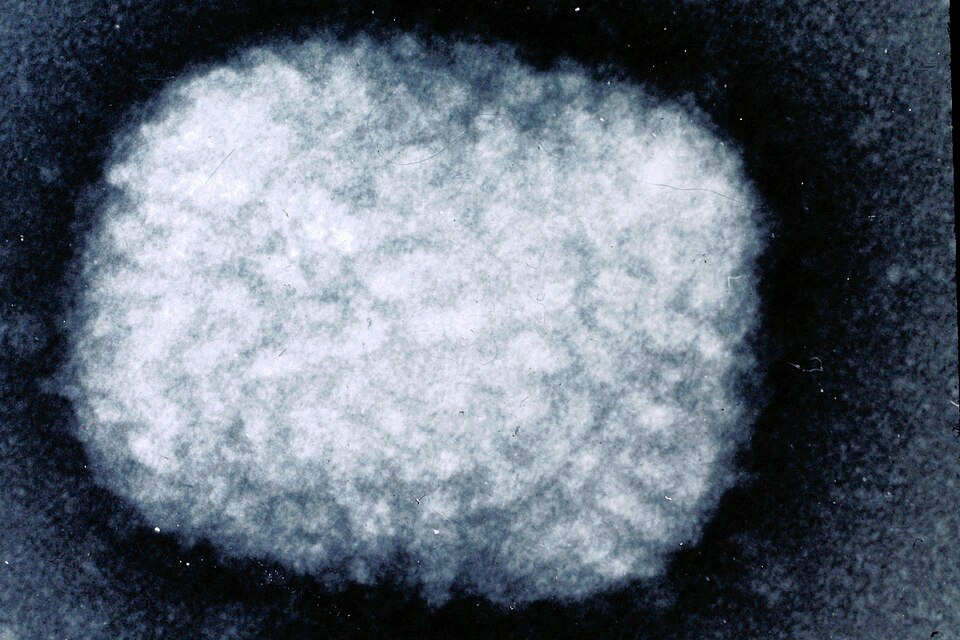
This transmission electron micrograph shows a smallpox (variola) virus particle at microscopic scale. Pairing the pathogen’s physical reality with the historical narrative helps students understand the Columbian Exchange as a biological transfer with profound political and demographic consequences. Source
Europeans did not dominate because disease made resistance impossible everywhere. Rather, epidemics created conditions that Europeans could exploit through warfare, alliances, coercion, and colonial rule.
Uneven outcomes
The impact of disease varied by region, timing, environment, and prior political conditions. Some communities were hit earlier than others. Some recovered partially, relocated, or adapted. Others were devastated by repeated epidemics over generations.
This unevenness matters because it reminds us that indigenous peoples were not passive victims. They resisted, negotiated, fled, rebuilt, and preserved elements of their societies under terrible circumstances. Still, the scale of mortality meant that many peoples faced European expansion after losing a large share of their population, which made destruction and subjugation far more likely.
Historical significance
For AP European History, the key point is that the Columbian Exchange was not only an economic or ecological process. By carrying deadly diseases to the Americas, it altered power relations and helped Europeans defeat, dominate, and in some cases destroy indigenous peoples.
Practice Questions
Identify one reason why Old World diseases had such a devastating impact on indigenous peoples in the Americas, and explain one way this affected European conquest. (2 marks)
1 mark for identifying a valid reason, such as lack of prior exposure or immunity to diseases like smallpox or measles.
1 mark for explaining one effect on conquest, such as population decline, weaker military resistance, loss of leaders, or political instability.
Evaluate the extent to which disease, rather than European military technology alone, explains the subjugation of indigenous peoples in the Americas in the sixteenth century. (6 marks)
1 mark for a clear thesis or line of argument about the importance of disease.
1 mark for explaining how epidemic disease caused major population loss.
1 mark for explaining how disease weakened leadership, labor systems, or military resistance.
1 mark for using a specific historical example, such as the Aztec or Inca case.
1 mark for addressing another factor, such as alliances, weapons, or strategy.
1 mark for a supported judgment that weighs disease against other causes.
FAQ
Smallpox spread efficiently through close contact and contaminated materials such as bedding and clothing. It caused high fever, pain, and a severe rash, and many survivors were left weakened or scarred for life.
Its wider effect came from timing. When many people fell ill at once, communities lost carers as well as patients. Children, elders, and already malnourished people were especially vulnerable, so mortality could rise beyond the disease itself.
Most sixteenth-century Europeans did not understand infection in modern scientific terms. Germ theory did not exist, and people often explained illness through humoral imbalance, divine judgement, bad air, or astrology.
Some observers did recognise a pattern: newcomers arrived, then sickness followed. However, noticing that link was not the same as understanding microbial transmission, so colonial authorities rarely adopted measures that would have prevented epidemic spread.
Reliable pre-contact population counts are rare, and many records from the first colonial decades were produced during chaos, warfare, and forced movement.
Historians therefore piece evidence together from several sources:
archaeology
tribute records
parish registers
eyewitness accounts
environmental data
Disagreement comes from different starting estimates and different ways of measuring deaths caused directly by disease versus deaths linked to famine, displacement, and violence.
A “virgin-soil epidemic” is an outbreak that strikes a population with no previous exposure to a disease, leaving people without collective experience of how to respond and with little or no immunity.
Some historians still find the term useful. Others criticise it because it can sound too biological and passive, as if microbes alone explain the catastrophe. The phrase may understate the roles of conquest, hunger, forced migration, and colonial violence in making epidemics so deadly.
Colonial regimes often concentrated surviving indigenous people into mission towns, labour centres, or tribute-paying communities. This made taxation and conversion easier, but it also increased contact between households and regions.
These arrangements could:
speed transmission
expose people to repeated outbreaks
reduce access to traditional food sources
weaken local methods of isolation and care
So disease was not only a first-contact event; colonial rule itself could help sustain epidemic conditions.