AP Syllabus focus:
'Colonial expansion spread goods, cultural practices, and diseases, while contributing to indigenous destruction and the growth of the slave trade.'
European expansion after 1492 connected continents in new ways, but those connections were deeply unequal. Exchange brought new goods and beliefs across oceans, yet it also produced conquest, demographic collapse, and coerced labor.
Cultural Exchange in an Unequal World
Colonial expansion linked Europe, Africa, and the Americas more closely than ever before. Goods did not travel alone; they carried habits, technologies, religious ideas, and assumptions about authority. European weapons, metal tools, textiles, livestock, and Christian objects entered overseas societies, while American products altered European consumption and daily life. Historians often describe this wider process as the Columbian Exchange.
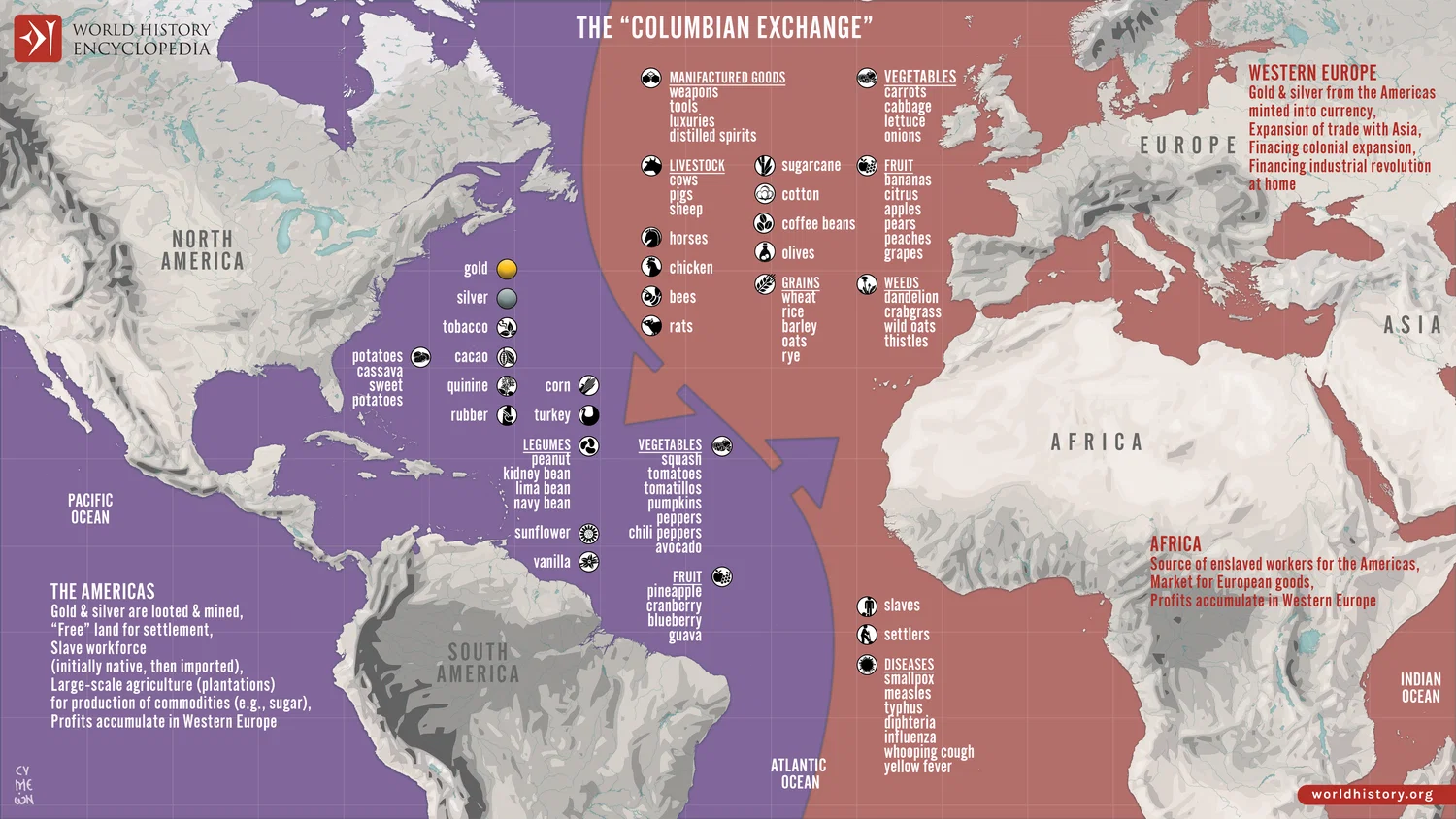
This diagram summarizes the Columbian Exchange by tracing major biological transfers between the Americas and Afro-Eurasia after 1492. It highlights how staple crops and domesticated animals moved across the Atlantic alongside pathogens, helping explain why “exchange” could generate prosperity for some regions while producing catastrophe for others. The directional arrows make the system’s asymmetry and global scale easy to visualize. Source
Columbian Exchange: The wide transfer of goods, peoples, diseases, and cultural influences between the Eastern and Western Hemispheres after 1492.
The word exchange can be misleading because the movement of culture usually took place under unequal conditions shaped by European military and political power.
Religion, language, and daily customs
Missionaries, settlers, and colonial officials tried to spread Christianity, European languages, and new social rules. Churches, schools, and courts became tools of cultural change. Conversion campaigns encouraged new marriage practices, baptismal names, and religious calendars. European dress, architecture, and agricultural routines also appeared in colonial towns and mission settlements.
At the same time, indigenous peoples did not simply abandon older traditions. They often adapted European elements to local needs or combined them with existing beliefs. Many colonial societies developed blended practices rather than complete cultural replacement. This blending is often called syncretism.
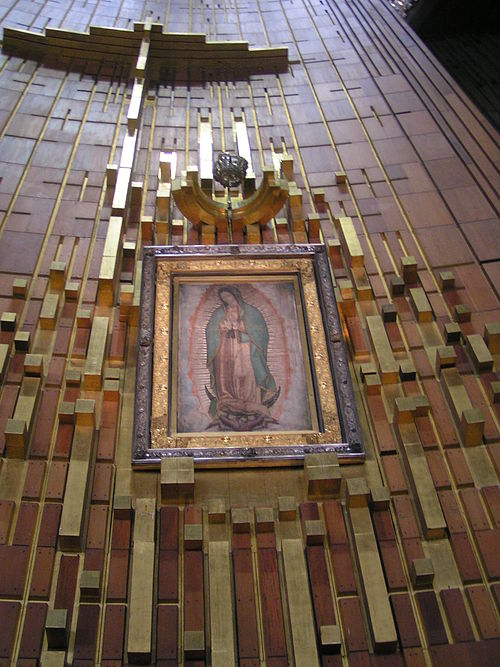
This photograph shows the venerated image of Our Lady of Guadalupe displayed at the Basilica in Mexico City, a central symbol of Catholic devotion in colonial and postcolonial Mexico. In historical terms, it can be used to discuss how Christianity in the Americas often developed through local reinterpretations and blended practices rather than simple replacement. The image provides a concrete anchor for analyzing religious change under colonial rule. Source
Syncretism: The blending of different religious or cultural traditions into a new form.
Syncretism shows that cultural contact could be creative, but it still unfolded within systems of conquest and domination. Exchange took place in ports, villages, households, and plantations, where interpreters, merchants, clergy, and laborers all shaped new colonial cultures.
Indigenous Destruction Beyond Military Conquest
The most devastating result of colonial expansion was the destruction of many indigenous societies. Disease was a major cause. Old World epidemics spread rapidly among populations with no previous exposure, weakening communities before or during conquest. Yet indigenous destruction was not only biological. Colonial rule also damaged political structures, social hierarchies, and sacred traditions.
This destruction included:
severe population decline
seizure of land and resources
weakening of traditional leadership
forced changes in religion and ritual
disruption of local economies and family life
European expansion also transformed the environment in ways that harmed indigenous communities. New animals, especially grazing livestock, changed land use and damaged fields. Colonial settlements redirected water, labor, and trade. In some places, people were forced into new villages or labor systems, breaking older ties to land and community. Sacred spaces were destroyed, repurposed, or brought under colonial supervision.
Why cultural loss mattered
Indigenous destruction involved more than death on a massive scale. It also meant the weakening of memory, language, and identity. Oral traditions could be interrupted when elders died. Native languages declined when colonial authorities favored European speech in churches and courts. Systems of tribute, exchange, and local justice were replaced by colonial demands. Even where indigenous peoples survived, survival often required adaptation under extreme pressure.
This is why historians treat colonial expansion as both a demographic and a cultural catastrophe. A people could remain physically present while losing control over religion, land, labor, or political authority.
Enslavement and the Growth of the Slave Trade
Colonial expansion increased demand for labor in mines, plantations, and colonial households. Europeans first exploited indigenous labor in many regions, but war, disease, and harsh working conditions reduced those populations dramatically. Colonial economies therefore turned increasingly to enslaved Africans, connecting American production to African captivity and Atlantic transport.
The resulting slave trade became one of the central institutions of colonial expansion.
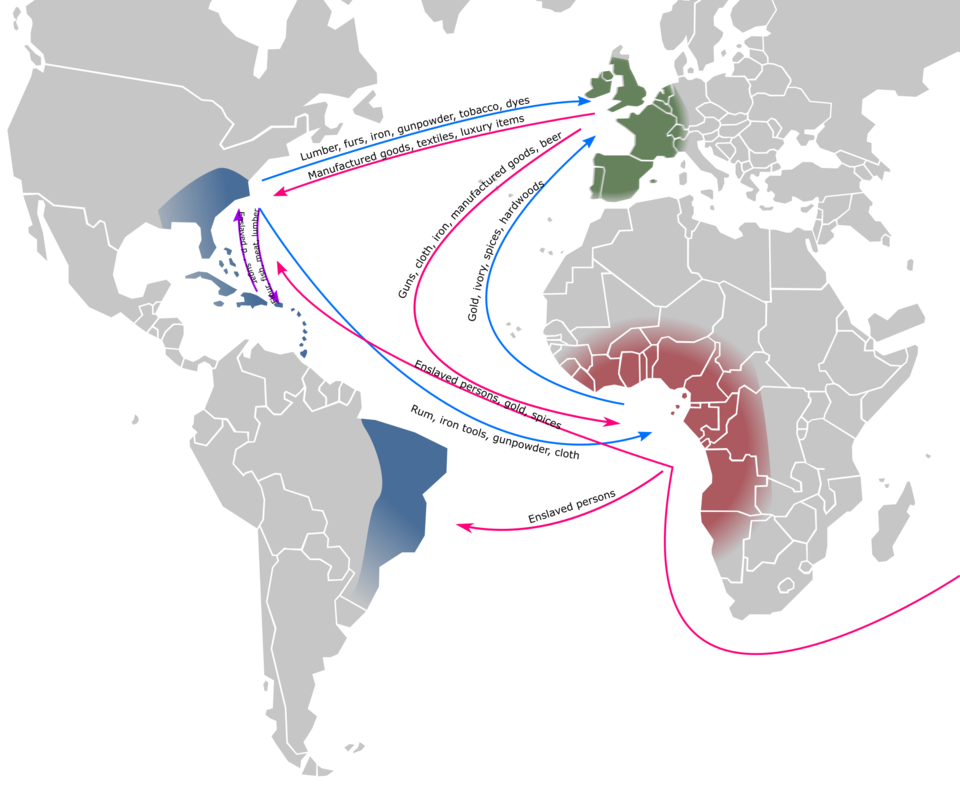
This map depicts the triangular trade routes linking European ports, West African coasts, and plantation regions in the Americas. By labeling routes and commodities, it shows how Atlantic commerce integrated distant regions into a single system built in part on the forced transport of enslaved Africans. The geographic framing helps explain how colonial economies depended on maritime networks and coerced labor. Source
European merchants, colonial planters, and other participants built a system that treated human beings as property. Enslavement tore millions from their communities and forced them into violent labor regimes designed to enrich empires.
Colonial expansion also encouraged ideas that tried to justify slavery. Europeans increasingly linked labor status to ancestry and physical difference, helping create more rigid racial hierarchies in colonial societies. These beliefs gave moral cover to exploitation and made slavery appear permanent and inheritable.
Coerced exchange and cultural survival
The slave trade produced cultural exchange, but in a profoundly coercive form. Enslaved Africans carried farming knowledge, foodways, musical forms, craftsmanship, and religious traditions to the Americas. These influences shaped colonial societies in lasting ways. At the same time, capture, sale, transport, and forced labor shattered families and communities.
Indigenous peoples and enslaved Africans were not passive. They resisted through flight, rebellion, preservation of language, hidden ritual practice, negotiation, and the formation of new communities. Their survival and resistance reveal that colonial expansion spread culture through force as well as contact.
Practice Questions
Identify ONE way colonial expansion contributed to indigenous destruction. (2 marks)
1 mark for identifying a valid way, such as the spread of epidemic disease, seizure of land, destruction of religious sites, or forced labor.
1 mark for explaining how that factor weakened indigenous societies or made European control easier.
Evaluate the extent to which colonial expansion from 1450 to 1700 should be understood more as a process of coercion and destruction than as a process of cultural exchange. (6 marks)
1 mark for a defensible thesis that addresses both cultural exchange and coercion/destruction.
1 mark for relevant broader context, such as overseas expansion after 1492 or growing Atlantic connections.
2 marks for specific evidence, such as spread of Christianity, syncretic practices, epidemic disease, seizure of land, forced labor, or the growth of the slave trade.
2 marks for analysis and reasoning, such as explaining the unequal balance of power, weighing exchange against violence, or showing how cultural blending occurred within imperial domination.
FAQ
Missionaries left some of the fullest written descriptions of indigenous beliefs, rituals, and daily life during early colonisation.
They are valuable because they sometimes recorded languages, ceremonies, and local customs that might otherwise be poorly documented. However, they were often hostile to non-Christian traditions, so their accounts can exaggerate ‘idolatry’ or treat conversion as more complete than it really was.
Historians therefore use them carefully and compare them with archaeology, indigenous traditions, and legal records.
Interpreters were often crucial figures in first contact, negotiation, and conversion. They translated words, but they also shaped meaning.
Because they understood more than one culture, interpreters could:
ease alliances
reduce conflict
mislead either side
advance their own interests
In many cases, colonial rule depended on these intermediaries. Without them, missionaries, officials, and merchants would have struggled to govern or persuade local populations.
Food was one of the most immediate areas of cultural blending. Colonists, indigenous peoples, and Africans all adapted ingredients and cooking methods from one another.
Examples include:
European use of American crops such as maize and cacao
African influence on preparation techniques and seasonings
mixed colonial diets combining wheat, pork, beans, cassava, and local produce
These food changes mattered because they affected everyday life across class lines and often preserved cultural memory even where political power was unequal.
Practices that could be shared collectively or adapted privately often survived more effectively. Music, rhythm, dance, storytelling, healing knowledge, and some religious customs could be passed on even under severe repression.
Survival depended on factors such as:
the size of the enslaved population
whether people from similar regions were kept together
the harshness of local slave regimes
opportunities for gathering and worship
Cultural survival was not static; many traditions changed form while retaining important African elements.
These laws helped colonial authorities reshape identity at the personal level. Baptismal records, Christian marriage rules, and European naming practices made it easier to classify, tax, convert, and monitor subject populations.
They also weakened older kinship systems by placing family life under church or state supervision.
Even so, people sometimes used these rules strategically:
to gain legal recognition
to protect children
to secure property claims
to navigate colonial hierarchies
So legal control and local adaptation often existed side by side.