AP Syllabus focus:
'The Columbian Exchange brought new plants, animals, and diseases that created important economic opportunities for Europeans.'
The Columbian Exchange reshaped European economies by turning unfamiliar crops, animals, and disease patterns into new sources of food, profit, investment, and control across the Atlantic world.
Economic meaning of the exchange
The Columbian Exchange was not just a movement of goods; it was a transfer of living things that altered production itself.
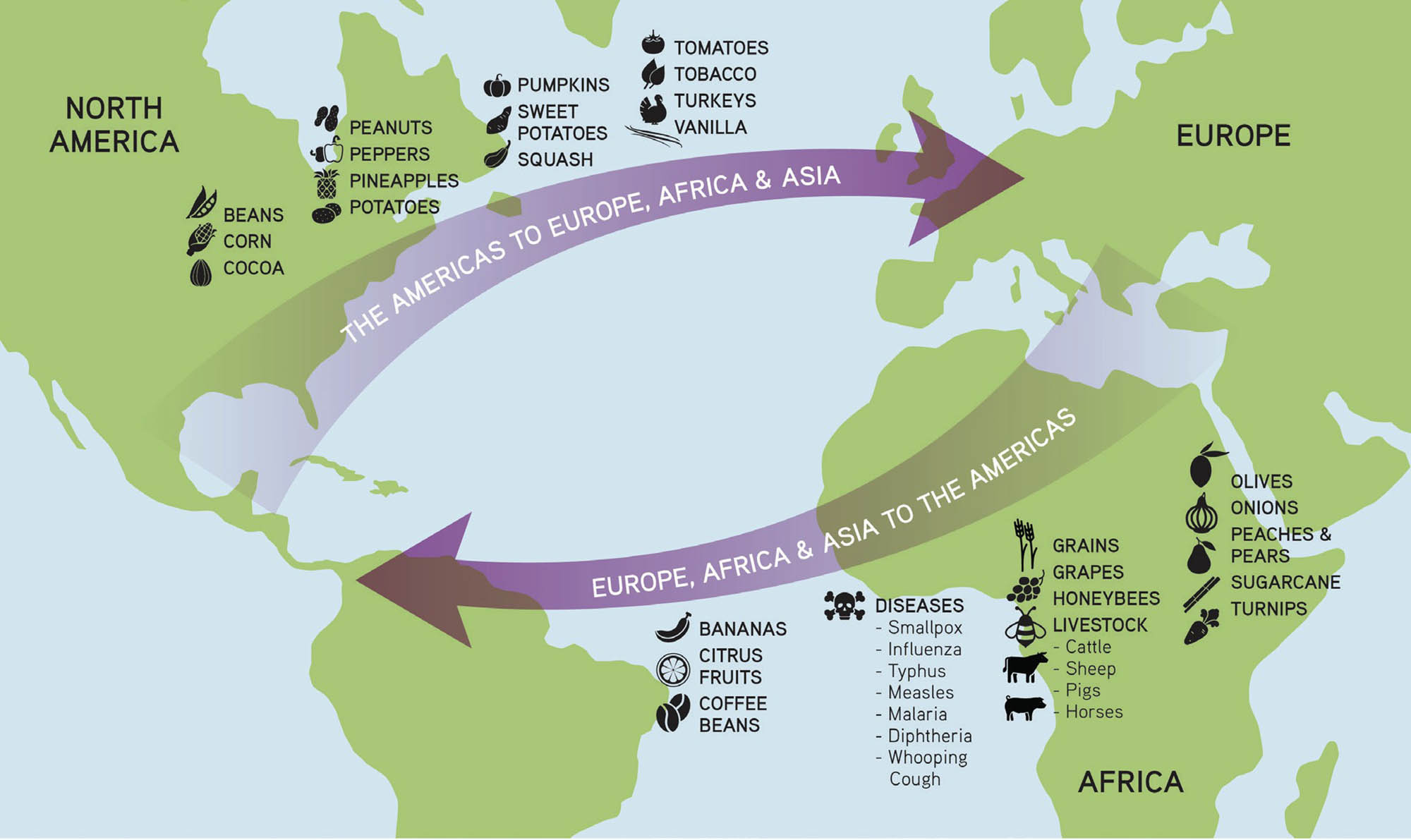
This map summarizes the two-way flow of organisms across the Atlantic after 1492, visually separating New World crops moving to Europe/Africa/Asia from Old World crops, livestock, and diseases moving to the Americas. The labeled categories make it easy to connect specific transfers (for example, potatoes and maize) to changes in European food supply and market demand. It also highlights how microbes traveled with people and goods, linking biology to shifts in labor and power. Source
Europeans encountered American crops such as maize, potatoes, cacao, and tobacco, while also moving European animals and microbes into the Americas. These biological changes mattered economically because they created new commodities to sell, new diets to sustain larger populations, and new possibilities for using land more intensively. In early modern Europe, economic opportunity often meant the chance to increase agricultural output, open profitable trades, or gain access to resources that could be taxed by states or exploited by private investors.
Columbian Exchange: The transatlantic transfer of plants, animals, diseases, and people after 1492.
New plants and food supply
American crops created opportunities first by changing Europe’s food base.
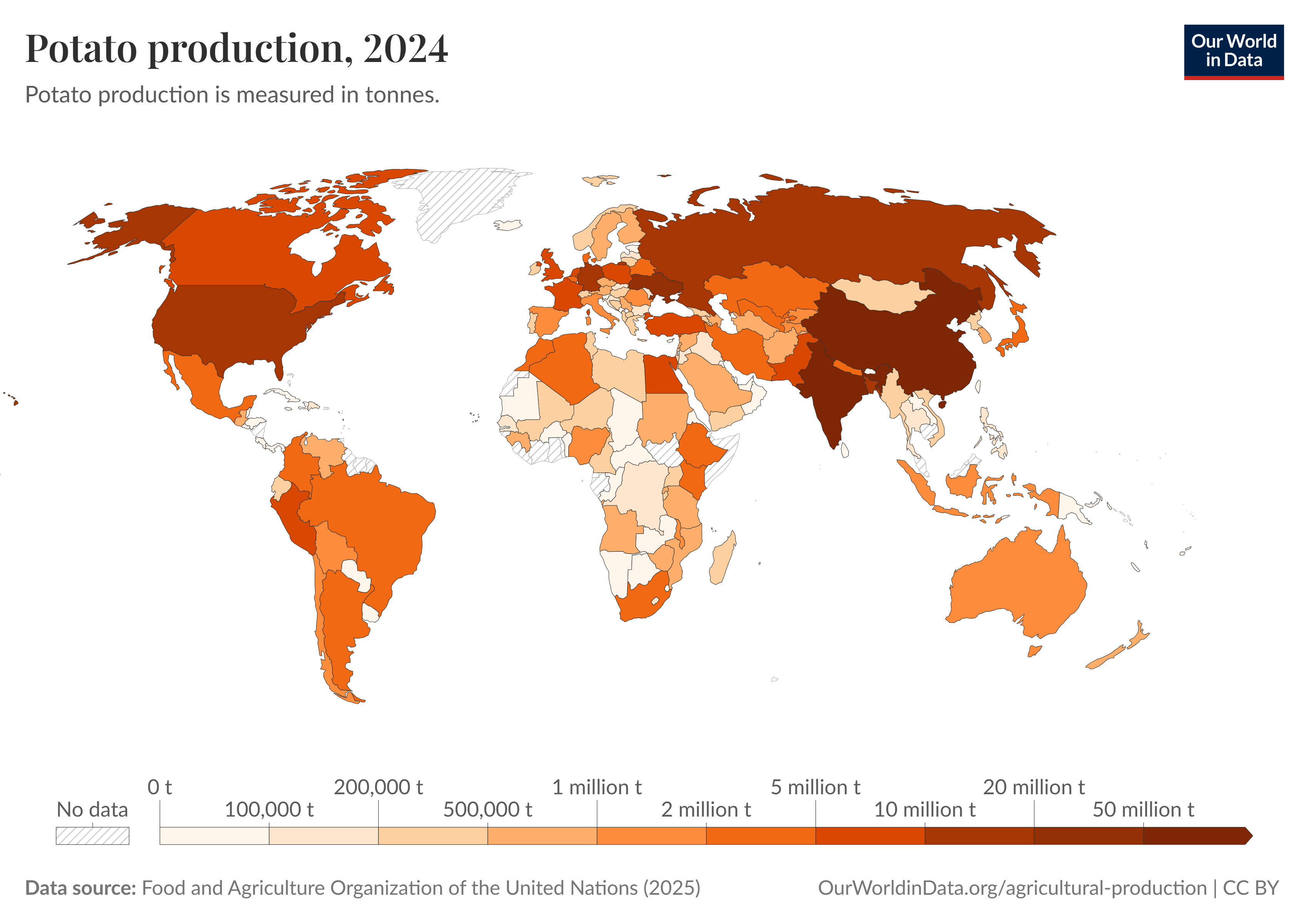
This time-series chart shows potato production over the modern era using UN FAO data (as presented by Our World in Data), illustrating how a New World crop became embedded in large-scale agriculture worldwide. For your notes, it functions as quantitative reinforcement for the claim that potatoes helped expand the food base and support population and labor growth. Use it to practice linking staple-crop adoption to broader economic capacity (surplus, urbanization, and market integration). Source
The potato and maize were especially important because they produced large amounts of calories and could grow in environments where older grains were less reliable. Over time, these crops helped many communities support more people from the same amount of land. That mattered economically: a stronger food supply could support population recovery, expand the labor force, and reduce the pressure to use all land for traditional cereals.
New crops also gave farmers more flexibility. Maize spread effectively in parts of southern and eastern Europe, while potatoes later became valuable in cooler and wetter regions. This did not create wealth instantly, but it widened the agricultural base on which wealth could be built. Peasants, landlords, and local markets all stood to benefit when food supplies became more dependable. A larger and better-fed population could also support urban growth, military recruitment, and expanding commercial activity.
Colonial commodities and commercial profit
New plants also created opportunities because Europeans could grow and sell them as high-value colonial products. Tobacco became a major commercial success because European consumers developed a strong and repeated demand for it. Cacao could be imported, processed, and marketed for profit. Even plants not originally native to the Americas, such as sugarcane, became far more profitable when transplanted into American environments with abundant land. The exchange therefore increased the scale of production and tied agriculture closely to long-distance trade.
European investors increasingly favored the cash crop model.
Cash crop: A crop grown mainly for sale on the market rather than for direct local consumption.
This encouraged merchants, shipowners, insurers, warehouse operators, and retailers to profit alongside planters. One imported product could generate income at multiple stages: cultivation overseas, shipment across the Atlantic, processing in Europe, and final sale to consumers. Governments also saw opportunity in customs duties, licenses, and monopoly grants. The Columbian Exchange therefore expanded not only what Europeans consumed, but also how many kinds of work and investment could be connected to overseas production.
Animals and productive land use
European animals created another set of economic openings. Cattle, sheep, horses, and pigs reproduced rapidly in many American environments and helped Europeans use colonial land in ways that generated profit. Ranching supplied meat, hides, tallow, and wool. Horses increased mobility and made it easier to manage large estates or move goods over distance. Draft animals could raise productivity by pulling plows and carts.
For European settlers and investors, this meant that overseas land could support both farming and animal husbandry on a large scale. Livestock turned territory into a source of tradable products, especially when herds expanded with relatively low labor costs. In this way, transferred animals became economic assets rather than merely tools of survival.
Disease and access to resources
Diseases carried from Europe to the Americas had economic consequences as well.
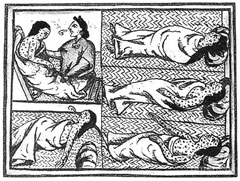
This historical illustration depicts Indigenous people suffering from smallpox, a disease that spread widely in the Americas after European contact. Visually, it helps students grasp how epidemic disease could rapidly undermine communities, disrupting labor systems and political control. In economic terms, the image reinforces why demographic collapse could translate into land seizure, coerced labor, and redirected production toward European markets. Source
Epidemics weakened or destroyed many indigenous communities, disrupting existing systems of farming, tribute, and political control. For Europeans, this tragic collapse created openings to seize land, extract wealth, and redirect labor toward enterprises that served European interests. Disease did not create profit by itself, but it reduced resistance to European occupation and lowered the costs of imposing new economic systems.
In practical terms, weakened indigenous societies made it easier for Europeans to gain access to fertile land, mines, and local systems of production. The key point is that biological exchange and economic opportunity were directly connected: microbes reshaped power, and shifts in power often became shifts in ownership, labor control, and revenue.
Distribution of benefits
The opportunities created by the Columbian Exchange were not shared equally. Merchants, landowners, colonial settlers, and states often gained more than ordinary rural workers. Those with access to capital could finance voyages, buy imports in bulk, or invest in overseas production. Even so, the broader European economy still felt the effects. New foods could sustain larger populations, colonial crops fed consumer demand, and animal products enlarged profitable trade.
Economic change therefore occurred at several levels at once:
households gained access to new foods
investors gained new commodities and overseas land
governments gained taxable imports and commercial revenue
urban trades benefited from shipping, processing, and retailing
What made the Columbian Exchange especially important was that it turned biological transfers into recurring commercial opportunities. Europeans were not simply discovering new goods; they were building systems of production and exchange around them.
Practice Questions
Identify ONE crop transferred through the Columbian Exchange that created an economic opportunity for Europeans and briefly explain how it did so. (2 marks)
1 mark for identifying a valid crop such as potato, maize, tobacco, or cacao.
1 mark for explaining how it created an economic opportunity, such as improving food supply, supporting population growth, or generating profitable trade.
Analyze how the Columbian Exchange created economic opportunities for Europeans in the period c. 1492 to 1700. (5 marks)
1 mark for making a historically defensible claim about how the exchange created economic opportunities.
1 mark for explaining how new food crops such as potatoes or maize strengthened Europe’s agricultural base.
1 mark for explaining how colonial products such as tobacco, cacao, or sugar generated profits through trade or processing.
1 mark for explaining how transferred animals such as cattle or sheep created profitable forms of production.
1 mark for explaining how epidemic disease weakened indigenous control and made resources easier for Europeans to exploit.
FAQ
Potatoes were highly useful in regions with poor soils, cool temperatures, or small farm plots. They produced a large food return from limited land.
In places where peasants had little room to expand grain farming, potatoes could support households more efficiently. That made them especially attractive in densely populated or marginal areas.
Tobacco combined several advantages:
strong consumer demand
repeat purchases
relatively high value compared with its bulk
easy taxation by governments
Because many consumers bought it regularly, merchants could expect continuing sales rather than one-time purchases. That made tobacco especially attractive for investors and states.
Raw sugar often needed further processing before sale. That created work in European port cities for:
refiners
dockworkers
coopers
merchants
shippers
It also encouraged re-export trade, since refined sugar could be sold on to other markets. Profit therefore did not depend solely on plantation ownership.
No. Some foods spread slowly because Europeans were uncertain about how to grow, cook, or classify them. New plants could be viewed with suspicion before people understood their value.
Acceptance often increased when populations faced food shortages, war, or pressure on land. Practical usefulness usually mattered more than curiosity alone.
These animal products were useful in everyday production. Hides could be turned into leather goods, while tallow was important for candles and soap.
They were also easier to transport and store than some fresh foods. That made them especially suited to long-distance trade and helped ranching become commercially worthwhile.