AP Syllabus focus:
'Religious reform increased state control of churches while also giving people new reasons to challenge political authority.'
Religious change in the sixteenth and seventeenth centuries did more than alter belief. It reshaped governance, church organization, and the political language Europeans used to justify obedience, criticism, and resistance.
Religion and political authority after reform
Before the Reformation, the western Church claimed authority that crossed political borders. Popes, bishops, church courts, and monasteries formed an international religious structure that rulers could influence but not fully control. Once reform fractured Christian unity, that situation changed. Princes, kings, town councils, and representative bodies had to decide which confession would operate in their territories and how religious life would be supervised.
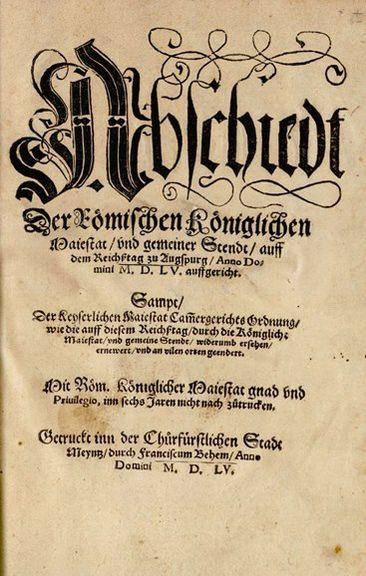
Title/heading page from a 1555 printed edition of the Augsburg imperial recess (the Peace of Augsburg), which legalized the coexistence of Lutheranism and Catholicism in the Holy Roman Empire while empowering territorial rulers to determine the official confession in their lands. As a visual primary source, it highlights how religious settlement was implemented through law, print, and government institutions rather than remaining only a theological dispute. Source
Religion therefore became tied more closely to political power. Early modern rulers believed religious unity promoted social order, loyalty, and stable government. If subjects worshiped differently, rulers feared disorder, disobedience, or outside influence. As a result, reform encouraged governments to intervene more deeply in church affairs than many medieval rulers had done.
How religious reform increased state control
Building territorial churches
In many parts of Europe, rulers used reform to create state churches or churches closely supervised by secular authority.
State church: A church officially supported, organized, or controlled by the government of a territory or kingdom.
This could involve appointing clergy, directing church policy, approving liturgy, and controlling church courts. Secular governments also gained access to wealth once held by monasteries, bishops, or other church institutions. That transfer of property strengthened rulers financially and symbolically, because it showed that political authority could now reach into areas once dominated by the Church.
In England, for example, the monarchy asserted supremacy over the national church.
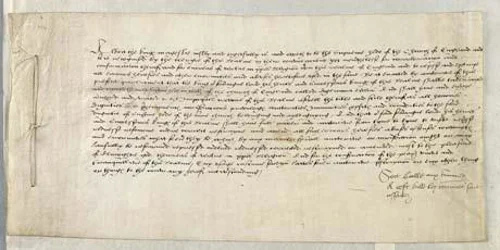
UK Parliament’s collection entry for the 1534 Act of Supremacy, the statute that declared Henry VIII supreme head of the Church of England and severed institutional ties with Rome. It exemplifies how reform-era religious change could be enacted through formal legislation, expanding the state’s authority over doctrine, governance, and ecclesiastical administration. Source
In many German territories, princes who adopted reform supervised church organization within their lands. These arrangements did not make religion less important; instead, they made religion more directly dependent on the state.
Using religion to strengthen government
Religious reform also helped rulers expand administration. Governments could require ministers to preach approved doctrines, teach obedience, and help enforce moral discipline. Officials inspected parishes, monitored clergy, and used churches to communicate policy to local communities. Religious change thus supported the broader growth of territorial government.
Historians often describe this pattern as confessionalization.
Confessionalization. The process by which governments and churches worked together to enforce a particular confession and discipline society more closely.
Through this process, rulers did not simply choose a faith; they used religion to organize education, poor relief, marriage rules, and public behavior. Religious conformity became part of political loyalty.
Why reform encouraged resistance
Religious reform also gave Europeans new reasons to question rulers. Once political authority claimed responsibility for defending the true faith, subjects could judge whether rulers were doing that job properly. If a monarch imposed the wrong religion, interfered with God’s law, or attacked a community’s worship, opposition could be presented as a religious duty rather than mere rebellion.
The spread of preaching and vernacular religious texts strengthened this tendency. More people could compare political actions with scripture or with the teaching of their own confession. This did not create modern democracy, but it did widen debate over when obedience had limits. Religious commitment could now conflict with political commands in a direct and personal way.
Some writers developed resistance theory to explain when opposition to rulers was lawful.
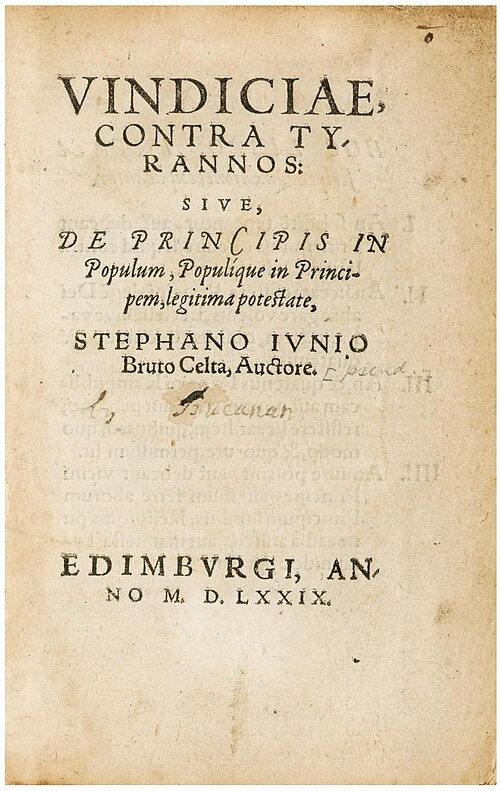
Title page of the 1579 tract Vindiciae contra tyrannos (“Defenses against tyrants”), a landmark work in early modern resistance theory associated with Huguenot political thought. The image underscores how debates over obedience, legitimate authority, and the defense of “true religion” were articulated through widely circulated print, not only through sermons or court politics. Source
Resistance theory: The argument that subjects, or lower political authorities, could legitimately oppose a ruler who violated divine law or endangered true religion.
A key idea was that obedience was not unlimited. If rulers were expected to protect true religion, then failure to do so could weaken their legitimacy. In some versions of this argument, lesser magistrates such as nobles, princes, or city councils had a duty to defend their communities against an ungodly superior ruler. This helped turn religious disagreement into a political argument about lawful authority.
Forms and limits of resistance
Religiously motivated resistance did not always mean open revolt. It could include petitions, refusal to conform, defense of local privileges, appeals to representative institutions, or organized opposition led by elites. Religion supplied moral language that made political resistance appear principled and just.
At the same time, most reformers feared disorder. Many insisted that ordinary believers should obey civil authorities in most circumstances. Even when resistance was defended, it was usually framed narrowly: as protection of God’s law, ancestral rights, or lawful institutions, not as a general right of every individual to overthrow a government.
This tension is central to the period. Religious reform strengthened rulers by giving them greater control over churches, clergy, and moral discipline. Yet the same reform weakened unquestioned obedience by making faith, conscience, and legitimate authority matters of intense public dispute. Political power became more centralized, but it also became more vulnerable to religiously justified challenge.
Practice Questions
Identify one way religious reform increased state control over churches in the sixteenth century. Then explain one reason this change strengthened rulers. (3 marks)
1 mark for identifying a valid method, such as rulers appointing clergy, controlling church courts, seizing church property, or creating a state church.
1 mark for giving a specific example, such as the English monarchy asserting supremacy over the church or German princes supervising territorial churches.
1 mark for explaining how this strengthened rulers, such as by increasing revenue, expanding administration, or linking religious conformity to political obedience.
Evaluate the extent to which religious reform encouraged resistance to political authority in early modern Europe. (6 marks)
1 mark for a clear thesis that addresses both resistance and the continued strengthening of rulers.
1 mark for relevant contextualization about the pre-Reformation Church or the importance of religious unity to political order.
1 mark for specific evidence showing increased state control, such as state churches, royal supremacy, or territorial church organization.
1 mark for specific evidence showing new grounds for resistance, such as vernacular scripture, resistance theory, or the role of lesser magistrates.
1 mark for analysis explaining how legitimacy became tied to defending the “true” faith.
1 mark for complexity, such as showing that reform both centralized power and undermined unquestioned obedience, or distinguishing elite-led resistance from broader popular opposition.
FAQ
Erastianism was the idea that the state should hold supreme authority over the Church in external matters such as discipline, governance, and law.
It mattered because it gave rulers a theory for supervising religion without treating religion as unimportant. In places where this view gained influence, monarchs and magistrates could justify appointing clergy, regulating worship, and settling disputes as part of ordinary government.
Religious exiles often lived in foreign cities where they encountered different political systems, printing networks, and fellow believers from other regions.
These communities exchanged pamphlets, sermons, and legal arguments. Distance from home sometimes made their views sharper, and exile encouraged them to think about when obedience ended and conscience began. Their writings could then be smuggled back across borders.
Loyalty oaths required subjects to declare support for a ruler’s religious settlement in public and legal form.
That made disagreement more dangerous. Refusing an oath could look like treason, but taking one could feel like a betrayal of conscience. Oaths therefore turned inward belief into a visible political test, forcing people to choose between safety, honour, and faith.
Urban governments already controlled many parts of daily life, including markets, charity, schooling, and public order. That made them well placed to manage religious change too.
Cities also had printers, educated elites, and active preaching. Because town councils could move quickly and had local legitimacy, they often became key arenas where religious policy and political authority were negotiated together.
Royal marriages could raise fears that foreign influence would shape domestic religion. A Catholic spouse or Protestant spouse might be seen as more than a family matter; it could signal future policy.
Marriage alliances also affected succession. If subjects feared the heir would follow a different confession, debate about religion could become debate about lawful rule, loyalty, and the future direction of the state.