AP Syllabus focus:
'Religious conflict overlapped with political and economic rivalry, while new ideas of sovereignty shaped emerging state institutions.'
In the sixteenth and seventeenth centuries, Europeans fought over religion, dynastic power, and trade at the same time.
These struggles weakened older universal authorities and encouraged rulers to build stronger territorial states.
Overlapping Sources of Conflict
Religious disagreement did not appear in isolation. In early modern Europe, rulers, nobles, and urban elites often used confessional divisions to pursue older struggles over land, privilege, taxation, and influence. A prince might support reform out of sincere belief, but also to resist outside control. A monarch might defend traditional religion not only on spiritual grounds, but also to strengthen legitimacy and obedience.
Three forces often operated together:
Religious conflict gave political disputes a moral and emotional intensity.
Political rivalry pushed dynasties and territorial rulers to block the expansion of their neighbors.
Economic competition made ports, trade routes, tax revenues, and productive regions especially valuable.
Because these motives overlapped, conflicts that appeared purely religious were often also contests for power.
This is why alliances could be unexpected. Shared faith did not always guarantee cooperation, and rulers sometimes worked with states of a different confession when strategic advantage mattered more.
This overlap is essential for understanding the period. Europeans did not move neatly from religious concerns to political ones. Instead, rulers and states acted in a world where religion, power, and wealth were tightly connected.
Sovereignty and the Decline of Universal Authority
One of the most important developments of the era was the growing importance of sovereignty.
Sovereignty: The principle that a ruler or state possesses supreme authority within its own territory and is not legally subject to an outside power such as a pope, emperor, or foreign prince.
This idea challenged the medieval vision of Europe as a single Christian commonwealth guided by universal institutions. Earlier political culture had recognized broad claims by the papacy and the Holy Roman Emperor, but the crises of the Reformation era weakened confidence in any single authority that could unite all Christians.
As sovereignty gained force, rulers increasingly claimed the right to govern the key functions of power inside their own lands:
making and enforcing laws
collecting taxes
raising armies
supervising churches
preserving public order
Sovereignty did not mean that rulers suddenly had complete control. Local privileges, noble rights, and representative bodies still limited many governments. However, the direction of change was clear: authority was becoming more territorial, more concentrated, and more closely tied to the institutions of the state.
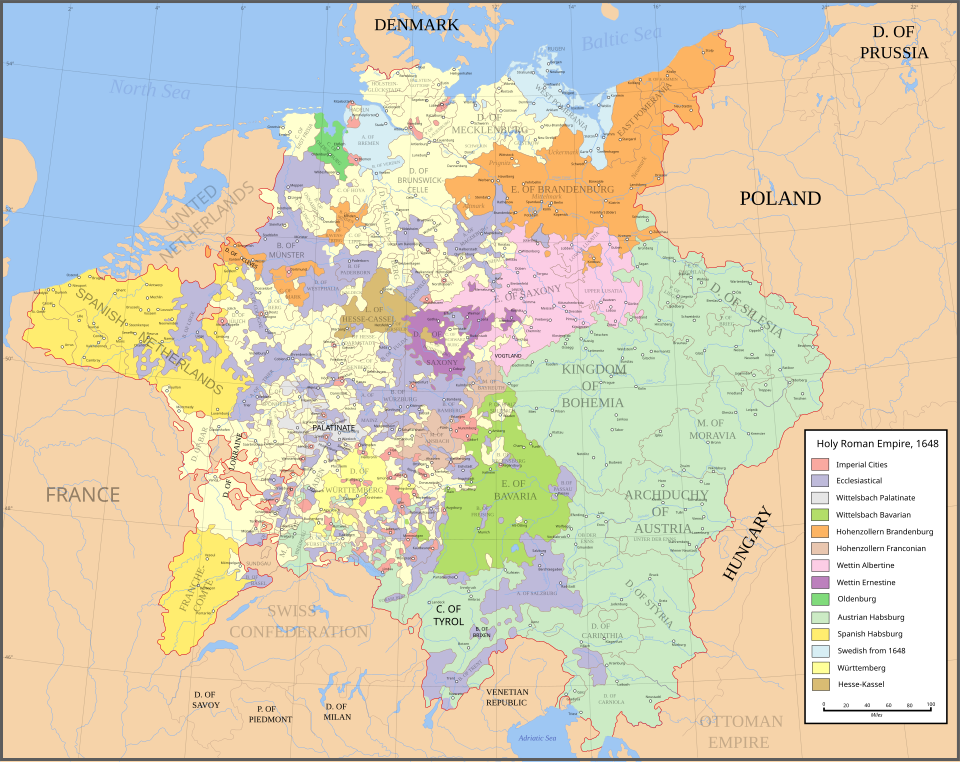
This map depicts the Holy Roman Empire in 1648, emphasizing its extreme political fragmentation into many semi-autonomous territories. Seeing the imperial landscape as a mosaic of jurisdictions clarifies why early modern rulers prioritized territorial control, administration, and legal authority within bounded spaces. It also helps explain how “universal” claims (imperial or papal) struggled to function effectively amid competing local powers. Source
Conflict and the Growth of State Institutions
Religious and political competition pushed rulers to develop stronger state institutions, meaning the offices, procedures, and personnel through which governments operated. War was expensive and continuous enough to require more than temporary improvisation.
Taxation and Finance
Conflict demanded reliable revenue. Governments expanded systems for tax collection, borrowing, and accounting. Even where rulers still depended on local elites or assemblies to approve taxes, war increased pressure for more regular fiscal administration. States that could gather money efficiently were better able to compete.
This made financial administration more important to government. Officials who could count resources, supervise collection, and track expenditures became essential to political power.
Armies and Administration
Military rivalry also encouraged rulers to rely on larger and more organized forces. To support armies, governments needed networks of officials capable of recruiting soldiers, supplying provisions, and enforcing commands across wider territories.
As a result, rulers increasingly depended on:
royal councils and ministers
legal experts and secretaries
provincial governors and local magistrates
permanent records and written orders
These changes did not create a modern state overnight, but they did make government more continuous and bureaucratic.
Religion and Public Order
Emerging states also treated religion as a matter of governance. Rulers often believed that religious division threatened rebellion, disorder, or foreign interference. For that reason, control over worship, church appointments, and religious discipline became part of statecraft.
In practice, this meant that governments tried to link political loyalty with religious obedience. Religion remained deeply important, but it was increasingly shaped by territorial authority.
Political and Economic Competition Beyond Theology
Economic rivalry intensified conflict because states competed for resources that strengthened power. Productive land, customs duties, strategic cities, and access to trade all mattered. Competition for these assets often turned local religious disputes into wider interstate struggles.
Political leaders therefore judged conflicts not only by doctrine but also by advantage. A neighboring ruler’s religious policy could alter the balance of power, affect commerce, or threaten borders. This helps explain why the age’s wars were so destructive: they involved not just belief, but also security, prestige, and material interests.
The same pattern appeared in diplomacy. States increasingly acted as if survival and advantage depended on defending their own interests first. That practical approach reinforced sovereignty because it treated each ruler as the guardian of a distinct political community rather than a subordinate member of one united Christendom.
Why This Development Mattered
The rise of sovereignty changed what government was expected to do. Subjects experienced more direct rule through taxation, law, military demands, and religious regulation. At the same time, rulers justified these expanding powers by claiming responsibility for peace and order within their territories.
Although the process was uneven, the long-term shift was significant:
universal Christian unity weakened
territorial states became more important
institutions of rule grew stronger through conflict
religious disputes became inseparable from struggles for power and resources
Practice Questions
Briefly identify ONE political rivalry and ONE economic interest that intensified religious conflict in sixteenth- and seventeenth-century Europe. (2 marks)
1 mark for correctly identifying one political rivalry, such as dynastic competition, territorial disputes, or efforts by rulers to resist outside interference.
1 mark for correctly identifying one economic interest, such as control of trade routes, customs revenue, ports, or wealthy provinces.
Evaluate the extent to which new ideas of sovereignty reshaped state institutions in Europe during the sixteenth and seventeenth centuries.(6 marks)
1 mark for a defensible thesis that makes a clear argument about the extent of change.
1 mark for broader contextualization, such as explaining the weakening of universal religious authority or the pressures created by prolonged conflict.
1 mark for one specific piece of relevant evidence, such as expanded taxation, larger administrative staffs, stronger territorial control over religion, or more organized military structures.
1 additional mark for a second specific piece of relevant evidence.
1 mark for explaining how the evidence supports the argument about sovereignty reshaping institutions.
1 mark for complexity, such as explaining limits on sovereignty, regional variation, or the continued importance of nobles, estates, and local privileges.
FAQ
Frontier regions were where abstract claims of authority became practical struggles over forts, tolls, roads, and populations. Rulers cared about them because they affected defence, trade, and prestige.
In contested borderlands, sovereignty could be unclear. Local communities might owe duties to one ruler, trade with another, and worship under mixed religious influences. That made frontiers especially unstable and strategically valuable.
Dynastic marriages still shaped diplomacy because ruling families treated territory, inheritance, and alliance as connected. Marriage could reduce tensions, strengthen claims, or create new rivalries.
In practice, sovereignty did not erase family politics. A ruler might speak the language of territorial authority while also pursuing family advantage through marriage settlements and inheritance rights.
Armies in this period often depended on irregular finance. When soldiers went unpaid, they might desert, mutiny, or live off the land.
That damaged the credibility of rulers who claimed to provide order. It also showed that sovereignty required more than legal authority; it depended on the practical ability to fund and control armed force.
More accurate maps helped rulers visualise boundaries, roads, rivers, and taxable settlements. This mattered for defence, administration, and negotiation.
Cartography also had symbolic value. A mapped territory looked more governable and more clearly owned. In that sense, maps supported sovereignty by turning claims into something officials could measure, defend, and administer.
War required cash before taxes could be fully collected, so rulers often relied on bankers and credit networks. Financiers became useful because they could move money quickly and across borders.
Their importance grew when conflict was prolonged. A government with better access to credit could keep armies in the field longer, making finance a key part of political competition as well as economic life.