AP Syllabus focus:
'Commercial and agricultural capitalism, population shifts, and urban growth reshaped daily life while straining older social structures.'
In the sixteenth and seventeenth centuries, economic expansion, demographic pressure, and urbanization altered work, family life, and social relations, creating both opportunity and instability across early modern Europe.
Changing Economic Patterns
Europe’s economy became more market-oriented as trade expanded, merchants accumulated wealth, and production increasingly aimed at profit rather than only local subsistence. This shift did not affect every region equally, but it changed how many Europeans worked and lived.
Commercial Capitalism
Commercial capitalism increasingly linked producers, merchants, and consumers across wider markets. Merchants invested money in trade, transport, and production, seeking returns through exchange rather than relying only on landholding or traditional privilege.
Commercial capitalism: An economic system in which merchants invested capital in trade and production in order to earn profit.
This growth in commerce encouraged specialization. Some regions focused more heavily on grain, livestock, textiles, or shipping because they could sell goods to distant markets. Merchants also expanded credit networks, allowing trade to grow beyond immediate cash transactions.
One major development was the spread of the putting-out system, in which merchants supplied raw materials to rural households and paid them to spin, weave, or finish goods.

This page illustrates the putting-out (domestic) system with historical images connected to home-based textile work, a key sector for rural manufacturing in early modern Europe. The visuals help students picture how production could be dispersed across households while still being coordinated by merchants supplying materials and collecting finished goods. Source
This system:
lowered labor costs for merchants
moved production outside strict guild controls
brought cash income into peasant households
tied rural families more directly to market fluctuations
As a result, traditional urban craft organizations faced growing competition. Guilds had long regulated training, quality, and prices, but they struggled to control production that was increasingly dispersed across the countryside.
Agricultural Capitalism
Agriculture also became more commercial in important parts of Europe. Landowners increasingly treated land as a source of profit, not simply status or customary obligation.
Agricultural capitalism: Profit-oriented farming based on investment, larger leased holdings, and increasing use of market exchange and wage labor.
In some regions, especially western Europe, landlords consolidated holdings, enclosed common land, or leased larger farms to tenants who produced for market sale.
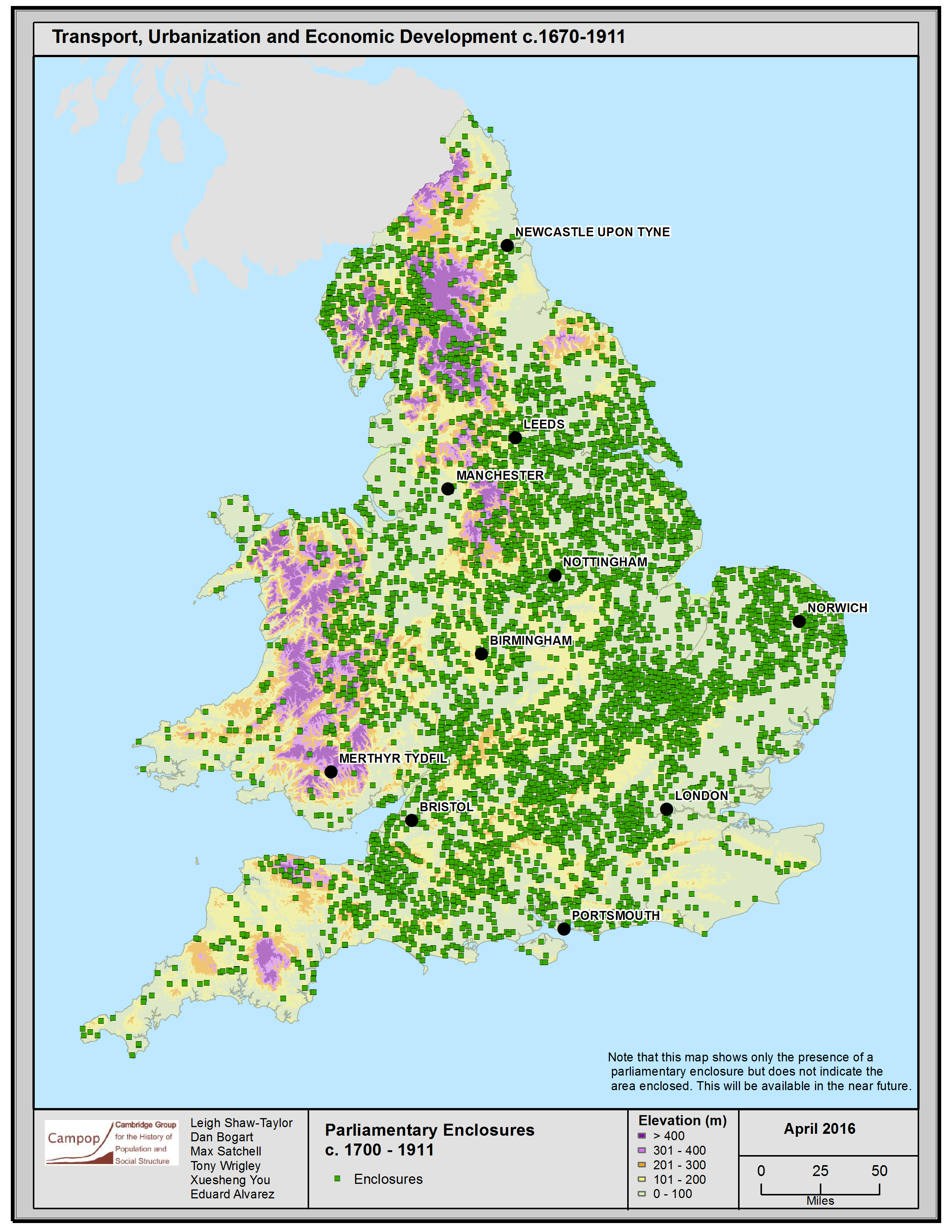
This map plots the locations of parliamentary enclosure acts in England and Wales (c.1700–1911), visually demonstrating how enclosure was spatially concentrated yet extensive across the countryside. It helps explain why loss of common rights and consolidation of holdings could reshape rural livelihoods and accelerate commercialization of agriculture. Source
These changes could increase efficiency and output, especially where demand for food was rising.
However, the benefits were uneven. Commercial farming often strengthened the position of:
large landowners
successful tenant farmers
merchants involved in grain and livestock markets
At the same time, it weakened the security of many small peasants. Families that depended on customary access to common fields, forests, or grazing land could lose resources that had supported their survival. More rural people became wage laborers, seasonal workers, or migrants.
Population Shifts and Mobility
Population growth after the late medieval demographic crises placed new pressure on land, food supplies, and employment. More people meant greater demand for grain, housing, and work, which pushed prices upward in many areas.
Demographic Recovery and Pressure
Rising population contributed to inflation, especially in food prices. Wages often failed to keep pace, so many laborers and artisans experienced declining purchasing power. This widened the gap between those who could profit from rising prices and those who lived on fixed wages or small incomes.
Population pressure also affected family strategies. In some areas:
younger people delayed marriage until they could afford a household
children and servants worked longer within household economies
families relied more on wage labor or side work to survive
These changes show that demographic growth was not just a statistic; it reshaped everyday choices about labor, marriage, and survival.
Migration and Urban Growth
Many people responded to economic pressure through migration. Some moved seasonally for harvests or construction work. Others left villages permanently for towns and cities in search of apprenticeships, domestic service, casual labor, or trade.
Urban growth was therefore fed heavily by immigration.
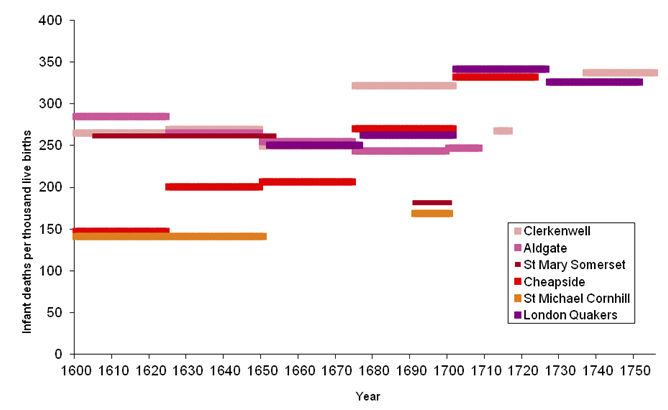
This figure summarizes London’s population growth across the early modern period (c.1550–1750), illustrating how a major European city expanded rapidly over time. Used alongside the text, it reinforces the idea that sustained in-migration was central to urban growth as cities struggled with high mortality and constant demographic turnover. Source
Early modern cities often had high death rates, so many depended on constant inflows of newcomers from the countryside. Expanding capitals and port cities became especially important because they offered:
government employment
artisan and service work
commercial exchange
access to regional and international trade
This movement created more dynamic urban economies, but it also produced instability because cities had to absorb growing numbers of poor and mobile residents.
Cities and Social Strain
Urban growth transformed social life. Cities became centers of wealth, communication, and opportunity, but they also made inequality more visible.
Urban Opportunities and Inequality
A small urban elite of merchants, financiers, and officeholders often gained substantial wealth. Beneath them stood master artisans, shopkeepers, and professionals. Below these groups were journeymen, servants, day laborers, and the unemployed poor.
As cities expanded, social divisions became sharper. Crowded housing, irregular employment, and dependence on food markets left many urban residents vulnerable to crisis. A failed harvest or sudden rise in prices could quickly push working families into poverty.
Commercial growth therefore did not create general prosperity. It created new wealth, but it also increased insecurity for those with little property or bargaining power.
Strain on Older Social Structures
The combined effects of commercial change, population growth, and urban expansion strained older institutions and customs. Guilds lost some authority as production moved beyond their supervision. Village communities found it harder to preserve customary land use when landlords and markets pushed for profit. Households, which remained central economic units, faced growing pressure to produce more income from wage labor, craft work, or migration.
Older social structures did not disappear, but they were increasingly challenged by:
expanding market forces
rising social inequality
greater geographic mobility
weakened customary protections
These tensions were fundamental to early modern European society. Economic change opened new possibilities, yet it also unsettled inherited patterns of work, status, and communal support.
Practice Questions
Identify ONE way commercial or agricultural capitalism changed daily life in early modern Europe, and explain ONE reason urban growth strained older social structures. (2 marks)
1 mark for correctly identifying one change in daily life, such as increased wage labor, growth of rural proto-industry, loss of common land, or greater dependence on markets.
1 mark for explaining one reason urban growth strained older structures, such as pressure on guilds, rising poverty, overcrowding, or the weakening of customary village support systems.
Evaluate the extent to which population shifts and urban growth reshaped European society in the sixteenth and early seventeenth centuries. (6 marks)
1 mark for a clear thesis that makes a judgment about the importance of population shifts and urban growth.
1 mark for providing relevant evidence about population change, such as rising demand for food, inflation, migration, or delayed marriage.
1 mark for providing relevant evidence about urban growth, such as expanding capitals, port cities, wage labor, or social inequality.
1 mark for explaining how these developments changed social relations, work patterns, or household life.
1 mark for explaining how older structures were strained, such as guild authority, customary land use, or traditional community support.
1 mark for complexity, such as showing that change varied by region or that economic growth created both opportunity and insecurity.
FAQ
Towns grew at different rates because they occupied different positions in trade and government.
Places often expanded more quickly if they had:
access to sea routes or major rivers
links to long-distance commerce
royal courts or administrative offices
nearby manufacturing or export activity
By contrast, towns tied mainly to older regional markets could stagnate if trade routes shifted elsewhere.
Many cities had very high death rates because of crowding, poor sanitation, and periodic disease.
As a result, urban populations often could not reproduce themselves naturally. They relied on a steady flow of newcomers, especially:
servants
apprentices
labourers
young unmarried people seeking work
Migration was therefore not just common; it was essential to urban survival.
Women often worked in ways that were vital but poorly recorded.
They commonly took part in:
spinning and textile finishing in rural households
market selling on a small scale
food processing and domestic service
family businesses run by artisans or shopkeepers
Because much of this labour happened within households or informal markets, it was easier for officials and guilds to undervalue it.
Rising poverty worried governments because it affected order as well as welfare.
Officials feared that large numbers of unsettled poor people might lead to:
vagrancy
theft
disorder
pressure on charity and food supplies
This concern encouraged more organised poor relief in some places, but also harsher distinctions between the “deserving” and “undeserving” poor.
Not necessarily. Producing for profit could increase overall output, but it could also make ordinary people more vulnerable.
If land was redirected towards profitable uses, some communities lost access to common resources they had relied upon.
Food security depended on several factors:
who controlled the land
whether labourers earned enough to buy food
transport and storage systems
the severity of harvest failure
So greater commercialisation did not automatically mean greater stability.