

AP Syllabus focus:
'Families remained central to social and economic life, while popular culture and folk traditions reinforced and sometimes challenged communal norms.'
In early modern Europe, the household was the center of production, authority, and identity, while festivals, rituals, and oral traditions gave communities shared values and ways to police behavior.
The Family as the Core of Everyday Life
For most Europeans, the family was the basic unit of both survival and identity. People usually did not separate home from work in a modern way. In towns, workshops, shops, and homes were often the same space; in the countryside, households organized farming, food storage, and seasonal labor.
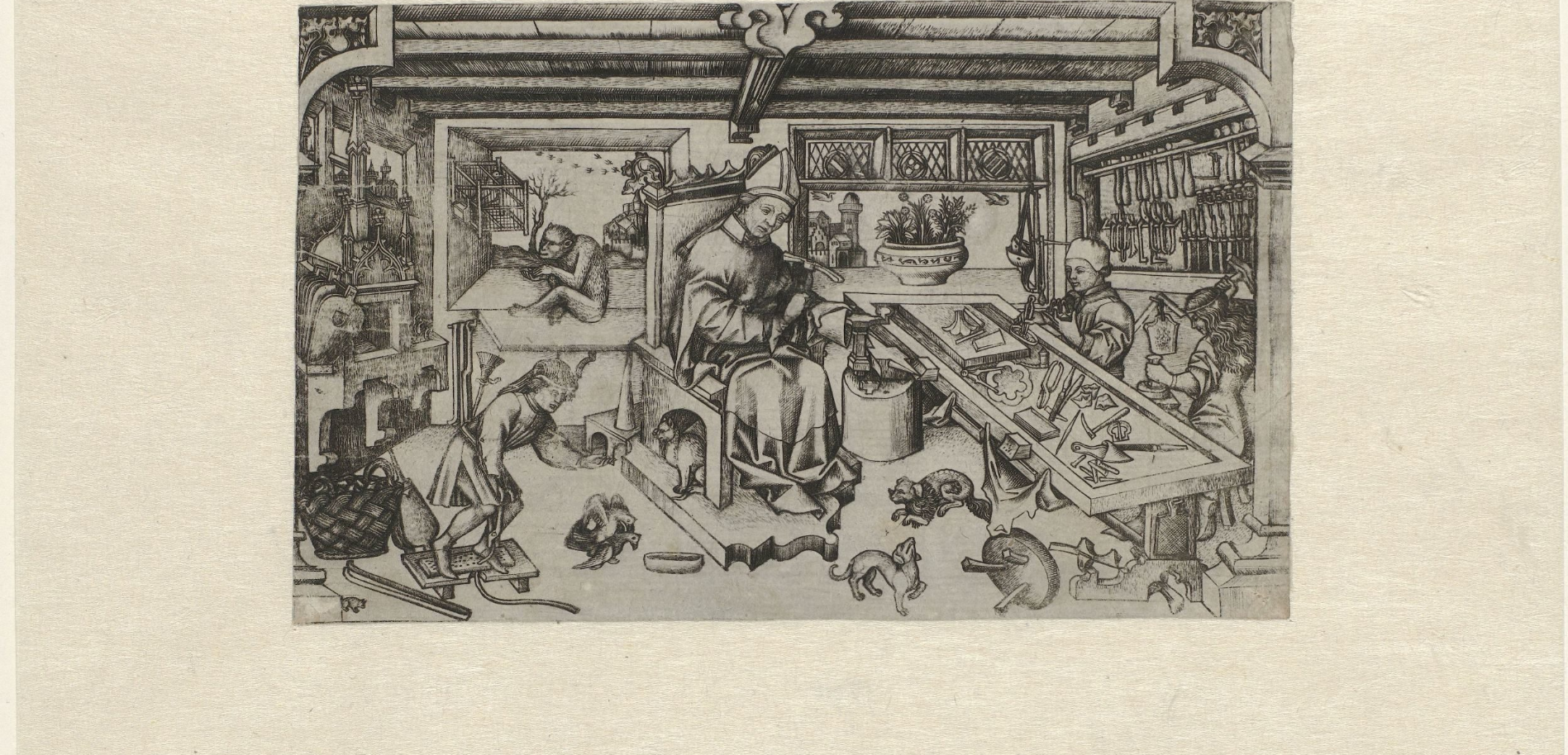
This engraving depicts St. Eligius (patron of goldsmiths) working in a busy workshop alongside assistants, surrounded by specialized tools and a furnace. It illustrates how early modern productive life often took place in household-like spaces where authority, apprenticeship, and labor were closely integrated. The scene is useful for connecting “family/household” structure to economic production and discipline within a shared domestic-work environment. Source
Family life also shaped status, inheritance, marriage choices, and relations with neighbors. Because political institutions were often distant, the household was the first place where people learned obedience, cooperation, and religious practice.
Household Structure and Economic Function
Early modern households were often larger and more complex than the modern nuclear family. A household might include parents, children, servants, apprentices, widowed relatives, or lodgers. This made the household a working unit, not just a private emotional group. Men, women, and children all contributed labor, though their tasks were usually divided by age, sex, and social position. Marriage was important partly because it created an economically viable household. Property, dowries, and inheritance all mattered, since families depended on stable access to land, tools, and trade connections.
Authority, Discipline, and Mutual Obligation
Family life was shaped by patriarchal authority, meaning the legal and social expectation that fathers or husbands would direct the household. Yet this authority came with obligations. Heads of household were expected to provide food, order, and moral leadership. Wives managed domestic production, children were trained for labor and discipline, and servants were supervised as part of the household community. The family therefore linked economic life with moral expectations. A disorderly household could damage a family’s reputation, while a well-run one showed honor, stability, and respectability.
Popular Culture in Everyday Experience
Popular culture was the shared culture of ordinary people, expressed through festivals, songs, stories, games, rituals, and communal celebrations. Much of it was oral rather than written, so customs were passed down through repetition and participation. These practices gave shape to the year and helped communities mark births, marriages, harvests, and religious holidays. They also created a strong sense of belonging, since people experienced them together in streets, churches, fields, markets, and village greens.
The Calendar, Ritual, and Collective Identity
Popular culture followed both the religious calendar and the agricultural cycle. Feast days, saints’ days, fairs, weddings, and harvest celebrations broke up the routine of work and gave people opportunities for recreation.
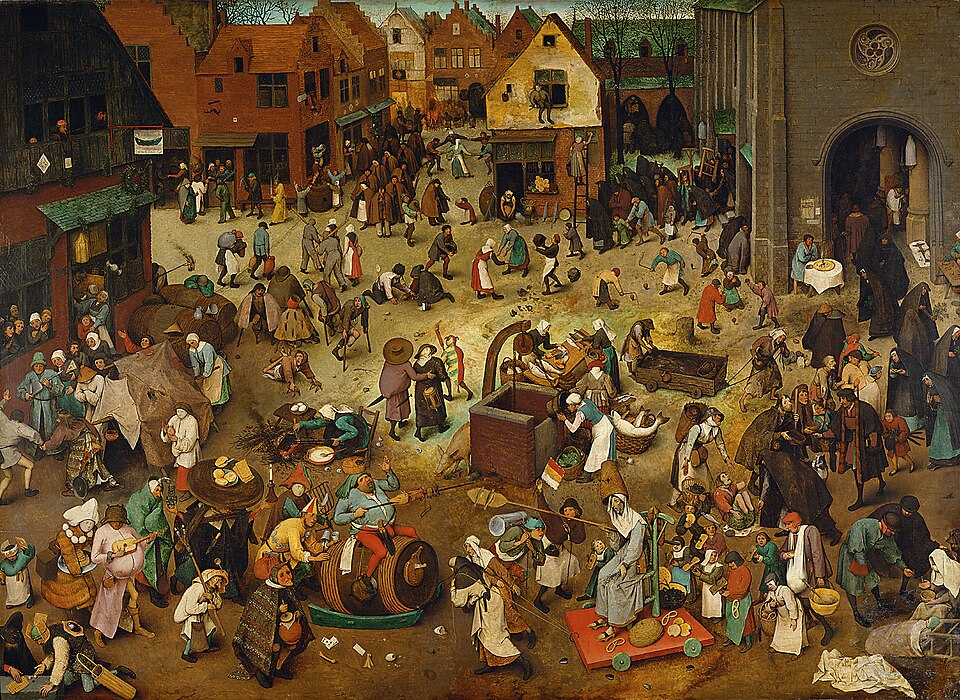
Bruegel’s scene stages a crowded town-square festival in which ‘Carnival’ and ‘Lent’ appear as opposing symbolic forces, surrounded by ordinary people eating, drinking, praying, trading, and performing rituals. The image helps students see how the religious calendar organized public life and how communal celebrations made social roles visible through shared, highly structured participation. It also hints at “inversion” and moral commentary by juxtaposing excess and restraint within one communal space. Source
Such events were not merely entertainment. They affirmed shared values, confirmed local traditions, and reminded people of their place within a larger community. Participation mattered: to join in was to show membership. Public rituals also made social roles visible, since age groups, guilds, neighborhoods, and families often took part in organized ways.
Oral Tradition and Moral Teaching
Songs, ballads, proverbs, folktales, and seasonal customs carried lessons about acceptable behavior. Popular culture could praise charity, hard work, proper marriage, and religious devotion, while mocking greed, laziness, sexual misconduct, or broken promises. In this sense, folk traditions helped enforce communal norms, the unwritten rules that governed reputation and conduct in a local society. Because these rules were widely shared, neighbors often judged one another openly. Culture, then, was not separate from discipline; it was one of the main ways communities taught and repeated standards.
Communal Life and Social Control
Most Europeans lived in close, face-to-face communities where privacy was limited and reputation mattered deeply. Daily life involved constant interaction with kin, neighbors, parish members, and fellow workers. In such settings, communal life depended on cooperation, but also on surveillance. People were expected to contribute to local obligations, respect custom, and avoid behavior that threatened harmony. Public opinion could be powerful because belonging to the community was essential for economic survival and social standing.
How Communities Reinforced Norms
Communal norms were reinforced through repeated public practices:
shared worship and holiday observance
neighborhood expectations about work, marriage, and charity
festive rituals that honored accepted roles
gossip, praise, ridicule, and exclusion
These methods did not rely only on formal law. Instead, they worked because communities were tightly connected. Approval brought honor; shame could isolate a person or household.
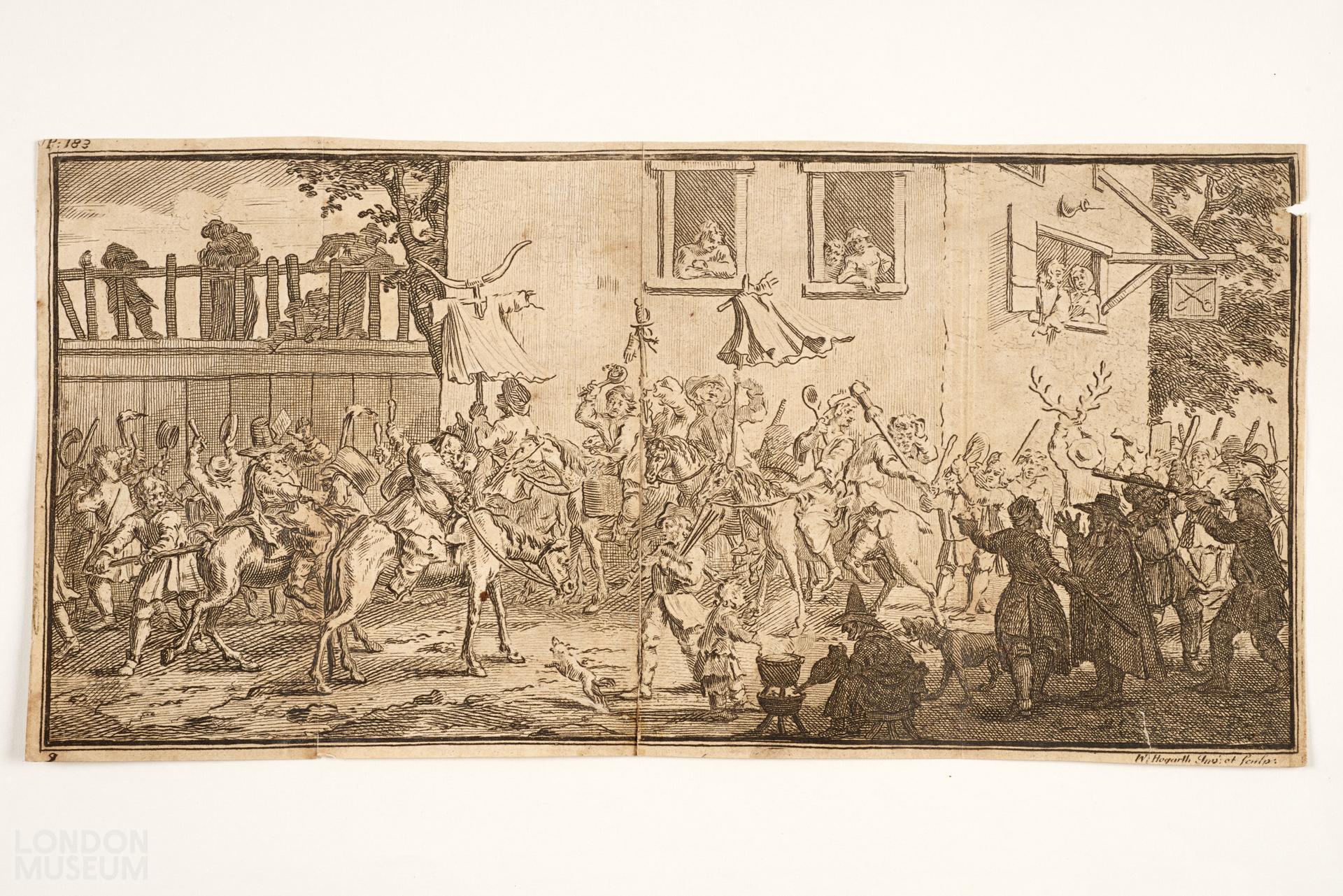
Hogarth’s engraving shows a noisy skimmington (charivari): a public procession that humiliates targets through mockery, cacophony, and theatrical display. As a form of “rough justice,” it demonstrates how communities enforced norms through spectacle and collective participation rather than formal courts. The image makes visible the link between popular culture and social discipline by depicting shame as a public, communal event. Source
Popular culture therefore helped ordinary people police their own society, often as effectively as church or state authorities.
How Folk Traditions Could Also Challenge Norms
Folk traditions did not always support order in a simple way. Some festivals allowed temporary inversion, moments when ordinary rules were relaxed and social hierarchies were mocked. Humor, disguise, and public performance could create space to criticize local authorities or expose hypocrisy. At times, collective customs also defended what people saw as traditional rights. If rulers, landlords, or local elites ignored customary expectations, communal action could take the form of protest, mockery, or disorder.
Even these challenges often remained rooted in community values. People were not always rejecting social norms altogether; they were sometimes arguing that leaders had failed to uphold them. This is why popular culture in early modern Europe could be both conservative and disruptive at the same time. It preserved inherited patterns of life, yet it also gave ordinary people language, symbols, and occasions through which they could express tension, resentment, or resistance.
Practice Questions
Answer all parts briefly.
a) Identify ONE reason families remained central to economic life in early modern Europe.
b) Identify ONE feature of popular culture that reinforced communal norms.
c) Identify ONE way folk traditions could challenge communal authority.
(3 marks)
1 mark for part (a) for one accurate identification, such as: the household was a unit of production; family labor was essential in farms or workshops; marriage and inheritance organized property and work.
1 mark for part (b) for one accurate identification, such as: festivals affirmed shared values; oral traditions taught acceptable behavior; communal rituals reinforced membership and reputation.
1 mark for part (c) for one accurate identification, such as: carnival-style inversion mocked authority; public songs or performances criticized leaders; customary protest defended community expectations.
Evaluate the extent to which popular culture in 16th- and 17th-century Europe reinforced communal norms more than it challenged them. (6 marks)
1 mark for a defensible thesis that makes a clear argument about reinforcement versus challenge.
1 mark for contextualization that situates the argument in household-based, face-to-face early modern communities.
Up to 2 marks for specific evidence, such as seasonal festivals, oral traditions, parish rituals, reputation, family labor, public mockery, or customary protest.
Up to 2 marks for analysis and reasoning, such as explaining that popular culture usually upheld shared values but also created limited spaces for criticism, inversion, or resistance.
FAQ
Godparents created a form of spiritual kinship that extended beyond the immediate household. At baptism, they became public witnesses to a child’s place within the Christian community.
They could also provide practical support:
help in times of illness or widowhood
social connections and patronage
moral oversight if parents died or struggled
This meant family life was often supported by wider networks, not just by parents and children alone.
Alehouses and taverns were major meeting places, especially for men, servants, travellers, and labourers. People exchanged news, arranged work, discussed prices, and formed local opinions there.
They also had an ambiguous reputation. Authorities often worried that drink, gambling, or loose talk might encourage disorder.
So these spaces were both social centres and places where community tensions could become visible.
A charivari was a noisy public demonstration, often involving shouting, music, masks, or mock processions. It was commonly aimed at people accused of violating accepted social expectations, especially in marriage.
It mattered because it was a communal judgement rather than a formal legal punishment.
Such actions show that ordinary people could enforce standards themselves, using ridicule and spectacle to pressure others into conformity.
Children were not separate from adult society in the modern sense. They joined seasonal customs, watched public ceremonies, learned songs, and took part in games tied to the rhythm of village or town life.
This helped teach them:
local traditions
gender expectations
ideas about obedience and reputation
Popular culture was therefore one of the main ways communities socialised the young.
Not entirely. Towns usually had more guild events, markets, and crowded public entertainments, while villages were more closely tied to the farming year and local custom.
Still, they shared important features:
oral storytelling
festive calendars
neighbourhood scrutiny
strong concern for reputation
So urban and rural communities differed in setting and scale, but both used popular culture to define belonging and behaviour.

.jpg)