AP Syllabus focus:
'The Renaissance and Reformation sparked debates about women’s education and their roles in family, church, and society.'
In early modern Europe, new learning and religious upheaval did not end male dominance, but they did intensify arguments over what women should know and how they should live.
Why Debates Expanded
The Renaissance and the Reformation both encouraged Europeans to reconsider old authorities. Humanists returned to classical and Christian texts, while reformers challenged established religious practice. In that climate, writers increasingly asked whether women were capable of serious learning and what purposes their education should serve.
Most participants in these debates still accepted patriarchy, the idea that men should lead households and public life. The controversy was therefore not usually about equality in a modern sense. Instead, it focused on whether women should be educated, how much they should learn, and whether learning would strengthen or disrupt social order.
Historians often connect these arguments to the broader querelle des femmes.
Querelle des femmes: A long-running European debate over women’s nature, abilities, and proper roles in education, marriage, religion, and public life.
These debates mattered because they touched three central institutions: the family, where women were expected to marry and raise children; the church, where women were valued spiritually but excluded from formal authority; and society, where education could shape status, reputation, and influence.
Education and Intellectual Change
Humanist Arguments for Learning
Renaissance humanism emphasized education as a way to form moral character. Some humanists extended that reasoning to women, especially daughters of noble and urban elite families. They argued that educated women could become more pious, more self-controlled, and more useful within the household.
Supporters of women’s learning usually defended it in practical and moral terms:
educated women could raise Christian children more effectively
literate wives could assist with household management and correspondence
cultured women could serve as refined companions in courtly society
reading could strengthen female virtue by directing women toward religious and moral texts
Writers such as Juan Luis Vives supported female education, but within clear limits. Education was often meant to produce modesty, obedience, and virtue rather than independence. Similarly, courtly ideals allowed some women to be admired for intelligence and grace, yet still expected them to remain socially restrained.
A few women used these openings to defend female intellectual ability more directly.
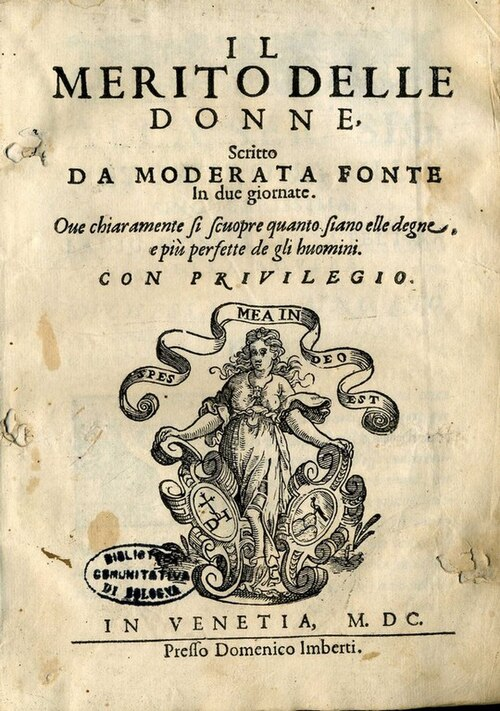
Frontispiece/title page from Moderata Fonte’s Il merito delle donne (Venice, 1600). As a printed artifact, it highlights how debates about women’s nature and education circulated through the expanding Renaissance-era book market, allowing elite women writers to enter public intellectual life even while social expectations remained restrictive. Source
Writers such as Moderata Fonte and Marie de Gournay challenged the assumption that women were naturally inferior in reason. Their work showed that debates about women’s education were no longer only theoretical; educated women themselves were participating in them.
Limits of Humanist Education
Even when humanists favored women’s schooling, they usually prescribed a narrower curriculum than for men. Boys might study rhetoric, advanced Latin, philosophy, or preparation for public life. Girls were more commonly taught:
vernacular reading and writing
religious instruction
music or needlework
household management
limited classical learning in elite settings
This meant that educational opportunity expanded without overturning social hierarchy. Most girls, especially poor rural women, had little access to formal schooling. The debate was therefore shaped strongly by social class.
Religious Change and Women’s Roles
Protestant Emphases
The Reformation gave new force to arguments for female literacy.
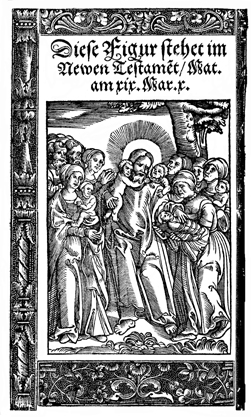
Woodcut illustration from Martin Luther’s Small Catechism (1545 edition), showing a didactic biblical scene framed by an ornamental border typical of early modern devotional print. Images like this supported Protestant teaching in the household and parish, complementing the push for reading catechisms and scripture as part of everyday religious practice. Source
Since Protestants stressed the importance of scripture and personal faith, girls were increasingly expected to read the Bible, catechisms, and devotional works. This did not imply equality with men, but it did strengthen the case for basic education.
Protestant reformers also elevated marriage as the normal Christian vocation. By rejecting monastic superiority and clerical celibacy, they emphasized women’s roles as wives, mothers, and moral guides within the home. The ideal Protestant woman was often described as pious, disciplined, hardworking, and devoted to the spiritual life of the household.
At the same time, this shift could restrict women’s choices. In many Protestant regions, convents were closed or weakened. Those convents had provided some women with literacy, religious community, and a respected alternative to marriage. As a result, Protestantism could simultaneously support women’s reading while narrowing acceptable female roles.
Mainstream Protestant churches also kept leadership firmly male. Women might teach children or influence family religion, but they were generally denied formal preaching and ordained authority.
Catholic Perspectives
The Catholic response also contributed to debate. Catholic reformers supported girls’ education in certain contexts, especially through convent schools and religious instruction. However, Catholic arguments usually linked women’s learning to piety, discipline, and obedience, not to public authority or intellectual equality.
In both Protestant and Catholic settings, women were expected to be religiously serious. The difference was not whether women should be moral and educated at all, but how education should shape their place in Christian society.
Family, Church, and Society
Debates over women’s education were ultimately debates about women’s roles. In the family, most writers assumed that husbands should govern and wives should obey. Yet they also increasingly admitted that an educated wife could be a better mother, household manager, and moral partner.
In the church, women’s influence was praised as important but usually defined as informal. Women were expected to teach children, model devotion, and encourage family piety, while remaining outside official authority.
In society more broadly, a small number of elite women used education to write, patronize learning, or participate in political culture. Their visibility demonstrated that women could be intellectually capable. Still, contemporaries often treated such cases as exceptional rather than representative.
The key historical point is that the Renaissance and Reformation did not create gender equality. Instead, they made women’s education and women’s social purpose matters of open debate. That was a significant change, even though traditional limits remained firmly in place.
Practice Questions
Identify ONE way the Reformation changed arguments about women’s education in Europe. (2 marks)
1 mark for identifying a change, such as increased support for girls’ literacy so women could read the Bible or catechisms.
1 mark for explaining that this support was usually tied to women’s domestic and religious duties rather than to equal public roles.
Evaluate the extent to which the Renaissance and Reformation changed European ideas about women’s roles between 1450 and 1650. (6 marks)
1 mark for a defensible thesis that addresses both change and continuity.
1 mark for relevant contextualization about Renaissance humanism or religious reform.
2 marks for specific evidence, such as humanist support for limited female education, the emphasis on women as wives and mothers, increased female literacy, or the decline of convent options in Protestant regions.
2 marks for analysis that explains extent of change, especially by showing that new arguments for education coexisted with continued patriarchy and restricted public authority for women.
FAQ
Education could still be useful for family strategy.
A well-educated daughter might improve a family’s reputation, manage estates during absences, handle correspondence, or marry more advantageously. In princely and noble households, literacy and languages could also prepare women for diplomatic marriages or court service.
So, investment in girls’ education was often practical and dynastic rather than egalitarian.
Convent schooling was usually more structured than household tutoring.
Girls in convent settings might learn reading, writing, music, devotion, and disciplined routine under female supervision. At home, education depended more heavily on family wealth, local tutors, and parental priorities.
Convents could also provide a female-centred intellectual environment, which made them especially important for girls who did not wish to marry.
Letters show education in action.
They reveal:
literacy levels
religious thought
family management
political awareness
self-presentation
Because many women did not publish formal treatises, private correspondence is often the clearest evidence of how educated women actually used reading and writing in daily life.
Yes. Elite rulers and regents often required broader training.
They might study languages, history, religion, rhetoric, and dynastic politics because they were expected to advise, negotiate, or govern in emergencies. Their education was shaped by power as much as by gender.
However, even these women were often praised in ways that stressed virtue and prudence rather than open political ambition.
No. Local context mattered a great deal.
Italian courts, French literary circles, English Protestant culture, and the German lands all developed somewhat different expectations. Urban elites usually had more educational opportunities than rural families, and confessional differences shaped what girls were expected to read.
Even so, a common pattern appeared across Europe: support for women’s learning was usually strongest when it could be justified as serving religion, family, or status.