AP Syllabus focus: ‘The unemployment rate is the percentage of the labor force that is not currently employed.’
Measuring unemployment turns a complex labour market into a single headline statistic. AP Macroeconomics focuses on how people are classified and how those counts become the unemployment rate used to track macroeconomic performance.
Measuring Unemployment
What the unemployment rate measures
Unemployment rate: The percentage of the labor force that is unemployed (not currently employed).
To interpret the rate correctly, you must know what is being counted and what is not. In AP Macroeconomics, the unemployment rate is built from counts of people (not hours worked or job vacancies), and it uses the labor force as the comparison group rather than the whole population.
Core classifications used in measurement
A country’s statistical agency (in the United States, commonly discussed as the Bureau of Labor Statistics framework) classifies individuals into mutually exclusive categories.
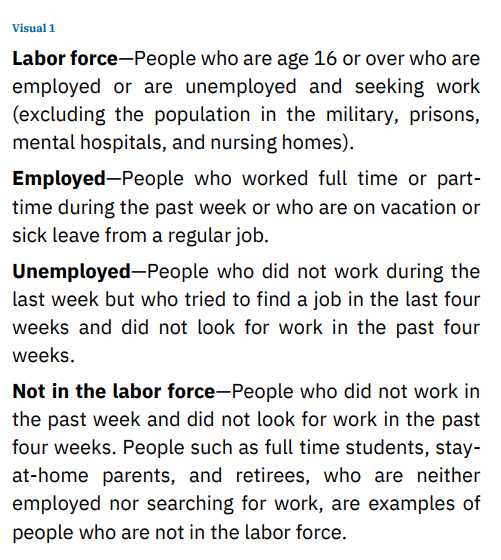
This diagram summarizes the standard survey classifications used to compute the unemployment rate: employed, unemployed (actively seeking work), and not in the labor force. It visually reinforces that the labor force is the sum of employed and unemployed, while nonparticipants are excluded from both the numerator and denominator. Source
The unemployment rate depends on two of them.
Employed: People who currently have a job (including those who worked for pay or profit, or who have a job but were temporarily absent).
In measurement, “employed” typically includes full-time and part-time workers, and it counts people by their status rather than by how intensively they are used.
Unemployed: People without a job who are available to work and have been actively seeking employment within a recent period.
This definition highlights that unemployment is not simply “not working.” Measurement requires evidence of attachment to the labor market (active search), which separates the unemployed from those not participating.
The labour force as the denominator
The unemployment rate is expressed as a share of the labor force, not the total adult population. For measurement purposes, the labor force is the pool of people counted as either employed or unemployed. This denominator matters because the rate can change even if the number of unemployed people stays the same (for example, if the labor force grows).
The unemployment-rate formula
= Unemployment rate, percent (%)
= Number of unemployed people, persons
= Labor force (employed + unemployed), persons
Because the measure is a percentage, it is designed for comparisons over time and across economies, provided the underlying definitions and survey methods are similar.
How the data are generated
Status is usually measured by survey-based counts
Unemployment is commonly measured using a household survey approach: a representative sample of households is asked about each person’s work status during a reference period (often a specific week). The answers are coded into employed, unemployed, or not in the labor force, and then scaled up to estimate national totals.
Key features of this measurement approach:
It is people-based: one person is counted once, even if they hold multiple jobs.
It is status-based: a person is either employed or unemployed based on criteria, not on whether they “want” a better job.
It is time-specific: classification refers to a recent reference period, enabling consistent month-to-month tracking.
“Actively seeking” is crucial for classification
To be measured as unemployed, an individual generally must have taken concrete steps to find work recently (for example, applying for jobs or interviewing). This rule is essential for consistent measurement because it separates:
Unemployment (jobless but searching)
From nonparticipation (jobless and not searching)
This distinction affects the unemployment rate because only those counted in the labor force appear in the denominator.
Interpreting changes in the unemployment rate (measurement logic)
A change in the unemployment rate can come from changes in the numerator, the denominator, or both. When interpreting a reported increase or decrease, focus on the underlying measurement relationships:
If unemployment (U) rises while the labor force (LF) is stable, the rate rises.
If employment increases and more unemployed people become employed, unemployment falls, lowering the rate.
If the labor force grows (more people counted as either employed or unemployed), the rate may move even if the number unemployed does not.
Because the statistic is a ratio, it is possible for the unemployment rate to fall without strong job growth if the labor force grows slowly, and it is possible for the rate to rise during periods when many people enter the labor force and begin searching for work.
Practice Questions
(2 marks) Define the unemployment rate and state the group used as its denominator.
1 mark: Defines unemployment rate as the percentage of the labour force that is unemployed / not currently employed.
1 mark: Correctly identifies the denominator as the labour force (employed + unemployed), not the total population.
(5 marks) Explain how an individual is classified as unemployed for official measurement and how that classification affects the reported unemployment rate. Use the symbols and in your explanation.
1 mark: States that “unemployed” means without a job and available to work.
1 mark: States that the person must be actively seeking work (recent job search).
1 mark: Explains that unemployed individuals are counted in .
1 mark: Explains that unemployed individuals are also included in (as part of employed + unemployed).
1 mark: Links to the rate as a ratio, e.g. , and explains that changing and/or changes the reported rate.
FAQ
Seasonal adjustment uses statistical techniques to remove predictable calendar patterns (e.g., school schedules, holidays, harvests).
This helps analysts compare months more meaningfully by focusing on underlying changes rather than recurring seasonal swings.
The headline rate typically corresponds to a narrower definition of unemployment.
Broader measures may also include people marginally attached to the labour force and those working part-time for economic reasons, giving a wider view of labour underutilisation.
In a household-based approach, people are counted once by status.
Someone with multiple jobs is still a single employed person; this prevents multiple-job holders from inflating employment counts relative to population.
Treatment depends on survey rules and how respondents describe their status.
Some frameworks may classify temporarily absent workers as employed, while others may classify certain temporary layoffs as unemployed if a return-to-work expectation and availability criteria are met.
Even with careful design, errors can arise from:
Sampling variability (survey is not a full census)
Misreporting or misunderstanding questions
Nonresponse bias if certain groups are less likely to participate
Agencies mitigate these with weighting, follow-ups, and methodology updates.