AP Syllabus focus: ‘The natural rate can change due to shifts in labor market conditions and demographics.’
Unemployment is not fixed across decades. Even at “normal” economic conditions, long-run changes in the workforce, job matching, and institutions can shift the unemployment rate consistent with full employment.
What “changes over time” refers to
The key idea is that the economy’s natural rate of unemployment can drift upward or downward, so the same actual unemployment rate may signal different labour-market health in different periods.
Natural rate of unemployment: The unemployment rate that exists when the economy is at full employment, reflecting ongoing job search and job matching rather than a broad deficiency of spending.
A changing natural rate means the benchmark used to judge “tight” versus “slack” labour markets is itself moving.
Why the natural rate can change: labour market conditions
Long-run shifts in how workers and jobs connect can alter the amount of unemployment that persists even in good times.
Matching efficiency and job search frictions
Matching efficiency is how easily unemployed workers can find suitable jobs.
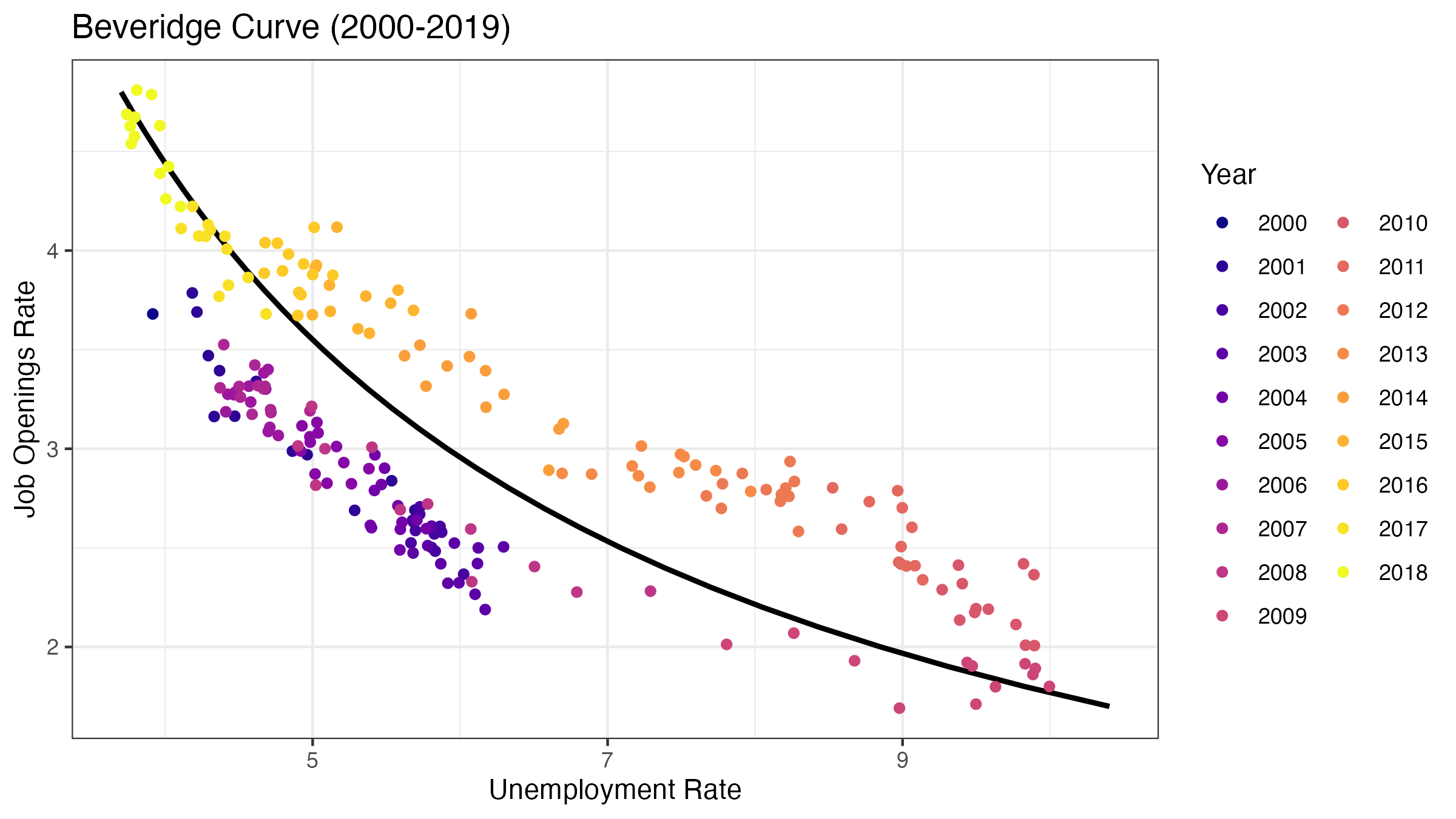
This Beveridge curve plots the job openings (vacancy) rate against the unemployment rate, illustrating their typical negative relationship over the business cycle. Movements along the curve are commonly interpreted as cyclical changes, while outward/inward shifts are often linked to changes in matching efficiency, skill mismatch, or other structural frictions that can affect the natural rate of unemployment. Source
Improved matching can lower the natural rate:
better information (online job platforms)
more effective placement services
reduced geographic barriers to moving for work
Reduced matching can raise the natural rate:
skills becoming less transferable
higher vacancy requirements (credentials, experience)
longer hiring processes and screening
Structural change in the economy
Changes in the composition of jobs can increase the likelihood that worker skills and employer needs diverge.
Sources of structural change include:
automation replacing routine tasks
globalisation shifting labour demand across industries and regions
expansion of sectors requiring specialised training (healthcare, tech)
If retraining is slow or costly, persistent mismatch increases the natural rate.
Labour market institutions and incentives
Rules and norms can affect job-finding rates and labour supply decisions.
Factors that may raise or lower the natural rate over time:
unemployment insurance generosity and duration (affects search intensity and reservation wages)
minimum wage and wage-setting practices (may change hiring at the margin)
union coverage and bargaining structures (can influence wage rigidity and turnover)
employment protection laws (affect hiring and firing, and thus vacancy creation)
These effects are empirical and can differ by country and era; the syllabus focus is that institutional change can shift the long-run benchmark.
Why the natural rate can change: demographics
The natural rate depends partly on the characteristics of the labour force, which evolve over time.
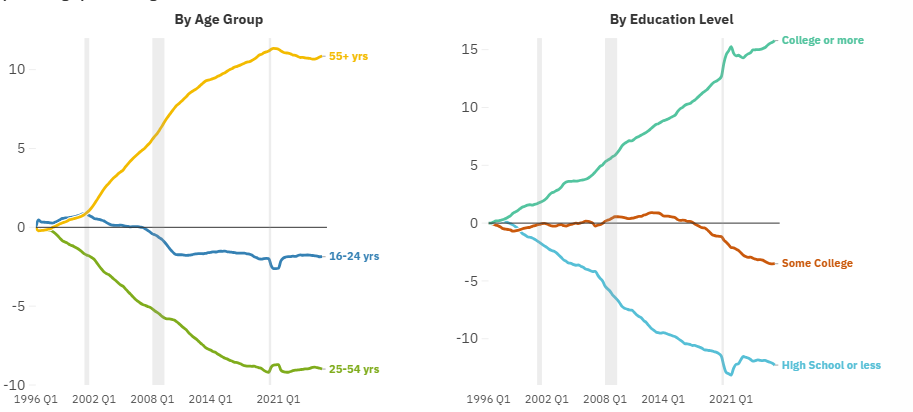
These figures summarize how labor-force composition (age and education shares) changes over time and how unemployment rates differ across demographic groups. Together, they illustrate why demographic shifts—such as an aging workforce and rising educational attainment—can mechanically change the economy’s long-run unemployment benchmark even when the economy is otherwise “normal.” Source
Age composition
Different age groups have different typical job-search patterns.
A larger share of young workers tends to raise the natural rate because:
first-time job search and frequent job switching are more common
An ageing workforce can lower the natural rate if:
workers have more experience and stable job matches
turnover is lower
Participation patterns and household structure
Changes in who enters the labour force can affect measured unemployment.
Rising labour force attachment of groups previously less attached can temporarily raise job search and measured unemployment.
Increased prevalence of dual-income households or caregiving responsibilities can shift preferred work arrangements, affecting match quality and duration of unemployment spells.
Education and skill distribution
If educational attainment rises and aligns with employer needs, the natural rate may fall; if credential requirements rise faster than skill acquisition, mismatch may increase.
How to interpret unemployment when the natural rate moves
When the natural rate changes, a stable unemployment rate can be misleading.
If the natural rate falls over time:
a given unemployment rate may indicate more slack than it used to
If the natural rate rises over time:
the same unemployment rate may reflect a tighter labour market than in earlier decades
This is why economists track long-run trends (demographics, matching indicators, institutional changes) instead of treating a single historical average as permanent.
Why this matters for policy and forecasting
A moving natural rate affects how policymakers interpret “full employment” and inflationary pressure.
If policymakers underestimate a rising natural rate, they may push demand too hard and risk inflation.
If they overestimate the natural rate when it has fallen, they may accept unnecessary unemployment.
Changes in the natural rate are typically gradual, but structural breaks (major technological shifts, regulatory reforms, or demographic turning points) can make trends more noticeable.
Practice Questions
(2 marks) State two factors that can cause the natural rate of unemployment to change over time.
1 mark for identifying a valid labour market condition factor (e.g., matching efficiency, structural change, labour market institutions).
1 mark for identifying a valid demographic factor (e.g., age composition, education/skills distribution, participation patterns).
(6 marks) Explain how changes in (i) the age profile of the labour force and (ii) job matching efficiency can each alter the natural rate of unemployment over time. Use economic reasoning.
1 mark: Links higher share of young workers to higher turnover/job switching.
1 mark: Explains why higher turnover increases ongoing job search unemployment even at full employment.
1 mark: Links ageing/experienced workforce to more stable matches (or lower turnover).
1 mark: Explains why more stable matches reduce the unemployment consistent with full employment.
1 mark: Defines or accurately describes improved matching efficiency (faster/less costly matching of workers to vacancies).
1 mark: Explains that better matching shortens unemployment duration and lowers the natural rate (or worse matching raises it).
FAQ
Changes in survey wording, classification rules, or treatment of certain groups can create breaks in historical series.
This can make the natural rate appear to shift even if underlying job-finding dynamics are unchanged.
Hysteresis is when temporary high unemployment leaves lasting damage.
Channels include skill loss, weaker job networks, and employer stigma attached to long unemployment spells, all of which reduce future matching efficiency.
Migration can change regional skill mixes and local matching.
If workers move into areas without aligned vacancies (or vacancies grow where workers are not), mismatch can increase even during expansion.
Licensing can restrict entry into certain jobs and slow transitions across occupations.
If requirements expand, some workers face longer retraining periods, raising the unemployment duration consistent with full employment.
Common indicators include vacancy rates, job-finding rates, separation rates, and long-term unemployment shares.
Economists also use the relationship between vacancies and unemployment (often summarised by the Beveridge curve) to judge changes in matching efficiency.