AP Syllabus focus: ‘The natural rate of unemployment equals frictional plus structural unemployment at full employment.’
The natural rate of unemployment connects labor market “normal” joblessness to the idea of full employment. It explains why an economy can be healthy even when measured unemployment is not zero.
What the Natural Rate of Unemployment Means
Core idea
The natural rate of unemployment is the unemployment rate that exists when the economy is at full employment, meaning labor markets are functioning normally and there is no unemployment caused by a general downturn in spending.
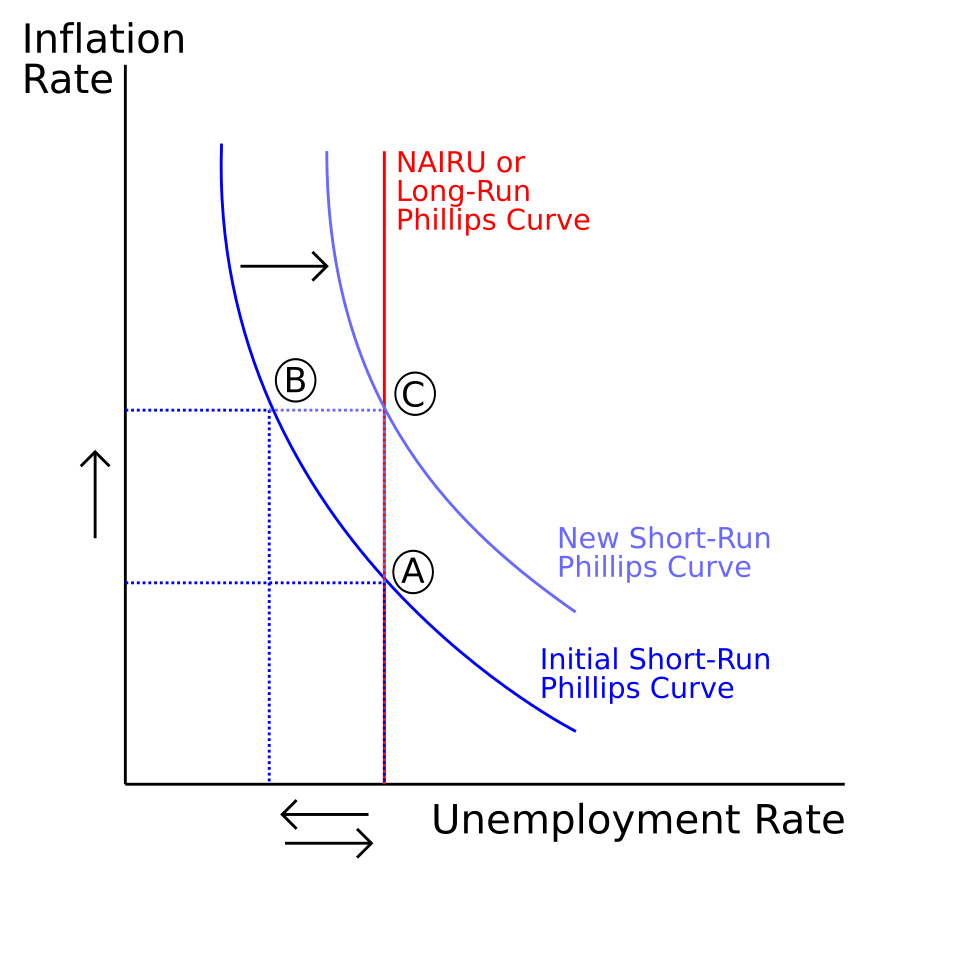
This Phillips-curve diagram distinguishes the short-run tradeoff between inflation and unemployment from the long-run outcome where unemployment returns to the natural rate (), shown by the vertical long-run Phillips curve. It visually reinforces that demand-side policy can move the economy along a short-run curve, but cannot permanently keep unemployment below without changing inflation dynamics. Source
Natural rate of unemployment — the unemployment rate at full employment, equal to the sum of frictional and structural unemployment.
In AP Macroeconomics, “natural” does not mean desirable or fixed; it means unemployment arising from ordinary job search and longer-run labor market mismatches, not from economy-wide weakness.
Full employment does not mean zero unemployment
At full employment, some workers are between jobs or retooling skills, and some firms are still searching for suitable workers. As a result, a positive unemployment rate can be consistent with a well-functioning economy.
= natural rate of unemployment (percent of the labour force)
= frictional unemployment rate (percent of the labour force)
= structural unemployment rate (percent of the labour force)
This relationship is a conceptual building block: it tells you what types of unemployment are present even when the economy is operating at full employment.
Components at Full Employment: Frictional + Structural
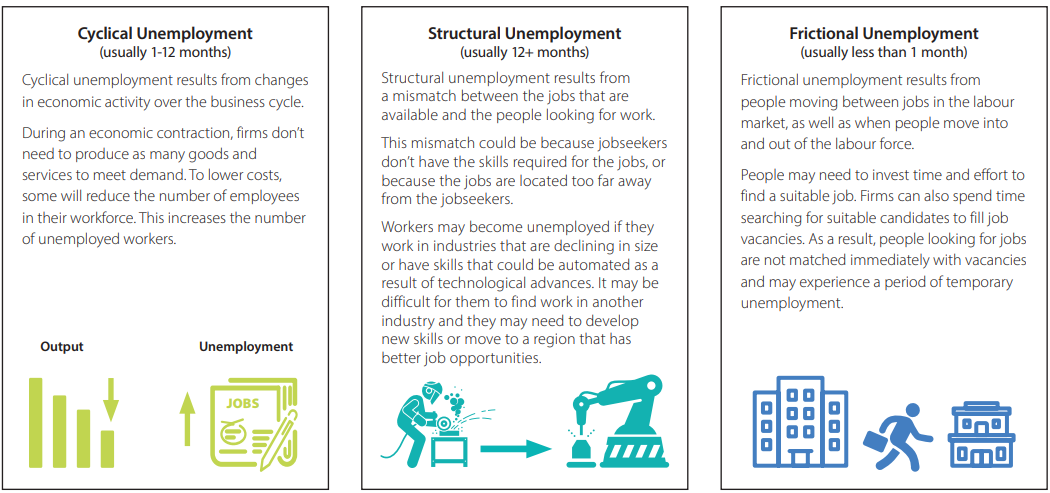
This diagram summarizes major unemployment categories and highlights the defining features of frictional and structural unemployment. It helps clarify why some unemployment persists even when the economy is at full employment, because job search and skill/location mismatches do not disappear entirely. Source
Frictional unemployment (job search)
Frictional unemployment reflects normal, short-term movement of workers between jobs and into the labor force. It persists because:
Workers and employers need time to find good matches (skills, pay, location).
People voluntarily leave jobs to search for better opportunities.
New entrants (such as graduates) take time to secure employment.
Frictional unemployment can be influenced by how quickly information and matching occur in labor markets.
Structural unemployment (mismatch)
Structural unemployment arises when there is a persistent mismatch between worker skills/locations and employer needs. It can occur when:
Technology or trade changes the mix of jobs available.
Certain industries decline while others expand.
Workers are not where the jobs are, or do not have required credentials.
Because structural issues take time to correct (retraining, relocation, credentialing), structural unemployment can remain even when the overall economy is strong.
Why the Natural Rate Matters for Measurement and Policy
Benchmark for “normal” unemployment
The natural rate provides a reference point for interpreting labor market data:
If the actual unemployment rate is near the natural rate, the economy is close to full employment.
If the actual unemployment rate is above the natural rate, the extra unemployment reflects economy-wide weakness rather than normal job search and mismatch.
If the actual unemployment rate is below the natural rate, labor markets may be unusually tight, with firms competing aggressively for workers.
Policy relevance
Because the natural rate is tied to frictional and structural factors, reducing it often requires long-run, supply-side improvements rather than short-run demand management. Policies that can affect the natural rate target the functioning of labor markets, such as:
Improving job matching and labour market information
Supporting retraining and skill acquisition
Reducing barriers to mobility or hiring
In AP terms, the natural rate helps distinguish unemployment that is likely to persist at full employment from unemployment that would fade as the economy returns to full employment.
Practice Questions
(2 marks) State what is meant by the natural rate of unemployment.
1 mark: Mentions it is the unemployment rate at full employment.
1 mark: States it equals frictional plus structural unemployment (or equivalent wording).
(5 marks) Explain why the natural rate of unemployment can be positive even when an economy is at full employment, and identify the types of unemployment included in it.
1 mark: Explains full employment does not mean zero unemployment.
1 mark: Identifies frictional unemployment as job search/transition unemployment.
1 mark: Explains why frictional unemployment persists at full employment (time to match, voluntary moves, entrants).
1 mark: Identifies structural unemployment as mismatch unemployment.
1 mark: Explains why structural unemployment persists at full employment (skills/location/industry changes take time to adjust).
FAQ
No. It depends on each country’s labour market institutions and structure (e.g., job matching efficiency, training systems, mobility, hiring regulations).
It can shift over different horizons. Structural changes (technology, sectoral shifts) are often gradual, but abrupt reallocation can raise mismatch relatively quickly.
They infer it from patterns in wage growth, vacancies, and unemployment over time, using statistical models and labour market data rather than a single direct measure.
Faster matching between vacancies and workers can reduce the duration of job search, lowering frictional unemployment and therefore reducing the natural rate.
Potentially, if achieved by reducing job-to-job movement or discouraging search for better matches, it may lower productivity growth and weaken efficient allocation of workers across firms.