AP Syllabus focus: ‘The labor force includes individuals who are employed or actively seeking employment.’
The labor force is a core concept for interpreting unemployment statistics and the economy’s use of human resources. This page clarifies who is counted, who is excluded, and why those distinctions matter.
Core idea: the labor force
Economists and statistical agencies sort people into categories that track how many individuals are supplying (or trying to supply) labor to the economy.
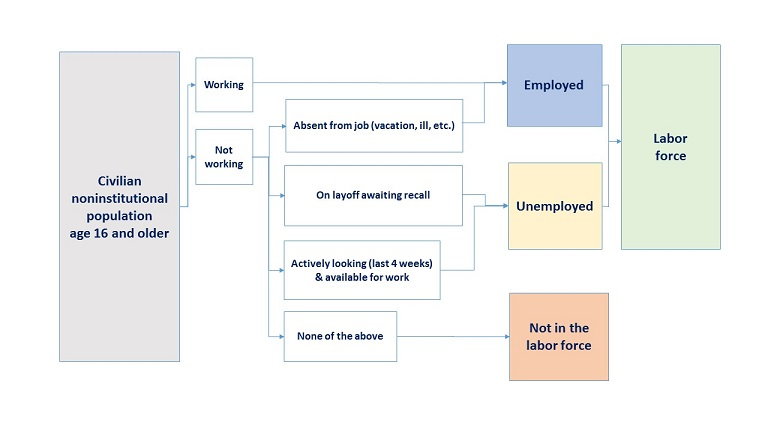
BLS’s CPS classification diagram shows the step-by-step questions used to assign a person to employed, unemployed, or not in the labor force. The visual makes clear that unemployment requires both availability and an active job search (or temporary layoff/recall expectation), while everyone else who is not working is categorized as not in the labor force. Source
Labor force: the group of people who are employed plus those who are unemployed and actively seeking employment.
Because the AP description emphasises “employed or actively seeking employment,” the key task is understanding what qualifies as each status and what does not.
Who is eligible to be counted?
Working-age civilian population (the starting pool)
Labor force concepts generally apply to the working-age civilian population, rather than to every person living in the country. While exact rules can vary by country, U.S. measurements commonly focus on civilians age 16+ and exclude certain institutionalised groups.
Important exclusions (often not eligible for classification as employed/unemployed in the headline measure) can include:
People in institutional settings (for example, prisons or long-term care facilities)
Some categories of active-duty military (often tracked separately)
These exclusions matter because they change the size of the population from which the labor force is drawn.
Employed: counted “in” the labor force
A person is employed if they currently have a job. Employment includes more than full-time wage-and-salary work.
Employed: a person who has a job (including many part-time positions) or is temporarily absent from a job but still has an employment relationship.
Common situations that still count as employed:
Part-time workers (even if they would prefer full-time work)
People temporarily absent due to illness, vacation, weather closures, or a short-term dispute, if they still have a job to return to
Many self-employed individuals (income can be irregular, but the person is still working)
The main idea is that the person is currently supplying labor through work activity or has an ongoing job attachment.
Unemployed: counted “in” the labor force only if actively seeking
A person is unemployed only if they do not have a job and are taking concrete steps to find one. Simply wanting a job is not enough.
Unemployed: a person without a job who is available to work and is actively seeking employment.
“Actively seeking” typically involves observable actions, such as:
Submitting applications or résumés
Interviewing
Contacting employers or employment agencies
People waiting to start a job soon may be treated as unemployed depending on the measurement rules, but the AP-level focus should remain on the phrase actively seeking employment.
Not in the labor force: neither employed nor actively seeking
People who are not working and not actively searching are classified as not in the labor force, even if they would take a job under the right circumstances.
Examples include:
Full-time students not looking for work
Retirees
Stay-at-home caregivers not job-searching
Individuals who want a job but have not searched recently
This category is crucial because it shows that “not unemployed” does not necessarily mean “employed”; it may mean the person is simply not participating in the labor market.
Why these categories matter for macroeconomics
Correct labor force classification helps economists:
Interpret how “tight” or “slack” the labor market is
Compare labor market conditions across time and countries (when definitions align)
Connect employment conditions to output, income, and overall economic performance
Misunderstanding the definition can lead to incorrect claims, such as assuming everyone without a job is unemployed or assuming part-time work is excluded from employment.
Common classification pitfalls (AP-relevant)
Students often make predictable mistakes:
Treating anyone without a job as unemployed (must be actively seeking)
Excluding part-time workers from employment (they are still employed)
Confusing not in the labor force with unemployed (they are different categories)
Forgetting that the labor force concept is about current participation, not long-run ability to work
Practice Questions
(2 marks) Define the labour force.
1 mark: States it includes employed people.
1 mark: States it also includes unemployed people who are actively seeking work (or equivalent wording).
(6 marks) For each person below, state whether they are employed, unemployed, or not in the labour force, and give one brief reason.
(a) A part-time shop worker.
(b) A university student who is not applying for jobs.
(c) A person without a job who submitted applications this week.
(d) A retiree who is not job-searching.
(e) A worker off sick for one week who will return to the same job.
(a) Employed: has a job (part-time counts).
(b) Not in labour force: not working and not actively seeking.
(c) Unemployed: no job and actively seeking.
(d) Not in labour force: not working and not actively seeking.
(e) Employed: temporarily absent but has a job attachment.
FAQ
To separate joblessness with current search effort from inactivity. This improves consistency in counting who is presently participating in the labour market.
Examples include submitting applications, interviewing, contacting employers, or registering with an employment agency. Passive interest (e.g., “I’d take a job”) usually does not qualify.
It depends on the statistical rules used. Some systems count certain unpaid work if it contributes to a family business; others require paid work. Always apply the definition your course/agency specifies.
They are measured separately because their work/availability conditions differ from civilian labour market behaviour, affecting comparability of unemployment statistics.
Seasonal workers are employed while working. When not working, they are unemployed only if they are available and actively seeking; otherwise, they are not in the labour force.