AP Syllabus focus: ‘Economists identify frictional, structural, and cyclical unemployment as key types.’
Unemployment is not a single phenomenon: it comes from different causes and therefore responds to different policies. Distinguishing frictional, structural, and cyclical unemployment helps interpret labour-market data and economic conditions.
Overview: Three key types
Economists separate unemployment into categories based on why workers are without jobs.
Frictional unemployment comes from normal job search and matching.
Structural unemployment comes from long-run changes that make some skills or locations less demanded.
Cyclical unemployment comes from economy-wide downturns that reduce overall spending and hiring.
These categories can overlap in real life, but the distinctions are useful for analysis and policy.
Frictional unemployment
Frictional unemployment is common even in a healthy economy because workers and firms need time to find a good match.
Frictional unemployment: Short-term unemployment caused by workers transitioning between jobs or entering/re-entering the labour force while searching for a suitable position.
Frictional unemployment is driven by information and search costs: workers do not instantly know all vacancies, and firms do not instantly know the best candidate.
Common sources of frictional unemployment
Voluntary job transitions (quitting to find a better job, relocating, changing careers)
New entrants (graduates, first-time job seekers)
Re-entrants (people returning after caregiving, education, or illness)
Seasonal patterns that create predictable gaps between jobs in some industries
Key implications
Some frictional unemployment can be viewed as beneficial because it supports better job matching, which can raise productivity and wages over time.
Policies that improve job market information (posting platforms, placement services) can reduce the time spent unemployed without reducing job mobility.
Structural unemployment
Structural unemployment reflects a mismatch between worker characteristics and employer needs, often lasting longer than frictional unemployment.
Structural unemployment: Unemployment caused by a persistent mismatch between workers’ skills and locations and the skills and locations demanded by employers.
Structural unemployment tends to rise when an economy changes its industrial composition (what it produces) or production methods (how it produces).
Causes of structural unemployment
Technological change that reduces demand for certain tasks (automation, new software)
Globalisation and trade shifts that expand some industries and shrink others
Geographic immobility (jobs move, workers cannot or will not relocate)
Institutional and incentive factors that slow adjustment (credential requirements, hiring frictions, long retraining periods)
What to look for
High unemployment concentrated in specific regions, industries, or demographic groups
Many vacancies existing alongside many unemployed workers (a sign of mismatch rather than weak overall demand)
Cyclical unemployment
Cyclical unemployment varies with the business cycle, rising in recessions and falling in expansions.
Cyclical unemployment: Unemployment caused by a decline in overall economic activity that reduces aggregate demand for goods and services, leading firms to cut production and employment.
When households, firms, or governments reduce spending, firms experience lower sales, so they may reduce hours, freeze hiring, or lay off workers.
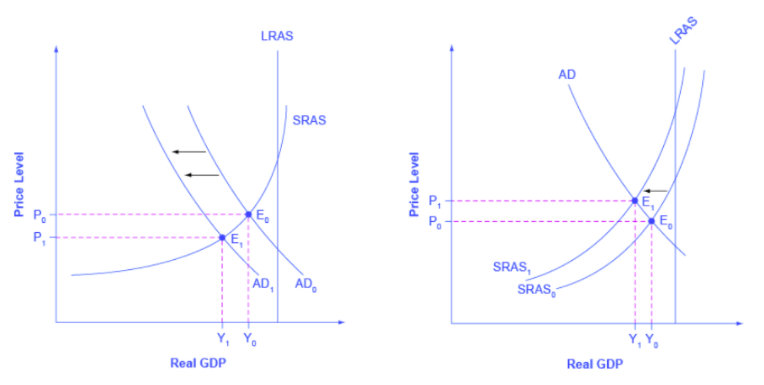
This AD–AS diagram illustrates how a negative shock (such as a fall in consumer or business confidence) can shift aggregate demand left, reducing real GDP below potential output. The gap between actual output and potential output corresponds to cyclical unemployment, because firms need fewer workers when economy-wide spending and production fall. Source
Why cyclical unemployment occurs
Firms respond to weaker demand by lowering output, which reduces the demand for labour.
Layoffs can spread across many sectors at once, even for workers whose skills are still valuable in normal times.
Interpreting cyclical unemployment
It is closely tied to recession indicators (falling output, falling income, reduced hiring).
It tends to be more responsive to stabilisation policy than structural unemployment, because the underlying issue is insufficient economy-wide spending rather than mismatch.
Practice Questions
(2 marks) Define cyclical unemployment.
1 mark: States it is unemployment linked to the business cycle/recessions.
1 mark: Explains it results from falling aggregate demand/output causing firms to reduce employment.
(6 marks) Explain two differences between frictional and structural unemployment, and give one policy measure that could reduce each type.
1 mark: Identifies a valid difference (e.g. duration/short-run vs persistent).
1 mark: Explains the difference.
1 mark: Identifies a second valid difference (e.g. search/matching vs skills/location mismatch).
1 mark: Explains the second difference.
1 mark: Policy to reduce frictional unemployment (e.g. improved job matching services/information).
1 mark: Policy to reduce structural unemployment (e.g. retraining, mobility support), with brief linkage.
FAQ
They look for mismatch signals such as persistent vacancies alongside high unemployment, sectoral/regional concentration, and wage patterns.
They also compare across industries: cyclical rises tend to be broad-based, while structural rises cluster.
Strong economies can encourage job switching as workers search for better matches.
More entrants (graduates, migrants) and faster firm growth can increase turnover, temporarily raising frictional unemployment.
Retraining takes time, and workers may face barriers such as costs, credentials, or relocation constraints.
Firms may also change requirements faster than education and training systems adapt.
Yes. Rapid changes can create short job-search periods (frictional) while also making some skills obsolete (structural).
The distinction often depends on whether workers can transition quickly with existing skills.
If wages are slow to adjust downward in declining sectors, firms may hire fewer workers there.
This can prolong mismatch until workers retrain, relocate, or demand shifts to sectors where wages better reflect productivity.