AP Syllabus focus: ‘The labor force participation rate measures the percentage of the adult population in the labor force.’
The labor force participation rate (LFPR) helps you interpret how much of a country’s working-age population is connected to the labour market. It adds crucial context to unemployment figures and overall economic capacity.
Core idea: participation, not joblessness
The LFPR focuses on whether people are in the labor force, not whether they currently have a job. This makes it a key indicator of how widely the economy’s human resources are being used or offered for use.
Labor force participation rate (LFPR): The percentage of the adult population that is in the labor force.
A higher LFPR means a larger share of adults are either working or actively trying to work; a lower LFPR means more adults are outside the measured labor market (for example, in school, retired, or not seeking work).
Components you must identify correctly
Adult population (the denominator)
For AP Macroeconomics, the adult population typically refers to the civilian noninstitutional population age 16 and over. It excludes:
Active-duty military
People in institutions (for example, prisons or long-term care facilities)
The denominator matters because changes in population definitions or eligibility can shift the LFPR even if behavior is unchanged.
Labor force (the numerator)
The labor force includes:
Employed people
Unemployed people who are actively seeking work and available to work
It excludes people who are not working and not actively searching, such as many full-time students, some caregivers, and discouraged workers (people who want a job but stopped searching).
The key equation (know it cold)
= Labor force participation rate, percent
= Employed + unemployed actively seeking work, people
= Civilian noninstitutional population age 16+, people
Because LFPR is a percentage, it is best compared over time or across countries with care about differing definitions and demographics.
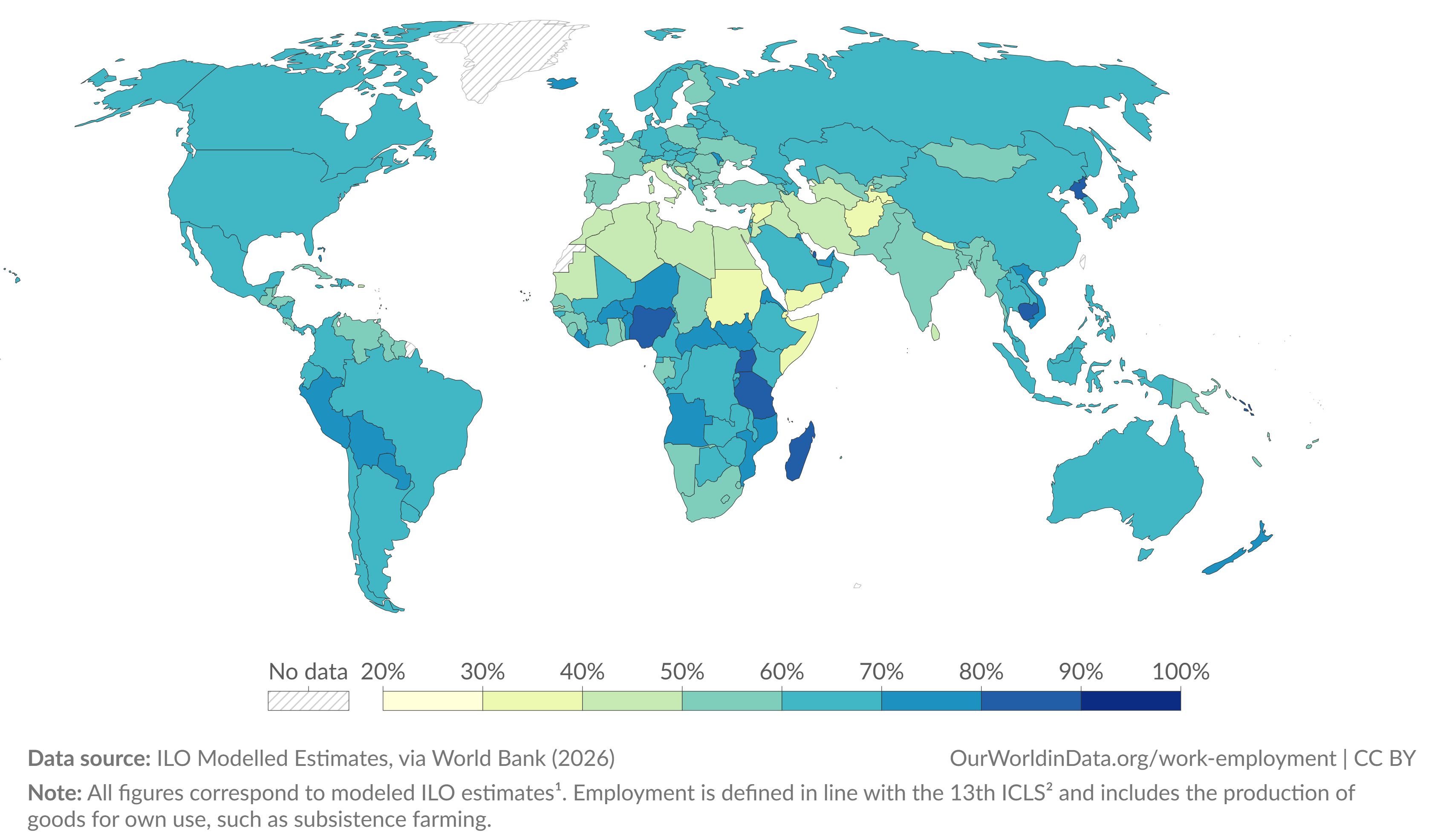
Interactive cross-country visualization of labor force participation rates (ILO-modelled estimates), enabling comparisons across nations and over time. It reinforces that LFPR measures the share of the working-age population that is economically active (employed or actively seeking work), while also highlighting that cross-country comparability depends on consistent definitions. Source
How to interpret changes in LFPR
When LFPR rises
An increase in LFPR generally means more adults are:
Entering jobs
Starting active job searches
Re-entering after time out of the labor market
A rising LFPR can signal expanding opportunities, stronger wages, or improved access to work (for example, childcare availability).
When LFPR falls
A decrease in LFPR means more adults are outside the labor force. Common interpretations include:
Aging population and higher retirement rates
More schooling or training (delayed entry)
More caregiving responsibilities
Discouragement after unsuccessful job search (exit from active searching)
A falling LFPR can coincide with either good news (more education) or bad news (workers giving up), so context is essential.
Why LFPR matters for macro analysis
LFPR helps evaluate the economy’s potential workforce and the breadth of labour-market engagement. It is especially useful for:
Assessing whether changes in unemployment reflect job creation versus people leaving/entering the labor force
Understanding productive capacity constraints tied to available workers
Comparing labour market engagement across demographic groups (age, gender) and over long periods
In practice, economists track LFPR alongside employment measures to understand whether the economy is drawing people into the workforce or leaving potential workers on the sidelines.
Practice Questions
(2 marks) Define the labour force participation rate and state what its numerator and denominator represent.
1 mark: Correct definition (percentage of adult population in the labour force).
1 mark: Numerator = labour force; denominator = adult population (working-age civilian noninstitutional population), both correctly described.
(6 marks) Explain two reasons why the labour force participation rate might fall during a weak economy, even if the adult population is rising.
1 mark: Identifies reason 1 (e.g., discouraged workers stop actively searching).
2 marks: Explains mechanism for reason 1 (exit from active search removes them from labour force, lowering numerator relative to denominator).
1 mark: Identifies reason 2 (e.g., delayed entry via education/training, early retirement, increased caregiving).
2 marks: Explains mechanism for reason 2 (more adults counted in population but not in labour force, reducing participation rate).
FAQ
Typically, it requires specific job-search actions within a recent reference period (for example, contacting employers or submitting applications).
Passive interest (e.g., “want a job”) without recent search activity usually does not count.
Yes. It can shift due to compositional changes in the adult population, such as ageing into higher-retirement age groups.
It can also move if institutional definitions or survey methods change.
A larger share of adults may be in full-time education or training, reducing the proportion actively working or searching.
Cultural norms and education system structure can amplify this effect.
‘Not employed’ includes both the unemployed (actively searching) and those not in the labour force.
‘Not in the labour force’ specifically means not working and not actively seeking work.
Policies can lower barriers to participation, such as:
Childcare support
Transport access
Work authorisation and re-entry programmes
Disability accommodation and rehabilitation
These can raise participation by increasing the share of adults able to search for or take jobs.