

AP Syllabus focus: 'The elementary charge e is the smallest indivisible amount of charge used in the course. A point charge models a charged object whose physical size is negligible in the situation analyzed.'
This subsubtopic introduces two core modeling ideas in electrostatics: charge is treated as coming in discrete units, and many real charged objects can be simplified when their size is unimportant to the analysis.
Elementary Charge as a Basic Unit
The elementary charge is the basic unit of electric charge used in AP Physics 2 Algebra. This means charge is not treated as continuously divisible without limit. Instead, the net charge of an object is modeled as being built from whole-number multiples of a smallest charge amount, written as .
When physicists say charge is quantized, they mean that an object’s charge must come in allowed amounts based on this fundamental unit.
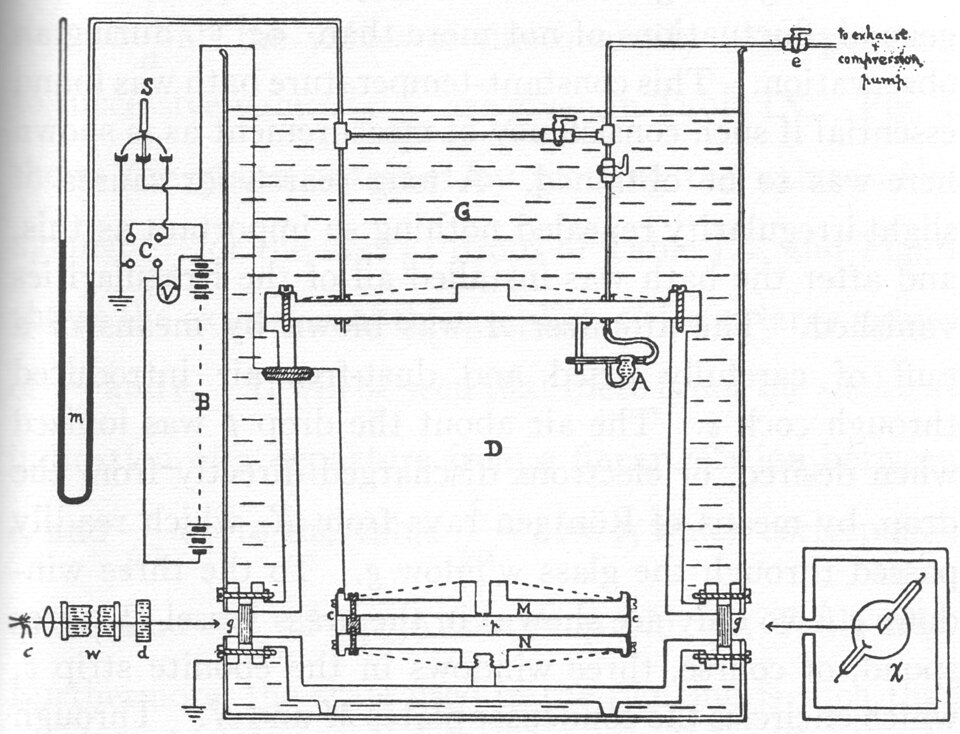
Schematic of Millikan’s oil-drop apparatus used to measure the elementary charge by balancing gravitational and electric forces on tiny charged droplets. The diagram highlights the key components (plates, field region, illumination/observation) that make it possible to infer that measured charges occur in integer multiples of a smallest unit, . Source
A charged object may have a large net charge or a very small net charge, but in this course that charge is still described using whole multiples of .
Elementary charge: The smallest indivisible amount of charge used in this course.
A useful way to express this idea is with a simple relationship between an object’s net charge and the number of elementary charges it contains in excess or deficit.
= net charge on an object, in coulombs
= integer number of elementary charges
= elementary charge
In this equation, must be an integer. That is the key idea. It can be positive, negative, or zero, depending on the object’s overall charge, but it is not a random decimal value. So a charge such as or fits the model, while a charge such as does not.
What “indivisible” means here
The phrase smallest indivisible amount is about the model used in this course.
Charge is treated as made of discrete packets.
Net charge changes in steps of .
Fractional pieces of are not used in standard AP Physics 2 Algebra charge models.
This idea is important because it connects microscopic and macroscopic thinking. A visible object may carry a net charge that seems smooth when measured, but the model still interprets that charge as a very large whole-number multiple of the elementary charge.
Point Charge Models
Many problems in electrostatics become much easier if a charged object can be treated as a point charge.
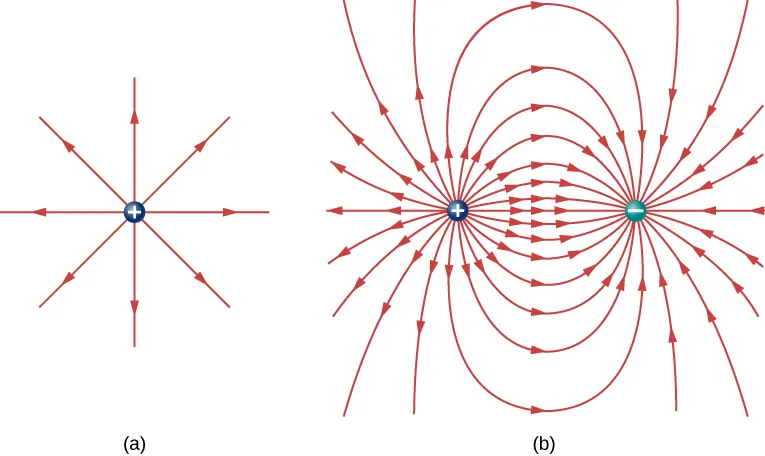
Electric field lines for (a) a positive point charge and (b) an electric dipole. The diagram emphasizes that field direction is tangent to the field lines, and that field strength is represented qualitatively by the density of lines (more crowded lines indicate a stronger field). Source
This does not mean the object literally has no size. It means its physical size is negligible in the situation analyzed.
Point charge: A model of a charged object in which the object’s size is small enough to ignore for the situation being studied.
The phrase “in the situation analyzed” is essential. Whether an object can be treated as a point charge depends on the scale of the problem. The same object might be a good point-charge model in one case and a poor one in another.
When the model is appropriate
A point-charge model is usually reasonable when:
the distance between interacting objects is much larger than the size of each object
only the overall effect of the charge matters
details of the object’s shape are not important to the question being asked
For example, if a charged sphere is very small compared with the distance to another object, its exact diameter may have little effect on the result. In that case, treating it as a point charge is a useful approximation.
What the model does not mean
A point charge model is a simplification, not a statement about the object’s actual physical structure.
It does not mean the object truly has zero size.
It does not mean every part of the object is at the same location.
It means the object’s size can be ignored without significantly affecting the analysis.
This is a common theme in physics: a model is judged by whether it is useful and accurate enough for a specific situation, not by whether it copies every physical detail.
Connecting the Two Ideas
These two ideas often appear together. A charged object can have a net charge equal to a whole-number multiple of , and at the same time be represented as a point charge if its size is negligible.
The two ideas answer different questions:
Elementary charge tells you how much charge is allowed.
Point charge tells you how to represent the object in a model.
That distinction matters. A point charge does not mean the object has only one elementary charge. A point charge can represent an object with a very large net charge, as long as the object’s size is unimportant in the analysis.
Why this matters in later electrostatics
Much of electrostatics relies on deciding what details matter and what details can be ignored. The elementary charge idea keeps the description of charge discrete and physically meaningful. The point charge idea lets you simplify real objects into idealized ones when distance and scale justify it.
Together, these ideas support clear reasoning about charged systems without forcing every problem to include the full size, shape, and internal structure of each object.
Common Errors to Avoid
Thinking small automatically means point charge. The correct question is whether the size is negligible compared with the length scale of the problem.
Treating in as any number. It must be an integer.
Confusing a point charge with a single elementary charge. They are different ideas.
Forgetting that a model may work well in one scenario and fail in another if the distance scale changes.
Practice Questions
A charged object has net charge .
State what this tells you about the object’s charge, and explain whether a charge of would be allowed in this course model.
1 mark: States that the object’s net charge is a whole-number multiple of the elementary charge, with negative sign.
1 mark: States that is not allowed because charge is modeled in integer multiples of .
A small charged sphere has diameter .
In experiment A, it is studied while it is from another charged object.
In experiment B, it is studied while it is from another charged object.
(a) In which experiment is the sphere more reasonably modeled as a point charge? Explain.
(b) Explain why the same object can be treated as a point charge in one situation but not as well in another.
(c) A student says, “If the sphere is modeled as a point charge, then it must carry only one elementary charge.” Explain why this statement is incorrect.
1 mark: Identifies experiment A as the better point-charge model.
1 mark: Explains that in experiment A the object’s size is negligible compared with the separation distance.
1 mark: Explains that in experiment B the size is not negligible compared with the separation distance, so size may matter.
1 mark: States that whether a point-charge model is valid depends on the situation analyzed or the scale of the problem.
1 mark: Explains that a point charge is a size-based model, not a statement that the object has only one elementary charge.
FAQ
Not exactly.
It means AP Physics 2 Algebra uses $e$ as the basic charge unit for modeling ordinary electrostatic situations. The course does not require you to go beyond that level of description.
So this is a modeling choice for the course, not a claim that all deeper particle physics has been ruled out.
By convention, $e$ represents the magnitude of the elementary charge.
The sign of an object’s net charge is handled separately in expressions like:
$q = +ne$
$q = -ne$
This keeps the basic unit positive while allowing the total charge to be positive, negative, or zero.
Sometimes, but only as an approximation.
It can be reasonable if:
you are very far from the group compared with its overall size
you only need a simplified description
the detailed arrangement does not significantly affect the result
If the internal spacing or arrangement matters, one point charge is not a good replacement.
Warning signs include:
the object’s size is comparable to the distance involved
the object’s shape begins to matter
different parts of the object would not all behave as if they were at one location
changing the object’s orientation would affect the result
When those features matter, a more detailed model is needed.
Because the elementary charge is extremely small compared with the total charge on everyday objects.
A macroscopic object can gain or lose an enormous number of elementary charges. As a result, measured values can appear smooth even though the underlying charge is still built from discrete units.
So quantization is still present, but it may not be obvious at ordinary scales.
