

AP Syllabus focus: 'Gravitational forces dominate at large scales even though they are weaker than electrostatic forces, because large-scale systems tend to be electrically neutral.'
This topic explains a key physics idea: the strongest force between individual particles does not necessarily control the behavior of planets, stars, or galaxies. Large-scale behavior depends strongly on cancellation.
Why this idea matters
At the level of individual particles, electrostatic forces are extremely strong. That can make it seem as though electric interactions should control the structure of the universe. However, large astronomical systems do not behave like isolated pairs of charged particles. They contain enormous numbers of particles, and the overall charge pattern matters more than the strength of any one interaction.
The central reason gravity dominates on large scales is that most large objects are almost electrically neutral.
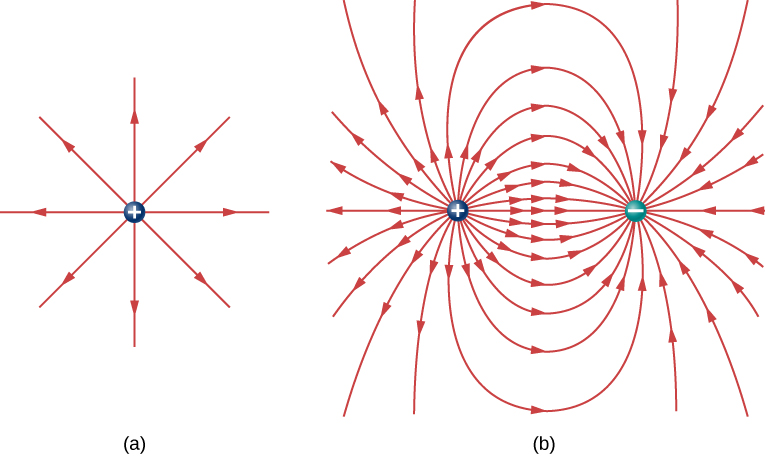
Electric field lines for a dipole (a + charge and a − charge) illustrate how opposite charges produce field contributions in opposite directions. Far from the pair, the field pattern becomes much weaker than it is near the charges, providing a visual reason that near-neutral collections of matter do not generate strong long-range electric forces. The diagram also shows how field-line density qualitatively represents field strength. Source
Their total positive charge and total negative charge are very nearly equal, so their large-scale electric effects mostly cancel out.
A electrically neutral system is central to this idea.
Electrically neutral: A system with equal total positive charge and total negative charge, so its net charge is zero.
Because large-scale objects tend to be neutral, electrostatic forces usually do not build into a large net force across the whole object. Gravity, by contrast, remains important across the entire mass of the system.
Large-scale neutrality
Most ordinary matter is made of atoms containing positive protons and negative electrons. In bulk matter, the numbers of protons and electrons are usually balanced very closely. That means a large object such as a rock, planet, or star usually has little or no net charge.
This does not mean there are no electric interactions inside the object. Electric forces are still essential within atoms and materials.
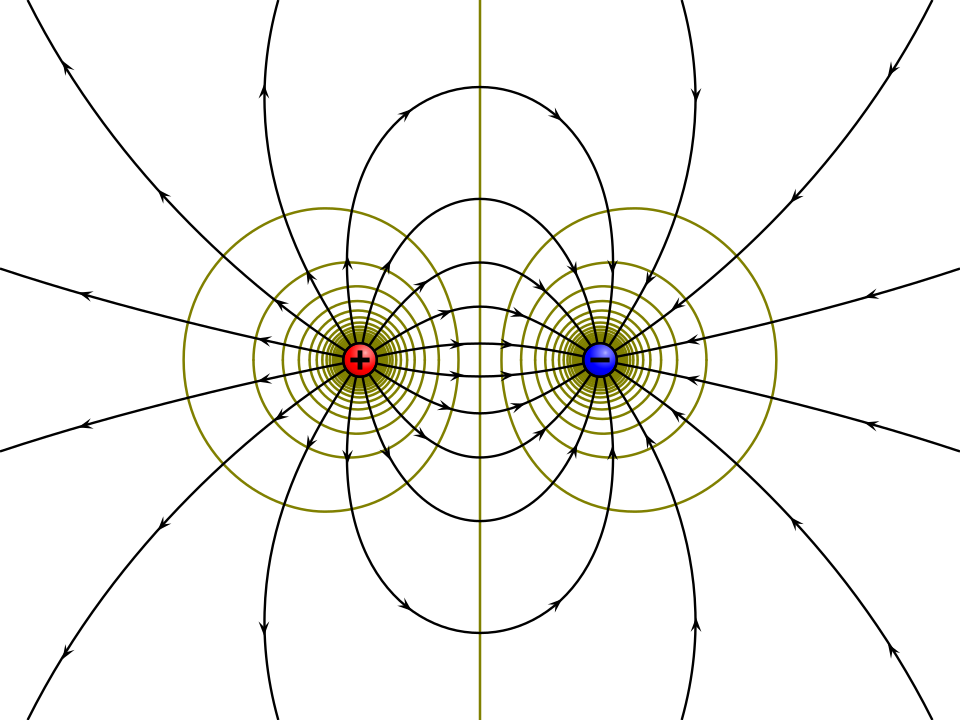
Field lines (direction of the electric field) and equipotential lines (constant electric potential) are shown around a +/− charge pair. The perpendicular relationship between field lines and equipotentials helps connect the qualitative picture of “cancelling contributions” to the idea of electric potential landscapes. This is especially useful for explaining why local electric structure can be strong even when a system’s net charge is zero. Source
The important point is that, when considering the object as a whole, those positive and negative charges almost balance.
Large-scale neutrality matters because:
the total charge of a large body is usually very close to zero
positive and negative contributions to the electric field tend to oppose each other
the remaining net electrostatic effect is often very small compared with the total amount of matter present
Even a tiny charge imbalance can create noticeable local effects, but on planetary, stellar, and galactic scales, matter is usually close enough to neutral that those imbalances do not control the overall motion of the system.
Why electrostatic effects cancel so well
Electric forces depend on charge. Since charge comes in two types, positive and negative, the effects from many particles can cancel when both types are present in nearly equal amounts.
For a large neutral object:
one region may contain positive charge
another region may contain negative charge
the combined effect at large distances is much smaller than the sum of the individual microscopic forces
This cancellation is the key reason electrostatic forces do not usually dominate large-scale structure. The force between two individual charged particles may be enormous compared with their gravitational attraction, but a star or planet is not a single charged particle. It is a huge collection of matter with nearly balanced charge.
As more and more particles are grouped into a large neutral system, the electric influence does not simply add up without limit.
Instead, opposite charges reduce one another’s large-scale effect. That makes electrostatic interactions very important microscopically, but often far less important macroscopically.
Why gravity survives the averaging
Gravity behaves differently in large systems. Every part of a massive object contributes to the object’s gravitational pull. When matter is collected into a planet, star, or galaxy, the gravitational effects of all that mass combine into a significant large-scale attraction.
The crucial contrast is this:
electric effects are often reduced by charge cancellation
gravitational effects continue to accumulate with the amount of matter present
Because of this, gravity becomes the dominant interaction for very large collections of matter spread over enormous distances. It is not that gravity becomes stronger than the electrostatic force between particles. Rather, gravity becomes more important for the overall system because it is not neutralized in the same way.
That is why large-scale motion in the universe is described mainly by gravity, even though electric forces are stronger in particle-by-particle comparisons.
Consequences for planets, stars, and galaxies
The motion of moons around planets, planets around stars, and stars within galaxies is governed mainly by gravity. These systems contain vast amounts of matter, and their near-neutrality prevents electrostatic forces from producing a comparably large overall effect.
This idea also explains why:
astronomical objects can interact strongly through gravity over long distances
large-scale cosmic structure forms through gravitational attraction
electric forces do not usually determine the overall paths of neutral celestial bodies
A planet may contain countless charged particles internally, but because the object is nearly neutral overall, those charges do not produce a dominant long-range electric interaction with other large neutral bodies.
What to say on AP Physics 2 questions
For AP Physics 2, the most important reasoning is conceptual. If asked why gravity dominates at large scales, focus on these ideas:
large-scale systems tend to be electrically neutral
equal amounts of positive and negative charge cause electric effects to mostly cancel
the cancellation makes the net electrostatic interaction between large bodies small
gravity still acts on all the mass in the system, so its large-scale effect remains significant
A strong response should avoid saying that gravity is stronger than electrostatic force. That is not the point. The correct explanation is that gravity dominates large-scale systems because electric charge is usually balanced, while mass still contributes to gravitational attraction across the whole system.
Practice Questions
Explain why gravity, rather than electrostatic force, usually determines the motion of planets and stars.
1 mark: States that large-scale objects tend to be electrically neutral.
1 mark: States that positive and negative charges mostly cancel, so the net electrostatic force is small, while gravity still acts on the mass of the objects.
A student says, “Since electrostatic forces between particles are much stronger than gravitational forces, galaxies should be held together mainly by electric forces.” Evaluate this statement using ideas about large-scale charge distribution.
1 mark: States that galaxies and other large-scale systems tend to be electrically neutral.
1 mark: Explains that large amounts of positive and negative charge are both present.
1 mark: Explains that these charges mostly cancel, reducing the net electrostatic effect on large scales.
1 mark: Explains that gravity acts on all the mass in the system and does not cancel in the same way.
1 mark: Gives the correct overall conclusion that gravity dominates large-scale structure even though electrostatic forces are stronger between individual charged particles.
FAQ
A plasma contains many free electrons and ions, so charges can move independently.
Even so, most large plasmas are quasi-neutral, meaning the total positive and negative charge is nearly balanced over large regions. Small local imbalances can exist, but they usually do not remain large for long because mobile charges quickly respond and reduce them.
Usually no. If a planet or star develops a significant net charge, it tends to attract opposite charge from its surroundings or repel additional like charge.
Because of this self-correcting behavior, very large long-lasting charge imbalances are difficult to maintain. The object may have tiny temporary imbalances, but not enough to dominate its large-scale motion.
Lightning shows that electric forces can be very strong locally when charge separation builds up in the atmosphere.
However, lightning is also a discharge process that reduces that imbalance. It does not mean Earth as a whole has a large net charge controlling its motion in space. The event is powerful but regional and temporary.
Magnetic fields can strongly affect charged particles, especially in plasmas around stars and in space.
But magnetic effects usually do not replace gravity as the main force governing the overall motion of large neutral bodies such as planets, stars, and galaxies. Gravity still sets the dominant large-scale structure and orbital behavior.
Only if there were a sustained, very large net charge separation across huge distances.
That is hard to maintain because opposite charges attract, like charges repel, and free charges often move so as to reduce imbalance. So while electric forces can dominate in special environments, large-scale systems generally return to near-neutrality, leaving gravity as the main large-scale influence.
