

AP Syllabus focus: 'Electric forces cause some macroscopic properties of everyday objects, but many particle interactions make contact forces such as normal force, friction, and tension more convenient models.'
Many familiar pushes, pulls, and supports seem purely mechanical, but at the atomic scale they come from electric interactions. In everyday physics, contact-force models are usually the most useful way to describe them.
Electric forces beneath everyday contact
Everyday objects seem to interact by simply touching. At the microscopic level, though, matter is made of atoms and molecules containing charged particles. When two objects are brought together, the charged particles in one object interact electrically with the charged particles in the other. These countless interactions produce the large-scale effects we observe, such as support, resistance to sliding, and pulling through a rope.
At the scale of whole objects, physicists often describe these effects using a contact force rather than tracking every microscopic interaction separately.
Contact force: A force that acts when objects interact through touching or through a material connection, modeled without tracking the individual particle interactions inside the materials.
This is a modeling choice. The force is still rooted in electric interactions, but the contact-force description is far more practical for analyzing visible objects.
Normal force
When a surface supports an object, the support is described by the normal force.
Normal force: The contact force exerted by a surface on an object, directed perpendicular to the surface.
A book resting on a table is a good example. The book does not fall through the table because the particles in the table resist being compressed by the particles in the book. That resistance comes from electric interactions within and between the materials. At the macroscopic level, we simply say the table exerts an upward normal force on the book.
This model is useful because it captures the overall effect of the surface on the object. Instead of drawing millions of tiny electric forces in a free-body diagram, we draw one normal force.
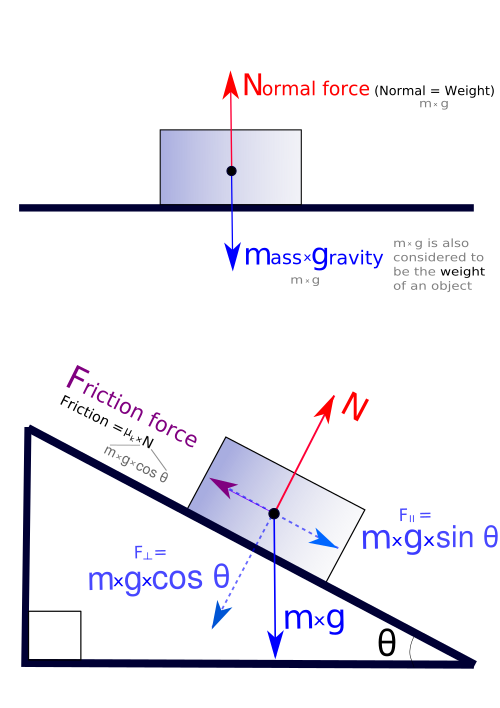
Free-body diagram of a block on a surface showing the weight vector downward and the contact-force components from the surface: normal force perpendicular to the surface and friction parallel to the surface. This reinforces how contact interactions are modeled as a few external forces acting on the object rather than tracking microscopic electric forces. Source
Friction
Motion or attempted motion along a surface involves friction.
Friction: A contact force parallel to a surface that opposes sliding or the tendency to slide between surfaces.
Friction also arises from electric interactions. Real surfaces are not perfectly smooth, even if they appear smooth to the eye. At the microscopic level, surface particles interact in complicated ways, including local attractions and resistance as irregularities press against one another. The combined result is a force that resists relative motion.
When a box is pushed across a floor, it is much more convenient to represent all of those microscopic effects with a single friction force. This lets us predict motion without needing a detailed atomic description of the floor and the box.
Tension
When a rope, cable, or string pulls on an object, the force is called tension.
Tension: The pulling contact force transmitted through a stretched rope, string, cable, or similar connector.
At the particle level, the material of the rope is held together by electric interactions. If one end is pulled, the particles shift slightly, and those internal interactions transmit the pull through the material. The rope then exerts a tension force on whatever is attached to it.
Again, the contact-force model is preferred because it is simple and effective. For most AP Physics 2 situations, we do not need the microscopic details of the rope’s internal structure. We only need the net pulling force it exerts.
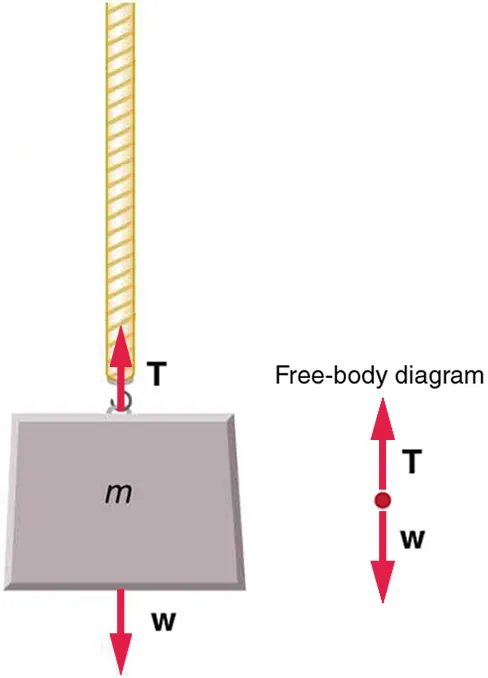
Diagram of a mass supported by a rope, with a corresponding free-body diagram showing tension upward and weight downward. It illustrates tension as the external pulling force the rope exerts on the object, simplifying the analysis to two forces when the mass is hanging at rest. Source
Why contact-force models are preferred
In principle, many everyday forces could be described as the sum of huge numbers of microscopic electric interactions. In practice, that description is too complicated to be useful in most mechanics problems. Contact-force models are preferred because they:
reduce enormous particle complexity to a small number of forces
match the scale at which we observe motion in everyday life
make free-body diagrams possible
allow accurate predictions without unnecessary microscopic detail
This does not mean the electric origin disappears. It means the macroscopic model is better suited to the question being asked.
Everyday objects and macroscopic properties
The specification emphasizes that electric forces cause some macroscopic properties of ordinary matter. These are properties seen at the scale of visible objects rather than individual particles. Examples include:
a table supporting a lamp
shoes gripping the floor while walking
a rope pulling a bucket
a wall preventing a cart from moving farther
In each case, the observable force is modeled as normal force, friction, or tension. These are not separate fundamental interactions competing with electric force. They are convenient macroscopic descriptions of how electric interactions in matter appear in ordinary situations.
Key AP Physics 2 idea
A common mistake is to think that contact forces and electric forces are unrelated categories. The more accurate view is that many contact forces are the net result of many electric interactions between particles in materials. AP Physics 2 focuses on choosing the model that best fits the scale of the problem.
For everyday objects, the most useful model is usually the contact-force model. It keeps the important physical behavior while avoiding impossible microscopic detail. So when you analyze a book on a table, a person walking, or a rope pulling a cart, remember that the underlying cause is electric, but the practical description is often normal force, friction, or tension.
Practice Questions
A student says, “The normal force is a completely different kind of force from electric force.”
State whether this statement is correct and justify your answer.
1 mark: States that the statement is incorrect.
1 mark: Explains that the normal force is a macroscopic model for the net effect of many electric interactions between particles in the two materials.
A block is pulled across a horizontal floor by a rope at constant speed.
Identify the contact forces acting on the block. For each force, explain how it is related to electric interactions at the particle level. Then explain why using contact-force models is more convenient than describing all of the electric interactions directly.
1 mark: Identifies the normal force from the floor on the block.
1 mark: Identifies the friction force from the floor on the block.
1 mark: Identifies the tension force from the rope on the block.
1 mark: Explains that each of these forces comes from many electric interactions between particles in the contacting materials.
1 mark: Explains that contact-force models are more convenient because tracking all microscopic interactions is impractical, while the net forces are sufficient to analyze the block’s motion.
FAQ
Not in the everyday sense of tiny hard pieces making perfect contact.
When two solids are pressed together, the outer electron regions of their atoms interact strongly. Those electric interactions create the repulsion that prevents the objects from passing through each other. So what we call “touching” is really a macroscopic effect of microscopic electric interactions.
The basic interaction is electric, but the arrangement of particles in a material matters a lot.
In rigid materials, particle positions strongly resist change.
In softer materials, particles can shift more easily.
Bonding structure and internal spacing affect how much a material compresses or bends.
So different materials respond differently even though the underlying cause is still electric interaction between particles.
A surface that looks smooth to your eye is still rough and structured at very small scales.
Microscopic bumps, variations in particle arrangement, and local electric attractions all contribute to friction. Even highly polished surfaces have tiny regions where particle interactions resist sliding. That is why friction depends on more than just what a surface looks like visually.
In the ideal AP Physics model, no. Tension is a pulling force only.
If you try to push with a rope or string, it usually goes slack or buckles because it cannot maintain the internal alignment needed to transmit a push. A rigid rod can push, but that is not described as tension in the same way an ideal string or rope is.
In reality, changes in force move through materials at a finite speed because particles influence neighboring particles step by step.
In many AP-level problems, that delay is so small compared with the time scale of the motion that we ignore it. This makes the model much simpler while still being accurate enough for everyday situations involving normal force, friction, and tension.
