

AP Syllabus focus: 'Coulomb's law describes electrostatic force as directly proportional to each charge magnitude and inversely proportional to the square of the distance between the objects.'
Coulomb's law is the main quantitative model for the size of electric forces between charged objects, and it lets you predict how force changes without always doing a full calculation.
Understanding Coulomb's Law
Coulomb's law describes how strongly two charged objects interact.

Two point charges and are separated by distance , with force vectors drawn on each charge to show the interaction along the line joining them. The figure contrasts like charges (repulsion) and unlike charges (attraction) while keeping the magnitudes equal and opposite, consistent with Newton’s third law. Source
In this subsubtopic, the emphasis is on force magnitude, meaning the size of the force rather than its direction. The law shows that two ideas control the interaction: the charge magnitude of each object and the separation distance between them.
Coulomb's law: The rule that gives the magnitude of the electrostatic force between two charged objects from their charge magnitudes and separation distance.
For AP Physics 2 Algebra, this law is used both for full numerical calculations and for quick proportional reasoning about how a force changes when one variable changes.
= magnitude of electrostatic force, newtons
= Coulomb constant,
and = charge magnitudes, coulombs
= separation distance, meters
The constant sets the scale of the interaction in vacuum or air. Because is large, even charges much smaller than can produce measurable forces.
Why the Charge Magnitudes Matter
The numerator contains the product , so the force is directly proportional to each charge magnitude. If one charge changes by a certain factor while the other charge and the distance stay constant, the force changes by that same factor.
Doubling one charge doubles the force.
Tripling one charge triples the force.
Halving one charge halves the force.
If both charges change, multiply the factors together. For example, doubling both charges makes the force four times as large. If either charge has zero magnitude, the force magnitude is zero in this model.
This part of the equation also shows symmetry. It does not matter which charge is called or ; the calculated force magnitude is the same. What matters is the product of the two charge magnitudes.
Why Distance Matters Even More
Distance appears in the denominator as , so the force does not weaken linearly with separation.
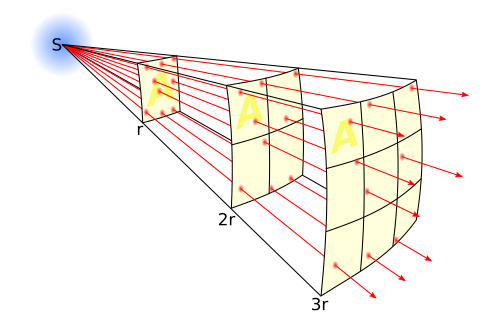
A point source emits uniformly in all directions, so the same output must pass through spherical surfaces whose area increases as . As increases, the intensity (and inverse-square-type effects like field strength) must decrease in proportion to , matching the structure of Coulomb’s law. Source
It follows an inverse-square relationship.
Inverse-square relationship: A relationship in which one quantity changes in proportion to .
Because the distance is squared, separation changes often matter more than charge changes.
If the distance doubles, the force becomes one-fourth as large.
If the distance triples, the force becomes one-ninth as large.
If the distance is cut in half, the force becomes four times as large.
If the distance is cut to one-third, the force becomes nine times as large.
This rapid change is one of the most important features of Coulomb's law. A common AP mistake is to think the force is simply inversely proportional to distance. That is incorrect. The denominator is , not . A change from to does not make the force half as large; it makes the force one-fourth as large.
Using Coulomb's Law Correctly
To use the equation successfully, pay close attention to units and to what each symbol represents.
Charge must be in coulombs. Many problems use smaller quantities such as microcoulombs or nanocoulombs, so unit conversion is often necessary.
Distance must be in meters.
The distance is the separation between the charged objects.
The equation above gives magnitude, so the final answer should be positive.
Coulomb's law is also a powerful comparison tool. Many questions can be answered without calculating a full numerical value. If a charge changes by a factor of and the distance changes by a factor of , then the force magnitude changes by a factor of , as long as only one charge changes. If both charges change, combine both charge factors before applying the distance factor.
Patterns Worth Memorizing
These proportional patterns appear repeatedly in AP Physics 2 Algebra:
One charge changes: the force changes by the same factor.
Both charges change: multiply the two charge factors together.
Only distance changes: use the inverse square of the distance factor.
Charge and distance both change: combine the charge factor and the inverse-square distance factor in one ratio.
This kind of reasoning is often faster and less error-prone than substituting numbers immediately. It also helps you check whether a calculated answer makes physical sense.
Interpreting the Formula Physically
Coulomb's law shows that electric force can become strong very quickly when charged objects are brought close together. It also shows that increasing separation is an especially effective way to reduce the interaction because distance is squared.
A useful reading strategy is built directly into the equation:
Look at the numerator to see how charge magnitudes scale the force directly.
Look at the denominator to see how distance scales the force more strongly through squaring.
Decide whether the problem asks for a numerical force magnitude or only a comparison between two situations.
Frequent Mistakes
Forgetting the square on
Using charge values without converting to coulombs
Treating a doubled distance as a doubled denominator instead of a fourfold denominator
Squaring each charge separately instead of using the product
Reporting a negative value when the question asks only for force magnitude
Practice Questions
A pair of charged objects exerts an electrostatic force of magnitude . One of the charges is tripled while the distance between the objects stays the same. What is the new force magnitude?
(2 marks)
1 mark for stating the new force is
1 mark for explaining that Coulomb's law is directly proportional to each charge magnitude
Two small charged objects have charge magnitudes and . They are separated by in air. Use .
(a) Calculate the magnitude of the electrostatic force between them.
(b) The first charge is then doubled and the separation is increased to . Determine the new force magnitude.
(5 marks)
1 mark for using
1 mark for correct substitution for part (a)
1 mark for obtaining for part (a)
1 mark for recognizing in part (b) that doubling one charge multiplies force by and doubling distance divides force by
1 mark for obtaining for part (b)
FAQ
The magnitude of a force is always nonnegative, so the absolute value makes sure the result is positive.
Without the absolute value, the sign of $q_1q_2$ would indicate interaction type rather than size. In magnitude questions, you only want the size of the force.
A charge of $1\ C$ represents an enormous amount of excess or missing charge. It corresponds to about $6.24\times10^{18}$ elementary charges.
Because Coulomb's law has a large constant $k$, a charge this large would create extremely strong forces in ordinary laboratory situations. That is why most AP problems use microcoulombs or nanocoulombs instead.
Historically, the force was measured at different separations using sensitive apparatus such as a torsion balance.
If the distance was multiplied by a factor and the measured force changed by the inverse square of that factor, the data supported an exponent of $2$. Repeated measurements showed that the square relationship matched the observations very well.
Distance is squared in the denominator, so any percentage error in $r$ has a stronger effect on the computed force than the same percentage error in a single charge value.
For example, a small underestimate of distance makes the calculated force too large. In careful experiments, measuring separation accurately is often one of the most important parts of the procedure.
The units of $k$ are chosen so that the final force comes out in newtons when charge is in coulombs and distance is in meters.
From $F_e = k\dfrac{|q_1q_2|}{r^2}$, the units must balance as $N = k\cdot C^2/m^2$. Solving for the units of $k$ gives $N\cdot m^2/C^2$.
