

AP Syllabus focus: 'The electrostatic force is parallel to the line joining the objects. Like charges repel each other, while opposite charges attract each other.'
Understanding whether charged objects pull together or push apart is essential for interpreting electric interactions. This topic focuses on force direction: where the force points, and how charge sign determines attraction or repulsion.
Force Direction Between Charged Objects
The electrostatic force between two charged objects has a very specific direction. It acts parallel to the line joining the objects. In other words, the force points along the straight line connecting one object to the other.
Electrostatic force: The push or pull that charged objects exert on each other because of electric charge.
This means the force does not point randomly, and it does not point sideways if only two charged objects are interacting. If one charge is directly to the right of another, the force must be horizontal. If one charge is above another, the force must be vertical. If one charge is diagonally located, the force must be diagonal.
A useful way to think about this is:
first identify the two objects
imagine the straight line connecting them
place the force arrow on that line
then decide whether the arrow points toward the other object or away from it
The phrase parallel to the line joining the objects tells you the directional path of the force. The sign of the charges tells you whether the force is attractive or repulsive.

Coulomb-force diagrams for two point charges separated by a distance , shown for both like-charge repulsion and opposite-charge attraction. The force vectors lie along the line joining the charges and point away (repel) for like signs and toward each other (attract) for opposite signs. The paired arrows also emphasize Newton’s third law: the forces on the two charges are equal in magnitude and opposite in direction. Source
Force Arrows on the Two Objects
Each object exerts a force on the other. The two force directions lie along the same line, but the arrows are on different objects and point in opposite directions.
If object A pulls object B toward itself, then object B also pulls object A toward itself. If object A pushes object B away, then object B pushes object A away. The important idea for this subtopic is that both forces always lie on the line connecting the objects.
Attraction and Repulsion
The sign of the two charges determines whether the interaction is attractive or repulsive.
Like Charges Repel
Like charges means both charges have the same sign:
positive and positive
negative and negative
When charges are alike, they repel. Repulsion means each object feels a force away from the other object.
If one charged object is to the left of the other and the interaction is repulsive:
the left object is pushed left
the right object is pushed right
So the objects tend to move apart if nothing prevents them from moving.
Opposite Charges Attract
Opposite charges means the charges have different signs:
positive and negative
When charges are opposite, they attract. Attraction means each object feels a force toward the other object.
If one charged object is to the left of the other and the interaction is attractive:
the left object is pulled right
the right object is pulled left
So the objects tend to move closer together if nothing prevents them from moving.
How to Predict the Direction Quickly
A reliable method for AP Physics 2 Algebra problems is to separate the task into two questions.
Step 1: Which way can the force point?
The force must point along the straight line connecting the two charges. That gives the possible direction.
Step 2: Does it point toward or away?
Use the charge signs:
same sign → repel → arrow points away
different signs → attract → arrow points toward
This method works whether the objects are arranged horizontally, vertically, or diagonally.
For example, if the other charge is above the charge you are analyzing:
attraction means the force points upward, toward the other charge
repulsion means the force points downward, away from the other charge
So the words toward and away are often more useful than left, right, up, or down.
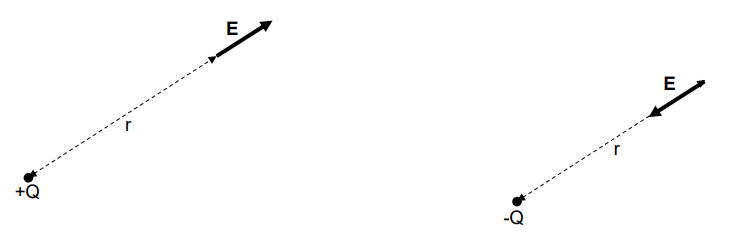
Diagrams of the electric field direction for a single point charge: field arrows radiate outward from and point inward toward . This supports the same directional vocabulary used for forces (“away from” versus “toward”), especially when translating a diagram into words. It also prepares you for later AP Physics 2 work using to connect field direction to the force direction on a test charge. Source
The actual compass direction depends on the positions of the objects.
Reading Force Diagrams Correctly
When analyzing a diagram, be careful about which object the force is acting on. Students often identify the correct interaction but draw the arrow on the wrong object or in the wrong direction.
A good habit is to say the interaction in a full sentence:
“This is the force on A due to B.”
“A and B have opposite charges, so the force on A points toward B.”
or “A and B have like charges, so the force on A points away from B.”
That wording helps prevent sign mistakes.
What the Words Mean Physically
Attract means the force tries to bring the objects closer together.
Repel means the force tries to increase the distance between them.
These words describe the interaction between the objects, not just one charge by itself. You cannot decide attraction or repulsion from a single charge alone; you must compare the signs of both charges.
Common Mistakes to Avoid
Drawing the force in a direction not on the line connecting the two charges
Forgetting that like charges repel
Forgetting that opposite charges attract
Using only the sign of one charge instead of comparing both charges
Drawing both force arrows on the same object
Confusing “toward the other object” with “toward the positive side” or “toward the negative side”
Another common error is treating attraction and repulsion as if they depend on where the objects are moving. They do not. The direction of the electrostatic force is set by the charge signs and the line joining the objects.
Language You Should Recognize
For this subsubtopic, these phrases all point to the same core ideas:
parallel to the line joining the objects
toward the other charge
away from the other charge
like charges repel
opposite charges attract
These are the central rules used to determine electrostatic force direction in simple charge interactions.
Practice Questions
Two small charged objects are placed on a horizontal line. Object A is positive and object B is negative. Object A is to the left of object B.
State the direction of the electrostatic force on object A and the direction of the electrostatic force on object B.
1 mark: States that the force on object A is toward object B, or to the right.
1 mark: States that the force on object B is toward object A, or to the left.
Two charged objects, P and Q, are fixed in place on a horizontal line. P is to the left of Q. The electrostatic force on P due to Q points to the left.
(a) Is the interaction between P and Q attractive or repulsive? (1 mark)
(b) What does this tell you about the signs of P and Q? (1 mark)
(c) State the direction of the force on Q due to P. (1 mark)
(d) A third object, R, is placed directly above P. R has the opposite sign to P. State the direction of the force on R due to P and explain your reasoning. (2 marks)
(a)
1 mark: Repulsive.
(b)
1 mark: P and Q must have the same sign, or they are like charges.
(c)
1 mark: The force on Q due to P points to the right.
(d)
1 mark: States that the force on R is downward, toward P.
1 mark: Explains that opposite charges attract and the force must be along the line joining R and P.
FAQ
Motion and force are not the same thing.
A charge can already have velocity in a direction that carries it away for a short time, even while the electric force points back toward the other charge.
The electric force changes the motion by producing acceleration. The path you see depends on:
the initial velocity
any constraints
any other forces present
So attraction tells you the direction of the electric force, not necessarily the immediate direction of motion.
Not necessarily. What matters is whether the two charges are the same sign or opposite signs.
If both charges flip sign, their sign relationship stays the same.
Same-sign pairs still repel.
Opposite-sign pairs still attract.
For example, a positive-positive pair repels, and a negative-negative pair also repels. A positive-negative pair attracts, and a negative-positive pair also attracts.
So reversing both signs usually leaves the attraction-or-repulsion pattern unchanged.
That drawing convention helps represent the interaction in a simple, idealized way.
For small charged objects, especially in introductory physics problems, each object is treated as though its charge is concentrated at one location. The straight line between those locations is then used for the force direction.
This is why the force is often shown center-to-center in diagrams.
It is a modeling choice that makes the geometry clear and lets you focus on the rule: the force acts along the line connecting the two interacting objects.
No. The amount of charge affects how strong the interaction is, but not whether it is attraction or repulsion.
The direction type is determined only by the sign comparison:
same sign gives repulsion
opposite signs give attraction
So a large positive charge and a small positive charge still repel.
A large negative charge and a small positive charge still attract.
Charge magnitude matters for strength, but sign determines the directional relationship.
The electric force rule does not change.
The force still points along the line joining the objects, and the interaction is still attraction or repulsion based on sign. What changes is the motion you may observe.
If one object is fixed:
it can still exert a force
the other object can still respond to that force
the fixed object may not move because of an external support or constraint
So “fixed” changes the physical setup, not the direction rule for the electrostatic force.
