

AP Syllabus focus: 'Electrostatic forces can be attractive or repulsive, while gravitational forces are always attractive. For charged objects with mass, gravitational force is usually much smaller than electrostatic force.'
This section compares two fundamental long-range interactions in physics and emphasizes their different directions of action and their very different strengths for objects that have both mass and charge.
Two forces that can act at a distance
Both electric and gravitational interactions can act without physical contact. A charged object can influence another charged object across space, and a massive object can influence another massive object across space. In AP Physics 2, the key comparison is not just that both are noncontact forces, but that they behave differently in two important ways: direction and relative strength.
When two objects carry charge, they can exert an electrostatic force on one another.
Electrostatic force: The interaction between charged objects. It can be attractive or repulsive, depending on the signs of the charges.
This makes electric interactions more flexible than gravitational ones. The same basic type of force can either pull objects together or push them apart. That difference becomes essential when predicting motion or deciding whether two objects move toward each other or away from each other.
All objects with mass also exert a gravitational force on one another.
Gravitational force: The interaction between objects with mass. In AP Physics, it is always attractive.
Because gravitational force never repels, it always tends to draw masses together. If two objects have both mass and charge, then both interactions may be present at the same time, and the forces must be compared.
Direction of the force
Electric force can attract or repel
The direction of an electric interaction depends on the signs of the charges involved.
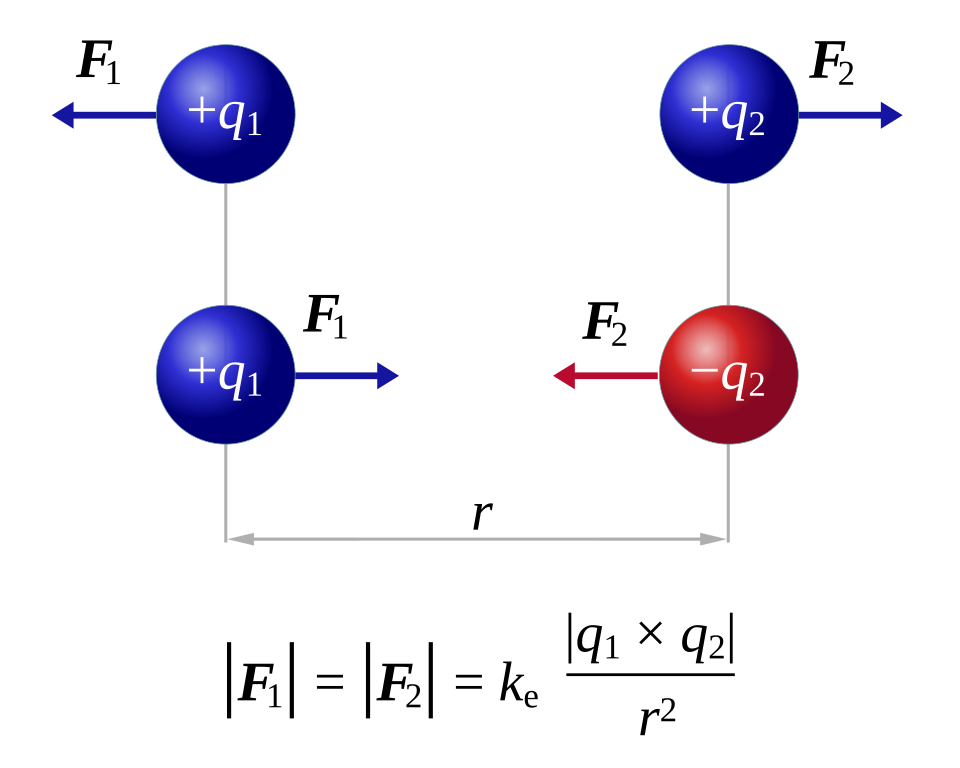
Coulomb’s law diagram contrasting repulsion between like charges and attraction between opposite charges. The force vectors are shown along the line connecting the charges, reinforcing that the direction flips with charge sign while the interaction remains inverse-square in distance. Source
Like charges repel.
Opposite charges attract.
The electric force can therefore point either away from another object or toward another object.
This means the electric force is not locked into a single kind of behavior. A pair of positively charged objects push apart, while a positive and a negative object pull together. The physical situation changes when the charge signs change.
Gravitational force is always attractive
Gravitational interaction is simpler in direction.
Any two objects with mass attract each other.
Gravity always points in the direction that would bring the objects closer together.
In the AP Physics 2 model, there is no case in which gravity causes two ordinary objects to repel.
This gives a useful contrast: electric force can switch between attraction and repulsion, but gravity cannot.
For two oppositely charged objects with mass, both forces are attractive, so each force tends to pull the objects together. For two like-charged objects with mass, the electric force is repulsive while gravity is attractive, so the two forces act in opposite senses.
Comparing their strengths
For objects that have both mass and charge, the specification emphasizes an important result: gravitational force is usually much smaller than electrostatic force.
That statement matters because it helps determine which interaction actually controls the motion of the object. In many physics situations involving charged particles or charged small objects, the electric interaction dominates so strongly that gravity can be ignored without changing the main result.
A useful way to interpret usually much smaller is to remember that gravity is still present, but its effect is often tiny compared with the electric effect. If a charged object changes speed or direction mainly because of nearby charges, that is typically because the electric force is far larger than the gravitational pull on the same object.
This comparison is especially important for small particles. An electron, proton, or charged dust particle has mass, so gravity does act on it. But if the particle is near other charged objects, the electric interaction is generally the more significant force. In practice, a very small amount of charge can lead to an electric interaction that easily outweighs gravity.
A stronger force produces the more noticeable change in motion. That makes this comparison practical, not just descriptive. When electric and gravitational forces compete, the larger one usually determines whether the object moves toward another object, moves away, or shows only a tiny effect from the weaker interaction.
How to think about both forces in a problem
When analyzing a situation, it helps to ask a short sequence of questions.
Does the object have mass? If yes, gravity can act.
Does the object have net charge, and are there nearby charges? If yes, an electric force can act.
Are the charges like or opposite? That determines whether the electric force is repulsive or attractive.
Which force is larger in magnitude? For charged objects with mass, the electric force is usually the important one.
This comparison also helps with predicting the net interaction.
If the objects are oppositely charged, electric force and gravity both favor attraction.
If the objects are like charged, electric force favors repulsion while gravity favors attraction.
Because electric force is usually much stronger, the overall behavior is often determined by the electric force.
So, for many charged-object situations, gravity is not removed from nature; it is simply too small to compete effectively. The key AP Physics idea is not that gravity disappears, but that electric forces usually dominate when charge is present.
Practice Questions
Two small spheres each have positive charge and mass. Compare the direction of the electric force and the gravitational force between the spheres.
[2 marks]
1 mark for stating that the electric force is repulsive.
1 mark for stating that the gravitational force is attractive.
Two isolated small objects each have mass. Both objects are positively charged.
(a) Describe the electric interaction between the objects.
(b) Describe the gravitational interaction between the objects.
(c) State which force is usually larger in magnitude for charged objects with mass.
(d) Based on your answers, determine whether the overall interaction is usually attraction or repulsion, and explain why.
[5 marks]
1 mark for stating that the electric interaction is repulsive.
1 mark for stating that the gravitational interaction is attractive.
1 mark for stating that the electric force is usually much larger than the gravitational force.
1 mark for stating that the overall interaction is usually repulsion.
1 mark for explaining that the repulsive electric force outweighs the attractive gravitational force.
FAQ
Weight depends on mass, and for small objects the gravitational pull is often modest.
A tiny imbalance of charge can still create a very strong electric interaction. That is why a small charged particle can respond much more strongly to nearby charges than to gravity, even though the particle still has mass.
Yes, but that usually happens only when the object's net charge is extremely small or when the electric effects from nearby objects nearly cancel.
In many classroom and particle-scale situations, the electric interaction is much more important. Still, gravity is always present, so it should be considered before deciding it is negligible.
No. Mass affects gravitational interaction, but charge affects electric interaction.
A more massive object may be harder to accelerate because of its inertia, but that does not automatically make its electric interaction stronger. To increase electric force, you need more charge or a different charge arrangement, not just more mass.
No. Gravity does not depend on whether charge is positive, negative, or zero.
A negatively charged object still experiences gravitational attraction because it has mass. The sign of charge changes the electric interaction, but it does not reverse or weaken gravity by itself.
Physicists usually start by identifying all possible forces on the object.
After that, they compare sizes. If the electric force is overwhelmingly larger, gravity may be dropped from the model to simplify the analysis. That is not a mistake; it is a justified approximation based on relative strength.
