AP Syllabus focus:
‘Heredity and environmental factors interact to shape behavior and mental processes.’
Debates about nature and nurture ask how much behavior comes from inborn biology versus life experience. AP Psychology emphasises that this is not an either/or question: the two continuously interact to shape mind and action.
Core idea: interaction, not competition
Nature and nurture are inseparable in real life
Nature: genetic and other biological influences that contribute to physical traits, brain function, and behavioural tendencies.
A person’s biology can bias how they perceive, feel, and respond, but those tendencies unfold in environments that can strengthen, weaken, or redirect them.
Nurture: environmental influences (physical and social) such as parenting, peers, culture, education, stress, nutrition, and opportunity that affect development and behaviour.
Nature and nurture often produce the same outcome through different routes (equifinality) or produce different outcomes from similar starting points, depending on context.
What “interaction” means in AP Psychology
Gene–environment interaction: when the effect of genetic predispositions on behaviour depends on the environment, and the effect of the environment depends on the individual’s biology.
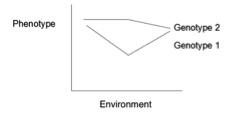
A norm-of-reaction graph illustrating gene–environment interaction: different genotypes show different slopes across the same environmental gradient. Non-parallel lines indicate that the environment’s effect is conditional on genotype (and vice versa), which is the core meaning of G×E in AP Psychology. Source
This interaction framing is the syllabus focus: heredity and environmental factors interact to shape behaviour and mental processes, meaning genes set conditions under which experiences matter, and experiences change how biology operates.
How heredity can shape environmental experience
People help create the environments that shape them
Even without describing specific research designs, AP Psychology expects you to understand the logic that individuals are not passive recipients of experience. Biological tendencies can influence:
Exposure to settings (seeking quiet vs. stimulation)
Evocation of responses from others (warmth, conflict, protection)
Selection of peers and activities over time (sports, arts, risk-taking)
These pathways matter because an “environmental” outcome (teacher attention, peer group norms) may partly reflect an individual’s predispositions interacting with social feedback.
Gene–environment correlation (conceptual tool)
A useful way to talk about nature–nurture blending is gene–environment correlation, where inherited tendencies are linked to particular environments. In practice, this can look like:
Passive links early in life (home context aligned with parents’ traits)
Evocative links (others respond to an individual’s behaviour)
Active links (individuals choose environments compatible with their traits)
The key AP takeaway is not memorising labels, but recognising that “environmental causes” may be intertwined with predispositions.
How environment can shape biology
Experience can alter gene expression
Epigenetics: environmentally influenced changes in gene expression that occur without altering the DNA sequence.
In AP-level terms, environments such as chronic stress, enrichment, relationships, and learning can change how readily certain genes are “turned on” or “turned off.”
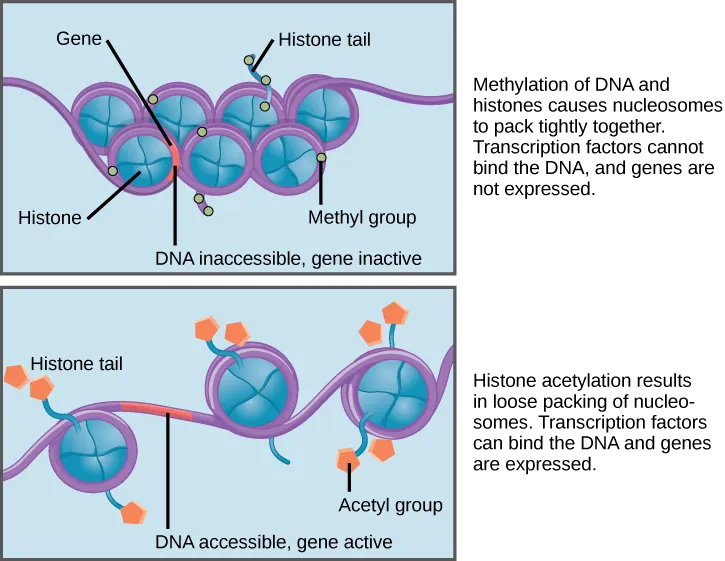
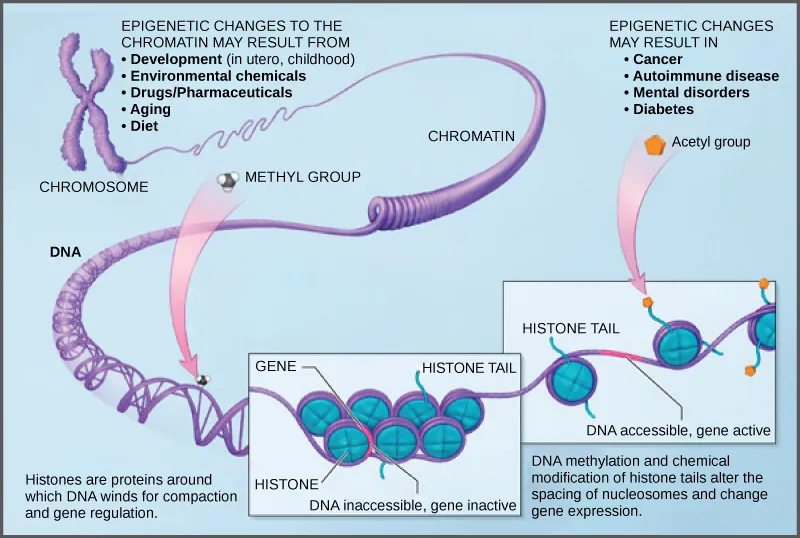
Diagram of epigenetic regulation showing how chemical tags on DNA and histone tails can alter chromatin structure and thereby increase or decrease gene expression. The key takeaway is mechanistic: environments can shift gene activity without changing the underlying DNA sequence. Source
This helps explain how similar predispositions can lead to different behavioural outcomes across contexts.
Learning and development are biological processes, too
When people learn, their nervous system changes: connections strengthen or weaken and networks reorganise. In nature–nurture terms, this means:
Biology enables experience (a working brain is required for learning)
Experience modifies biology (learning leaves biological traces)
Behaviour emerges from both (what you do reflects current brain state shaped by past inputs)
Models for thinking about nature–nurture outcomes
Reaction range (potential + context)
A practical way to integrate nature and nurture is to think in terms of potential ranges rather than fixed destiny:
Biology may set a range of possible outcomes
Environment helps determine where within that range a person develops
Extreme or supportive environments can shift outcomes substantially
This helps avoid two common errors: genetic determinism (“it’s all genes”) and environmental blank-slate thinking (“anyone can become anything with the right upbringing”).
Differential susceptibility and sensitivity
People vary in how strongly they react to the same environment:
Some are more sensitive to both negative and positive conditions
Others show more stability across changing contexts
This supports the syllabus emphasis on interaction: the “same” environment is not psychologically equivalent for all individuals.
Applying the interaction idea to behaviour and mental processes
What counts as “behaviour” and “mental processes”
For AP Psychology, interaction applies broadly to:
Behaviour: aggression, helping, habits, coping, risk-taking
Mental processes: perception, attention, emotion, motivation, memory, self-control
In each domain, heredity can influence baseline tendencies and constraints, while environment supplies learning histories, cues, and reinforcement patterns that guide moment-to-moment functioning.
Avoiding common misconceptions
Nature vs nurture is not a zero-sum split: identifying a biological influence does not remove environmental influence.
Genes influence probabilities, not certainties: predispositions can be amplified or buffered by context.
Environment is not just parenting: culture, peers, schools, stress, and opportunity also shape development.
Interaction is dynamic across time: early tendencies can alter later environments, which then feed back into behaviour.
Practice Questions
Explain what psychologists mean by the statement that behaviour is shaped by an interaction of nature and nurture. (2 marks)
1 mark: Defines nature and/or nurture in psychological terms (genetic/biological influences; environmental influences).
1 mark: Explicitly states interaction (e.g., genetic predispositions affect how environments influence behaviour, and environments can modify the expression/impact of predispositions).
Discuss two different ways that heredity and environment can become linked in shaping an individual’s behaviour and mental processes. Use psychological terminology. (6 marks)
Up to 2 marks: Accurate description of gene–environment interaction (effects of genes depend on environment and/or vice versa), applied to behaviour/mental processes.
Up to 2 marks: Accurate description of gene–environment correlation (e.g., passive/evocative/active links between predispositions and environments), applied appropriately.
Up to 2 marks: Clear use of relevant terminology and a coherent explanation showing how the two ways are distinct (interaction vs correlation), with correct linkage to shaping behaviour/mental processes.
FAQ
Environmental inputs can push development in different directions when experiences differ in timing, intensity, and meaning.
Key factors include:
Quality of close relationships and attachment security
Chronic stress versus stable support
Peer group norms and social roles
Opportunities for mastery (schooling, hobbies, work)
Differences can compound over time as early experiences influence later choices and environments.
Risk factors increase the likelihood that a predisposition results in problems (e.g., persistent stress, instability, harsh discipline).
Protective factors reduce that likelihood or promote resilience (e.g., reliable support, safe housing, positive school climate).
In interaction terms, protective factors can buffer predispositions, while risk factors can amplify them.
Yes. The same logic applies to strengths such as musical skill, leadership, or emotional regulation.
Supportive environments (coaching, practice time, encouragement) may allow predispositions to develop into expertise, while limited access and stress can constrain development even when predispositions exist.
Culture shapes shared environments: norms, values, expectations, and institutions.
It can influence:
Which behaviours are rewarded or punished
How emotions are expressed and interpreted
What opportunities are available and to whom
What identities are socially reinforced
These cultural patterns can interact with individual predispositions to shape behaviour.
Yes, because early periods can be “sensitive” for certain developments (e.g., emotion regulation, stress reactivity).
Early stress may calibrate how strongly someone responds to threat, while early enrichment may support long-term learning habits.
Later improvement can still help substantially, but outcomes may depend on duration, timing, and the individual’s biological sensitivity.