AP Syllabus focus:
‘Heredity, or nature, refers to genetic or predisposed characteristics that influence physical, behavioral, and mental traits and processes.’
Heredity is psychology’s shorthand for the genetic contributions to who you are. It explains how biological information is passed across generations and how inherited predispositions can shape mind and behaviour.
What “heredity” means in psychology
In AP Psychology, heredity (often called nature) refers to the genetic endowment you receive from your biological parents and how that endowment can influence physical traits, behavioral tendencies, and mental processes. Heredity matters because the brain and body are built and regulated using genetic instructions, and those biological systems support behaviour.
Heredity: the transmission of genetic characteristics from parents to offspring that can influence physical development, behaviour, and mental processes.
Heredity does not mean behaviours are fixed or “inevitable.” Instead, genes typically create predispositions (increased likelihoods) that can be expressed in different ways depending on biological development.
Core genetic building blocks (as used in psychology)
Psychology uses basic genetics to describe where predispositions come from and how they vary between people.
Genes, chromosomes, and alleles
Chromosomes are threadlike structures that carry DNA in the cell nucleus (humans usually have 23 pairs).
DNA contains sequences that provide instructions for building proteins that affect structure and function throughout the body, including the nervous system.
Genes are functional segments of DNA that contribute to traits by influencing protein production.
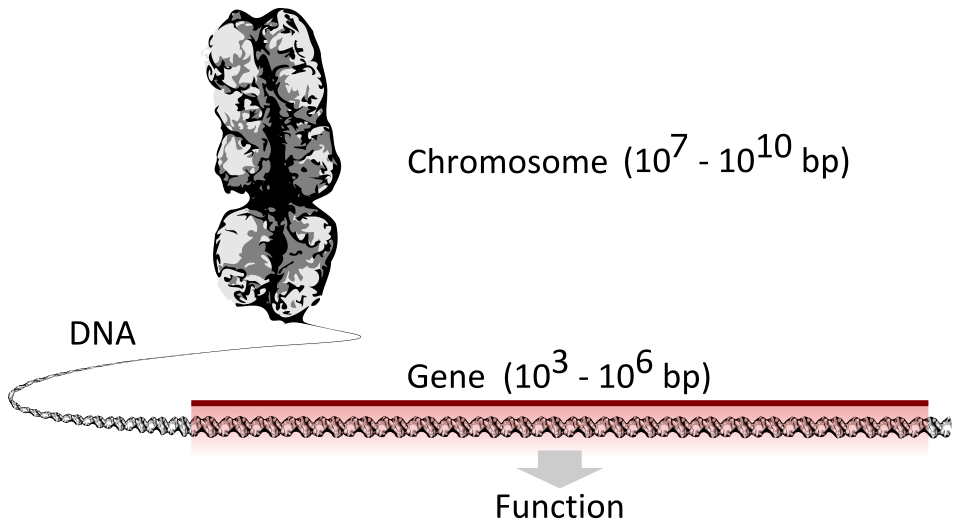
This diagram shows the nested relationship between chromosomes, the DNA double helix, and a gene as a specific functional region of DNA. It helps clarify how genetic information is organized in cells and why genes are often described as “segments” within the larger DNA molecule. Source
Alleles are different versions of the same gene, contributing to individual variation.
Allele: an alternative form of a gene that helps account for variation in inherited traits.
Small genetic differences across many alleles help explain why people differ in temperament, learning-related capacities, and vulnerability to certain psychological difficulties.
How inherited biology can influence behaviour and mental processes
Genes affect behaviour indirectly by shaping biological systems that generate and regulate thoughts, emotions, and actions. Key pathways include:
Neural development and connectivity: genetic instructions guide how brain regions develop, connect, and specialise.
Neurochemical functioning: genes influence the production and regulation of neurotransmitter-related proteins (e.g., receptors, transporters, enzymes), affecting signalling efficiency.
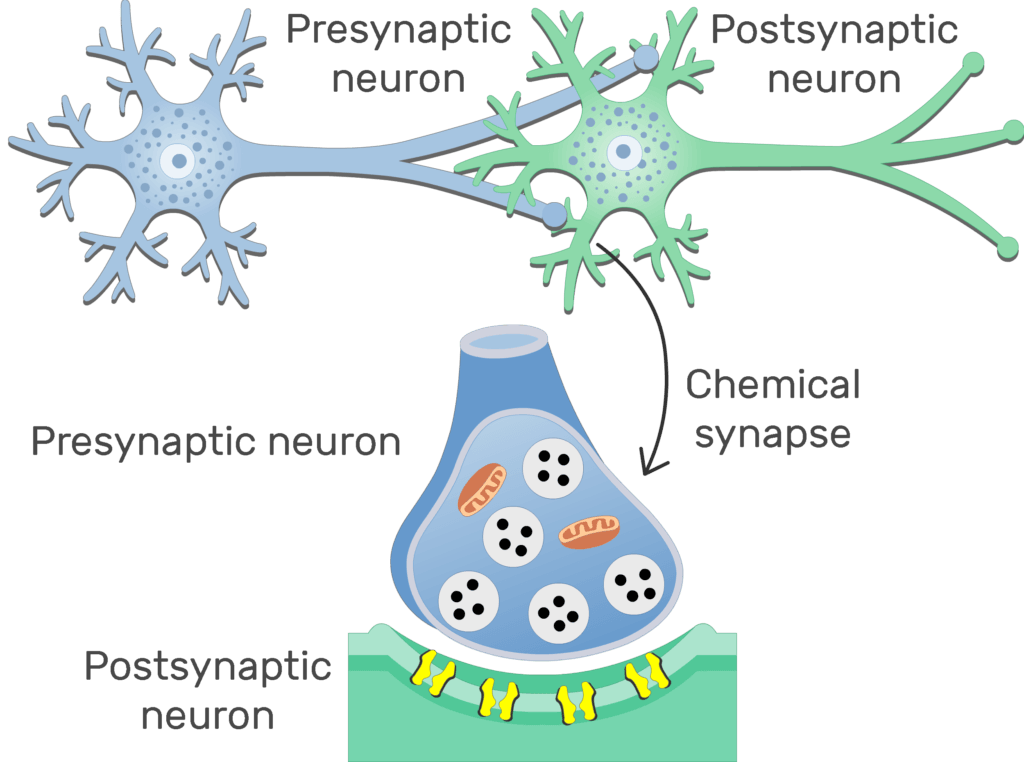
This labeled diagram depicts a chemical synapse, including the presynaptic terminal, synaptic cleft, and postsynaptic membrane, illustrating where neurotransmitters are released and where receptors detect the signal. It connects genetic “instructions” to brain function by highlighting protein-dependent steps (e.g., vesicle release machinery and receptor binding) that can vary across individuals. Source
Hormonal and stress responsiveness: genetic variation can influence sensitivity of physiological stress systems, which can affect arousal, attention, and emotion regulation.
Sensory and motor capacities: inherited differences in sensory receptor functioning or motor coordination can influence experience and behaviour (for example, sensitivity to stimulation).
In this way, heredity can contribute to stable individual differences (such as baseline emotional reactivity) that are relevant to personality and mental functioning.
Predispositions, not blueprints
A central idea in psychology is that genetic influence is often probabilistic:
Many psychological characteristics reflect risk rather than certainty (a predisposition can exist without a trait ever becoming obvious).
Genetic effects may be small and distributed across multiple systems, rather than tied to a single “gene for” a complex behaviour.
The same inherited predisposition can be expressed differently across individuals because development involves many biological steps and regulatory mechanisms.
Polygenic influence and complex traits
Most psychological traits are complex, meaning they commonly involve:
Polygenic influence: many genes, each contributing a small effect.
Continuous variation: traits like cognitive performance or emotional reactivity often vary along a spectrum rather than falling into simple categories.
Multiple biological routes: different combinations of genetic influences can contribute to similar behavioural outcomes.
Because of this complexity, heredity in psychology is best understood as contributing to a person’s range of potential outcomes in physical, behavioural, and mental traits and processes, rather than determining a single outcome.
Practice Questions
Define heredity (nature) as used in psychology and state one way it can influence mental processes. (1–3 marks)
1 mark: Accurate definition of heredity as genetic transmission/inherited characteristics.
1 mark: Links heredity to mental processes (e.g., influences brain development or neurochemical functioning).
1 mark: Clear, psychology-relevant example of influence (e.g., predisposition to anxiety, differences in attention/arousal).
Explain why heredity is described as providing predispositions rather than fixed outcomes, and describe two biological pathways through which inherited variation can affect behaviour. (4–6 marks)
1–2 marks: Explains probabilistic nature (risk/likelihood; not inevitable; complex traits not single-gene).
2 marks: Describes pathway 1 (e.g., neural development/connectivity; neurotransmitter receptors/transporters).
2 marks: Describes pathway 2 (e.g., stress/hormonal responsiveness; sensory/motor capacities).
Up to 1 mark: Uses accurate psychological language (e.g., polygenic, individual differences, mental processes).
FAQ
Yes. Some inherited variants can be present without being expressed in a noticeable way.
This may occur when expression depends on particular allele combinations or when a trait is influenced by many genes and does not cross a threshold in every generation.
Autosomal inheritance involves genes on non-sex chromosomes (pairs 1–22).
Sex-linked inheritance involves genes on the X or Y chromosome, which can produce different patterns of expression in males and females due to differing sex chromosome combinations.
A de novo mutation is a new genetic change that arises in a parent’s sperm/egg or early in embryonic development.
It can help explain why a person shows an inherited-risk-like trait even with no family history of that trait.
Pleiotropy occurs when one gene influences multiple traits.
In psychology, this matters because a single genetic variant might affect several outcomes (e.g., aspects of cognition and emotion), complicating “one gene, one trait” thinking.
A PRS is a statistical estimate that sums the tiny contributions of many genetic variants linked to a trait.
It indicates relative genetic propensity in a population, but it is not a diagnosis and does not determine an individual’s outcome.