AP Syllabus focus:
‘The evolutionary perspective examines how natural selection shapes behavior and mental processes to support survival and reproduction.’
Evolutionary perspectives explain why certain behaviors and mental processes may be widespread by linking them to adaptive problems faced across human history. They emphasize function: how a trait could have increased survival or reproductive success.
What the evolutionary perspective claims
The evolutionary perspective applies principles of biological evolution to psychology, proposing that some patterns of thinking, feeling, and acting reflect adaptations shaped over many generations. In this view, the mind is not a blank slate; it includes tendencies that helped ancestors cope with recurring challenges (e.g., avoiding threats, finding mates, caring for offspring).
Natural selection as the core mechanism
Natural selection: The process by which heritable traits that increase survival and reproduction become more common in a population over generations.
Natural selection requires three ingredients:
Variation: Individuals differ in traits (including predispositions influencing behavior).
Heritability: Some differences are influenced by genes and can be passed on.
Differential reproduction: Traits linked to greater fitness (reproductive success) tend to spread.
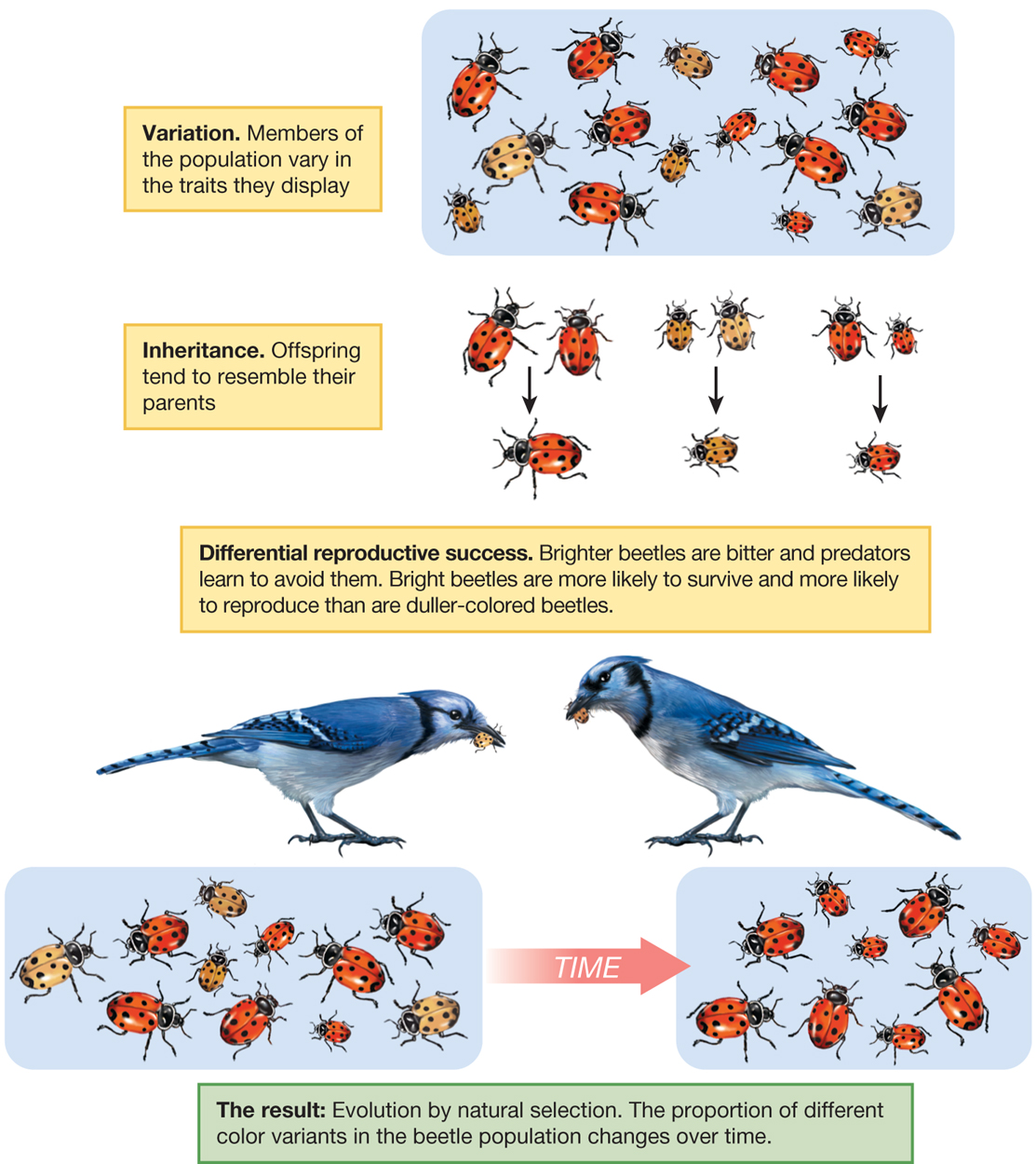
This diagram illustrates the logic of natural selection as a multi-step process: individuals vary, some traits are inherited, and those traits can produce differences in survival/reproduction that shift trait frequencies over time. Seeing the full chain in one figure reinforces the difference between having a helpful trait and that trait actually becoming more common across generations. Source
Adaptations and psychological traits
Adaptation: An inherited characteristic that increases the likelihood of survival and reproduction in a particular environment.
Psychological adaptations are proposed to include:
Attention to threat (rapid orienting to potential danger)
Disgust responses (reducing disease risk)
Social inference (tracking trust, reputation, and reciprocity)
Attachment tendencies (promoting infant survival through proximity to caregivers)
Importantly, evolutionary psychologists distinguish between:
Ultimate explanations: Why a trait may have evolved (its function for survival/reproduction).
Proximate explanations: How it works now (brain mechanisms, learning history, current context).
Evolution and reproduction-focused mechanisms
Sexual selection
Some traits spread because they improve mating success, even if they do not directly aid survival.
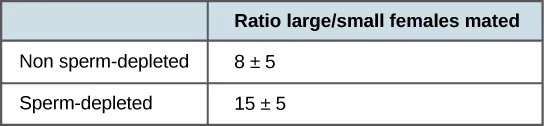
This figure summarizes empirical results showing how mate choice shifts depending on an organism’s reproductive constraints (here, sperm depletion), linking behavior to reproductive payoff. It reinforces the evolutionary claim that selection can shape psychological/behavioral strategies when they alter mating success and thus fitness. Source
Intrasexual competition: Competition with same-sex rivals (e.g., displays of dominance).
Intersexual selection: Preferences by potential mates (e.g., cues related to health or fertility).
This framework helps interpret patterns in mate preferences, jealousy, and courtship behaviors as potentially linked to recurrent reproductive challenges, while still allowing for cultural and individual variation.
Kin selection and inclusive fitness
Because relatives share genes, helping genetic relatives can indirectly increase the propagation of shared genes.
Kin-directed altruism: Greater helping toward closer relatives is predicted when costs are outweighed by genetic benefits.
This supports evolutionary accounts of strong protective responses toward offspring and siblings.
How this perspective explains behavior and mental processes
Evolutionary accounts focus on the possibility that certain biases are:
Species-typical: Common across humans because they solved common ancestral problems.
Context-sensitive: Triggered by specific cues (e.g., threat cues increase vigilance).
Trade-offs: What helps in one context may hurt in another (e.g., risk-taking may increase mating opportunities but raise injury risk).
A key idea is environmental mismatch: modern environments can differ sharply from ancestral conditions, so an evolved tendency may be less adaptive today (e.g., strong preference for calorie-dense foods in food-abundant settings).
Evidence, methods, and limitations
Common research approaches
Cross-cultural patterns: Similarities across societies can suggest evolved tendencies (while differences highlight flexibility).
Developmental universals: Early-emerging behaviors may indicate predispositions.
Comparative evidence: Parallels with other species can inform function, especially for basic social and defensive behaviors.
Limits and careful interpretation
“Just-so story” risk: A plausible evolutionary narrative is not proof; claims need testable predictions.
Not genetic determinism: Evolutionary perspectives describe predispositions, not fixed outcomes; environments still shape expression.
Multiple causation: The same behavior can reflect learning, culture, and evolved biases simultaneously, so good explanations specify the level of analysis and competing hypotheses.
Practice Questions
Explain how natural selection could shape a behavioural tendency that increases survival. (2 marks)
1 mark: States that individuals with heritable traits that aid survival/reproduction are more likely to pass on those traits.
1 mark: Applies to behaviour (e.g., a predisposition such as threat vigilance) and links it to increased survival.
Discuss the evolutionary perspective on behaviour, including one strength and one limitation. (6 marks)
1 mark: Identifies the evolutionary perspective as explaining behaviour/mental processes via adaptations shaped by natural selection.
1 mark: Links explanations to survival and reproduction (fitness).
1 mark: Describes a relevant mechanism (e.g., sexual selection or kin selection) in behavioural terms.
1 mark: Strength explained (e.g., generates testable predictions; explains cross-cultural similarities; integrates biology and behaviour).
1 mark: Limitation explained (e.g., post-hoc ‘just-so’ explanations; difficulty testing ancestral claims; underestimates cultural variation if misapplied).
1 mark: Coherent elaboration/application to a behaviour (e.g., mate preference, threat detection, parental investment).
FAQ
They look for challenges that were recurrent over long periods (e.g., avoiding predators, selecting mates, caring for dependent offspring).
Evidence often draws on:
anthropology and archaeology (living conditions, mortality risks)
comparative biology (similar problems in related species)
cross-cultural regularities suggesting recurrence
The EEA is the statistical range of ancestral conditions in which a trait was selected, not one single habitat or time.
It matters because modern settings can differ, producing mismatch where:
cues differ (online social signals vs face-to-face)
costs/benefits change (abundant calories vs scarcity)
They test present-day predictions derived from the hypothesis, such as:
whether responses track specific cues (e.g., pathogen cues increasing disgust)
whether patterns replicate across cultures
whether similar functions appear in other species
Strong tests compare alternative explanations and use preregistered methods.
Culture can be treated as part of the current environment that shapes how predispositions are expressed.
Researchers may examine:
whether a tendency is universal but varies in degree
whether cultural practices amplify or suppress certain behaviours
whether different ecologies (resources, disease prevalence) shift strategies
Reciprocal altruism involves helping non-relatives with the expectation of future return, supported by mechanisms like trust and punishment of cheaters.
Kin altruism is based on genetic relatedness.
Reciprocity models often focus on:
repeated interactions
reputation tracking
cheater detection mechanisms