AP Syllabus focus:
‘Some theorists applied evolutionary ideas in discriminatory ways, including eugenics.’
Eugenics shows how appealing scientific-sounding arguments can be when paired with social prejudice. In psychology, it is a key cautionary example of misapplying evolutionary language to justify discrimination and coercive public policy.
What eugenics was (and what it was not)
Eugenics attempted to “improve” human populations by controlling reproduction, claiming that complex traits (e.g., intelligence, morality, “criminality”) were largely inherited and could be bred in or out.
Eugenics: A social movement and set of policies aimed at increasing reproduction among “desirable” groups and limiting reproduction among “undesirable” groups, based on claims about heredity.
Eugenics was not a neutral extension of evolutionary theory. It blended selective readings of biology with existing classism, ableism, and racism, turning descriptive ideas about variation into prescriptive rules about who should have rights.
Why evolutionary language felt persuasive
Natural selection was miscast as a guide for social policy rather than a biological process.
“Survival of the fittest” was treated as if fitness meant virtue or worth, not reproductive success in a given environment.
Statistical group averages were treated as fixed “types,” ignoring overlap and context.
Core misuses of evolutionary ideas
Social Darwinism and the “natural” justification of inequality
Social Darwinism argued that social hierarchies reflect “natural” superiority, implying that helping disadvantaged groups interferes with “progress.”
Social Darwinism: The misguided application of evolutionary concepts to society to argue that inequality is biologically justified and should not be corrected.
This framing commits a common error: moving from what is observed in nature to what ought to be done in society (often called the naturalistic fallacy).
Genetic determinism and oversimplified heredity
Eugenic arguments often relied on genetic determinism—the belief that genes rigidly determine behaviour and mental traits—minimising:
Environmental effects (education, nutrition, stress, discrimination)
Gene–environment interaction (the same predisposition can yield different outcomes in different contexts)
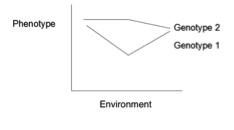
Reaction-norm graph showing different genotypes responding differently across an environmental gradient (non-parallel lines), which is the hallmark of a gene × environment interaction. The figure reinforces that genetic influences are conditional: outcomes depend on context rather than being fixed or inevitable. Source
Polygenic traits (many traits reflect many genes plus experience, not a single “defect”)
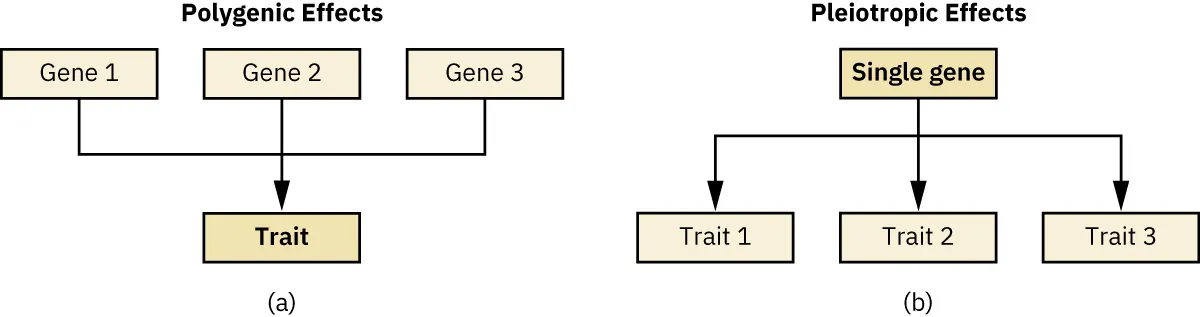
Diagram contrasting (a) polygenic effects—multiple genes contributing to one trait—and (b) pleiotropy—one gene influencing multiple traits. This is a useful visual antidote to genetic determinism because it shows why complex outcomes rarely map onto a single inherited “cause.” Source
Scientific racism and biased measurement
Eugenics often used biased “evidence” to claim innate group differences:
Tests and categories were designed within a dominant culture, then treated as objective.
Test performance was interpreted as inborn ability rather than shaped by schooling, language, familiarity, and opportunity.
Group comparisons were used to argue for policies restricting rights, not to improve conditions.
How eugenics became discriminatory policy
Eugenics moved from ideology to institutions by targeting reproduction and family life. Common strategies included:
Forced sterilisation of people labelled “unfit” (often those with disabilities, mental illness diagnoses, people in poverty, or marginalised ethnic groups)
Marriage restrictions and reproductive surveillance
Immigration limits justified by claims about national “stock”
Segregation and institutionalisation framed as protecting society and preventing reproduction
These policies typically lacked meaningful consent, relied on stigmatising labels, and were enforced most harshly against groups with less power to resist.
Psychological harm and social consequences
Even when framed as “public health,” eugenic practices produced predictable psychological effects:
Stigma and dehumanisation (being treated as biologically inferior)
Learned helplessness and fear under coercive systems
Intergenerational trauma when communities face systematic reproductive control
Distrust of medical and psychological institutions, reducing help-seeking
What AP Psychology expects you to understand
In the AP framework, eugenics is a historical example of how evolutionary ideas can be misused: some theorists turned claims about heredity and selection into moral rankings of people, promoting discriminatory practices and policies under the banner of “science.”
Practice Questions
Define eugenics and state one way it misused evolutionary ideas. (2 marks)
1 mark: Accurate definition of eugenics (controlling reproduction to “improve” the population).
1 mark: Clear misuse (e.g., treating “fitness” as moral worth; justifying inequality as natural; assuming complex traits are fixed and inherited).
Explain how eugenic thinking translated into discriminatory policies, and outline two psychological or social consequences of those policies. (5 marks)
1 mark: Link from evolutionary language to social ranking (e.g., Social Darwinism/naturalistic fallacy).
2 marks: Two accurate policy mechanisms (e.g., forced sterilisation, marriage restrictions, immigration limits, segregation), 1 mark each.
2 marks: Two consequences (e.g., stigma/dehumanisation, intergenerational trauma, distrust of institutions, fear/learned helplessness), 1 mark each.
FAQ
It upheld compulsory sterilisation laws, signalling legal approval.
This ruling helped normalise coercive “public welfare” arguments over individual rights.
Nazi policy escalated eugenic ideas into systematic persecution and mass violence.
Earlier programmes often focused on sterilisation and segregation; the Nazi regime expanded this into genocide.
Key safeguards include:
Informed consent and capacity protections
Independent ethics review (IRBs)
Justice and non-discrimination requirements
They aim to limit coercion and protect vulnerable groups.
Not necessarily; the ethical difference often hinges on choice, coercion, and social pressure.
Concerns arise when screening becomes mandatory, stigmatises disability, or restricts reproductive autonomy.
Warning signs include:
Treating poverty/disability as hereditary “defects”
Incentives or penalties tied to reproduction
Claims that certain groups should reproduce less “for society”