AP Syllabus focus:
‘Environmental factors, or nurture, are external influences such as family interactions and education.’
Environmental influences are the non-genetic conditions that shape how people think, feel, and act. In AP Psychology, “environment” includes everyday relationships and institutions that provide experiences, opportunities, and constraints across development.
What “Environment” Means in Psychology
In psychology, environment refers to external influences (often called nurture) that affect behavior and mental processes. These influences can be immediate (home routines) or broad (school systems), and they can be supportive, harmful, or mixed.
Environment (nurture): External influences on an individual (e.g., family interactions, education, peers, culture, and living conditions) that shape behavior and mental processes.
Environmental factors are described at multiple levels:
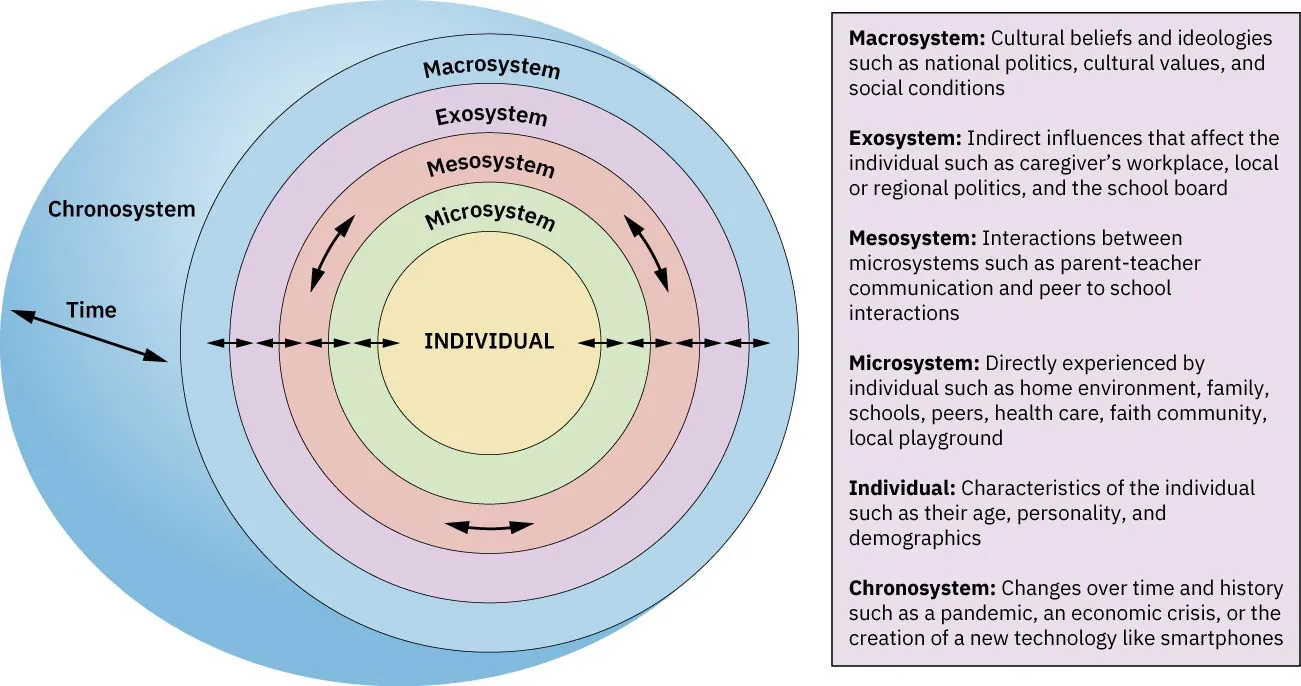
Bronfenbrenner’s ecological systems model shows environmental influence as nested layers around the individual. The microsystem (direct settings like family/school) is embedded within broader, more indirect systems (mesosystem, exosystem, macrosystem), with the chronosystem representing change over time. This helps explain why “environment” in psychology includes both immediate relationships and wider institutions. Source
Microsystem: Direct contexts such as family interactions, friends, classrooms
Mesosystem: Connections among settings (e.g., parent–teacher communication)
Exosystem/Macrosystem: Indirect influences such as workplace demands on parents, community resources, cultural values, laws, and norms
Core examples emphasised by the syllabus
Family interactions: Parenting style, warmth, conflict, communication patterns, discipline practices, caregiver stress, and attachment-related experiences
Education: Teacher expectations, instructional quality, classroom climate, school safety, academic tracking, access to advanced courses, and extracurricular opportunities
How Environmental Factors Shape Behavior and Mental Processes
Environmental influences matter because they structure experience, and experience changes psychological outcomes through several broad routes.
Learning and socialisation routes
Reinforcement and punishment: Consequences in home/school shape the likelihood of future behavior
Observation and modelling: People learn norms and coping strategies by watching caregivers, peers, and teachers
Language and cognitive stimulation: Conversation quality, reading exposure, and feedback influence vocabulary, memory strategies, and problem-solving habits
Stress and coping: Chronic conflict, instability, or high demands can alter attention, emotion regulation, and risk-taking; supportive environments can build resilience
Opportunity and constraint routes
Environmental conditions influence what is realistically possible:
Access to safe spaces, nutrition, and consistent routines can support attention and mood
Educational resources and mentoring can broaden aspirations and persistence
Bias, exclusion, or low expectations can narrow opportunities and affect motivation and self-concept
Shared vs Nonshared Environmental Influences
Not all environmental influences are experienced equally, even within the same household.
Shared environment: Environmental factors siblings raised together tend to have in common (e.g., neighbourhood, household rules, family socioeconomic resources).
Shared factors can create similarities, but differences often come from experiences unique to each person.
Nonshared environment: Environmental factors that differ between individuals in the same family (e.g., different teachers, peer groups, illnesses, roles in the family), contributing to differences in outcomes.
A key implication for AP Psychology is that “same home” does not mean “same environment,” especially when relationships, expectations, and peer contexts differ.
Studying Environmental Influences Carefully
To make environmental explanations useful, psychologists operationalise the environment as measurable variables and consider alternative explanations.
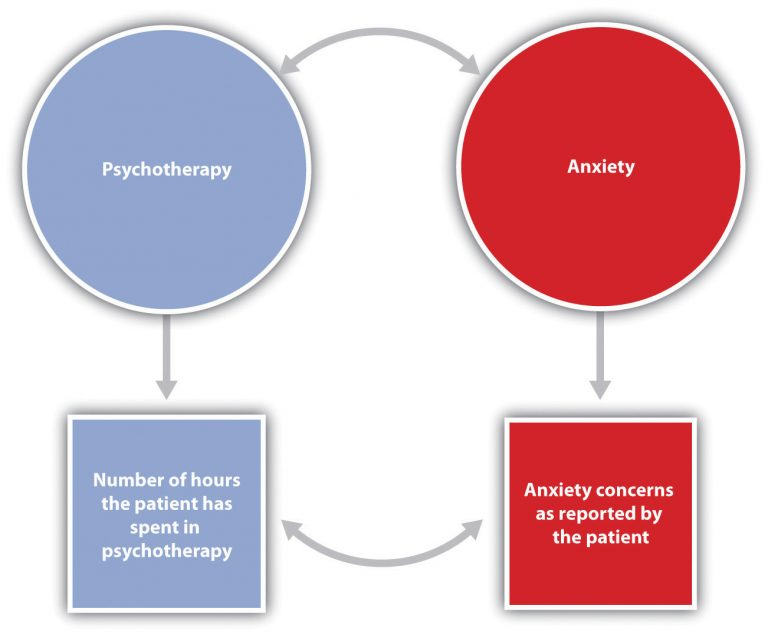
This research-hypothesis diagram distinguishes conceptual variables (abstract constructs) from measured variables (their numeric indicators). The vertical arrows represent operational definitions—how a construct is translated into an observable measure (e.g., self-reported anxiety, hours in therapy). In environmental psychology, the same logic applies when turning broad ideas like “school climate” or “family stress” into measurable variables. Source
Common measurement approaches (conceptual)
Self-reports and interviews: Perceived parenting, school belonging, stress exposure
Observations: Parent–child interaction quality, classroom behaviour management
Archival and contextual indicators: Attendance, school resources, neighbourhood crime rates
Interpreting environmental effects
Context specificity: The same environment can affect individuals differently depending on age, temperament, and prior experiences
Direction of effects: Children and adolescents also shape their environments (e.g., eliciting different responses from adults), complicating simple cause-and-effect claims
Cumulative exposure: Multiple small factors (supportive or adverse) can add up across time, influencing long-term outcomes in learning and adjustment
Practice Questions
Define “environment” (nurture) in psychology and give one example linked to either family interactions or education. (2 marks)
1 mark: Accurate definition of environment/nurture as external influences shaping behaviour and mental processes.
1 mark: Appropriate example clearly linked to family interactions (e.g., consistent discipline) or education (e.g., teacher expectations).
A student’s grades improve after moving to a new school. Using the concept of environmental factors (nurture), explain two ways education and/or family interactions could account for this change, and include one issue psychologists face when attributing change to the environment. (6 marks)
Up to 2 marks: Explanation of one environmental influence (education or family) with clear link to grades (e.g., higher quality teaching, supportive classroom climate, increased parental monitoring).
Up to 2 marks: Explanation of a second, distinct environmental influence with clear link (e.g., peer group norms valuing study, reduced household conflict improving concentration).
1 mark: Identifies a relevant attribution issue (e.g., direction of effect, context specificity, measurement/operationalisation limits).
1 mark: Brief elaboration of the issue applied to the scenario (e.g., improved grades may change family responses; perceived support may differ from actual support).
FAQ
They often combine methods to improve validity, such as:
Structured observations (coded warmth, responsiveness, conflict)
Daily diary methods (short, repeated reports to reduce recall bias)
Multi-informant ratings (child, caregiver, sometimes teachers)
Convergence across measures strengthens confidence that the measured interaction pattern is reliable.
It can include institutional and social features, such as:
School climate (belonging, safety, norms)
Discipline policies and consistency
Access to support services (counselling, learning support)
Academic tracking and expectations
These factors shape opportunity, motivation, and stress levels.
Nonshared experiences can arise from:
Different parental expectations by age or birth order
Different peer groups and teachers
Different roles in family conflict or caregiving
Random life events (injury, friendship changes)
These differences can produce distinct outcomes despite shared housing and resources.
They may use:
Objective indicators (deprivation indices, crime statistics, school funding)
Geographic measures (distance to parks, libraries, community centres)
Participant perceptions (safety, cohesion, noise)
Using both objective and subjective measures helps capture lived experience and context.
Yes. Environmental changes can alter cues and consequences that maintain behaviour. Examples include:
Reducing daily stressors and increasing predictability
Improving access to academic support
Increasing positive adult supervision
Effects may be gradual because habits, expectations, and skills often require repeated experience to shift.