AP Syllabus focus:
‘The Great Compromise created a bicameral Congress: representation in the House is based on population, while each state has equal representation in the Senate.’
The Great (Connecticut) Compromise was a pivotal bargain at the Constitutional Convention that resolved a major dispute over representation. It created Congress’s two-chamber structure, balancing large-state and small-state political power.
The Representation Crisis at the Convention
Delegates agreed the national legislature needed legitimacy and authority, but they disagreed over how states and citizens should be represented. The conflict threatened to derail the entire Constitution because representation affects who shapes laws, taxes, and national priorities.
Competing visions:

This image (a mural painting) depicts the Connecticut Compromise as a moment of negotiation centered on a dual system of representation. It complements the notes by visually linking the political conflict between large-state and small-state delegations to the institutional outcome: a House tied to population and a Senate organized around state equality. As a curated Senate history resource, it also reinforces the idea that the compromise was necessary to keep the Convention—and the Constitution—on track. Source
Large states argued that states with more people should have more influence in the legislature.
Small states feared being permanently outvoted if representation depended only on population.
The compromise was not just about fairness; it was about building a durable system where different constituencies would remain invested in the new national government.
The Great (Connecticut) Compromise
The solution combined two competing plans into a single legislative design.
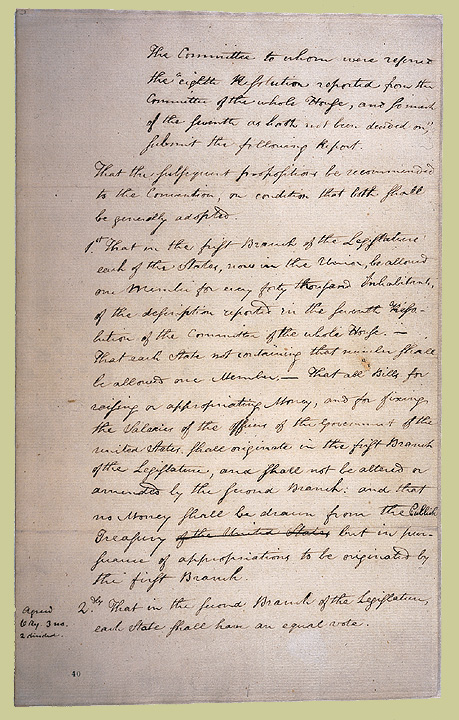
This National Archives image shows the July 5, 1787 “Report of the Grand Committee,” a key written step toward the Great (Connecticut) Compromise. The document captures the Convention’s move to a two-chamber legislature by pairing population-based representation in the House with equal state representation in the Senate. Using the primary document helps connect the abstract idea of “compromise” to the actual institutional blueprint the framers debated and adopted. Source
Great (Connecticut) Compromise: An agreement creating a bicameral Congress with population-based representation in the House and equal state representation in the Senate.
This compromise is often linked to Connecticut delegates because Connecticut served as a “middle” state that could credibly broker between the extremes.
Bicameral Congress: Two Chambers, Two Logics
The compromise created a bicameral legislature—two distinct chambers designed to represent different political principles.
Bicameral: A legislative structure with two chambers that must both participate in lawmaking, often to represent different constituencies and to slow or moderate policy change.
A bicameral design reduces the chance that a single political majority can dominate the entire legislative process, because agreement must be built across two bodies with different representational bases.
House of Representatives: Representation by Population
The House was designed to reflect citizens more directly through population-based representation. Under the syllabus focus, “representation in the House is based on population,” meaning:
States with larger populations receive more seats.
States with smaller populations receive fewer seats.
This approach was meant to connect national lawmaking to the principle that the people are the ultimate source of authority, while also ensuring that growing states would not be politically capped in a rapidly changing nation.
Senate: Equal Representation for Each State
To protect smaller states, the compromise also established that “each state has equal representation in the Senate.” This means:
Every state, regardless of population, has the same number of senators.
Small states gain a strong institutional safeguard against being routinely overridden by large-state coalitions.
The Senate therefore represents states as political units, reinforcing the idea that states retained an important constitutional role even as they joined a stronger union.
Why the Bicameral Structure Matters for Lawmaking
Because both chambers are part of Congress, bicameralism shapes how policy is made and how political power is exercised.
Key effects:
Coalition-building: Successful legislation typically requires broader agreement across different regional and population-based interests.
Compromise incentives: The two chambers encourage bargaining between large-state priorities (often stronger in the House) and small-state concerns (protected in the Senate).
Stability vs. responsiveness: The House is structured to be more responsive to population shifts, while the Senate provides continuity for states as equal members of the federal system.
High-Utility Takeaways for AP Comparison and Analysis
When describing the Great Compromise, emphasise the trade-off it institutionalised:
Democratic responsiveness in the House (population-based representation)
State equality in the Senate (equal representation per state)
This design helps explain why representation debates persist in American politics: the Constitution intentionally blends two different theories of representation inside one legislature.
Practice Questions
(2 marks) Identify two features of the Great (Connecticut) Compromise regarding representation in Congress.
1 mark: House of Representatives representation is based on population.
1 mark: Senate provides equal representation for each state.
(6 marks) Explain how the Great (Connecticut) Compromise balanced the interests of large and small states, and analyse one way bicameralism affects the passage of federal legislation.
2 marks: Explains large-state interest (population-based influence) and links it to House representation by population.
2 marks: Explains small-state interest (protection from domination) and links it to equal representation in the Senate.
2 marks: Analyses a bicameralism effect on lawmaking (e.g., need for cross-chamber coalitions, increased negotiation, or moderation/slower passage because both chambers must agree).
FAQ
The label highlights Connecticut’s role as a broker state and credits key Connecticut delegates with proposing the two-chamber solution.
Different textbooks emphasise either its impact (“Great”) or its origin (“Connecticut”).
It made population counts politically consequential, because House seats depend on population.
Later disputes often focus on:
who is counted
how districts are drawn
how seats are redistributed after demographic change
Equal Senate representation acted as an insurance policy: small states could join the union without accepting permanent minority status in national decision-making.
It also signalled that states remained meaningful constitutional actors.
It forces proposals to be viable in two different political arenas at once.
This typically increases:
negotiation between coalitions
attention to regional/state interests
incentives to write bills that can survive multiple rounds of revision
No. It settled the core large-state vs small-state question for Congress, but representation remained politically sensitive and continued to generate arguments about fairness and influence in later American politics.