AP Syllabus focus:
‘The Three-Fifths Compromise set a formula for counting enslaved people for House representation and taxation; delegates also postponed a decision on banning the importation of enslaved persons until 1808.’
The Constitution’s ratification depended on bargaining over slavery’s place in national institutions.
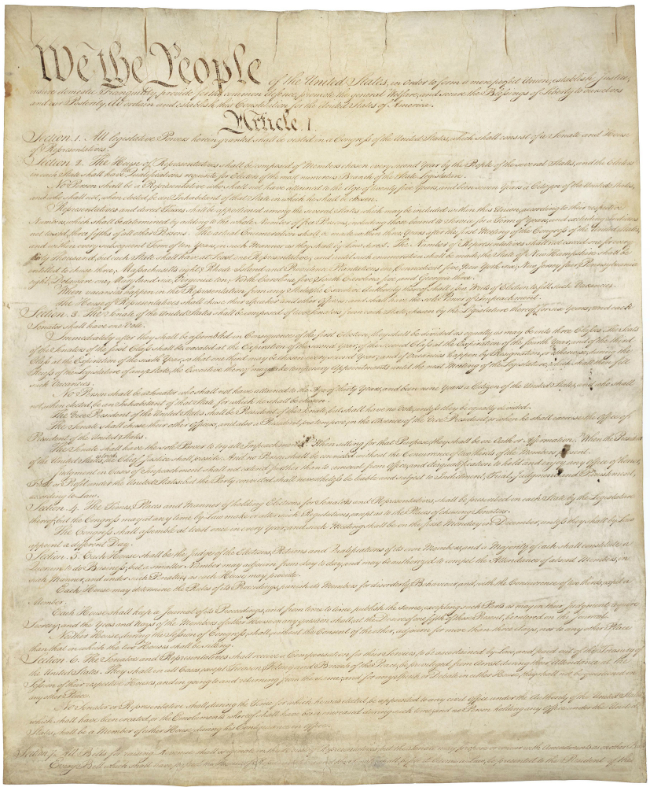
High-resolution image of the engrossed U.S. Constitution. Using the primary document reinforces that the Three-Fifths apportionment rule and the 1808 “migration or importation” limitation were built into the constitutional framework itself, shaping representation, taxation, and early federal power over the international slave trade. Source
Slavery-related compromises shaped representation, taxation, and early federal limits on the international slave trade, while embedding sectional conflict into the new system.
Why slavery became a constitutional bargaining issue
Slavery affected how political power would be allocated among states. Delegates disputed whether enslaved people—who were denied political rights—should nonetheless increase a state’s representation in the national government.
Slaveholding states sought to count enslaved people toward population totals to gain more seats in the House of Representatives (and thus greater influence in national policymaking).
Non-slaveholding states argued that counting enslaved people for representation was illegitimate if enslaved people could not vote, and that it would unfairly amplify slave-state power.
Representation and taxation were linked
The Constitution tied House representation to population counts, and it also contemplated direct taxes apportioned by population. This linkage helped frame a trade-off: if enslaved people were partly counted for representation, they would also be partly counted for taxation.
The Three-Fifths Compromise: apportionment formula
The Three-Fifths Compromise created a constitutional rule for counting enslaved people when determining a state’s population for representation and direct taxation.
Three-Fifths Compromise: A constitutional agreement to count three-fifths of the enslaved population for purposes of House apportionment and direct taxation, increasing slave-state representation while partially linking that boost to tax liability.
This formula became central to how the early House was apportioned among states and how political influence was distributed across regions.
EQUATION
= Population total used for House representation and direct taxes (people)
= Number of free inhabitants counted fully (people)
= Number of enslaved inhabitants counted at three-fifths (people)
Political effects of the formula
Because House seats are based on population counts, the compromise produced durable consequences for national power.
It increased representation for slaveholding states relative to counting only free persons.
It also increased those states’ influence in selecting the president because Electoral College votes track congressional representation (House seats plus Senate seats), even though enslaved people could not vote.
It did not create rights or citizenship for enslaved people; it treated them as a basis for allocating power among states, not as political participants.
Why both sides accepted it
The compromise reflected mutual incentives to keep the constitutional project viable.
Slaveholding states gained additional representation and national leverage.
Non-slaveholding states gained a partial constraint by linking representation to taxation and by preventing enslaved people from being counted fully for representation.
Postponing action on banning the importation of enslaved persons until 1808
Delegates also compromised on the international slave trade by delaying federal authority to ban the importation of enslaved people.
Importation clause (1808 compromise): A constitutional arrangement that postponed any federal decision to ban the importation of enslaved persons until 1808, limiting Congress’s ability to prohibit the trade before that date.
This delay was designed to secure support from states with economic interests tied to continued importation, while still allowing the Constitution to gesture toward eventual federal restriction.
Institutional implications of the 1808 postponement
The postponement mattered because it clarified what Congress could and could not do early on.
Before 1808, Congress could not impose a full ban on importing enslaved persons.
The compromise signalled that slavery was not merely a state-level institution; it was entangled with national constitutional bargaining and federal timing rules.
How these compromises shaped early national politics
Although framed as pragmatic solutions, these provisions structured power relationships.
The Three-Fifths formula affected the composition of the House, the balance of influence across states, and the bargaining environment for federal legislation touching slavery.
The 1808 delay placed a constitutional time barrier on immediate federal action against the international trade, reflecting the limits of consensus at the Convention.
These slavery-related compromises were therefore not peripheral; they were mechanisms for allocating representation and managing conflict while enabling ratification in a deeply divided union.
Practice Questions
(1–3 marks) Describe the Three-Fifths Compromise and explain one way it affected representation in the House of Representatives.
1 mark: Identifies that enslaved people were counted as three-fifths for apportionment.
1 mark: Links the rule to House representation (population-based seats).
1 mark: Explains an effect, e.g. it increased slaveholding states’ seats/influence compared with counting only free persons.
(4–6 marks) Explain how the Constitution’s slavery-related compromises addressed (a) representation and taxation and (b) the importation of enslaved persons. Evaluate the extent to which these compromises helped secure agreement at the Constitutional Convention.
Up to 3 marks (a): Accurate explanation that representation and direct taxation were tied to population; enslaved people counted at three-fifths for both; clear linkage to apportionment consequences.
Up to 2 marks (b): Accurate explanation that a ban on importation was postponed until 1808; shows this limited immediate federal action.
Up to 1 mark evaluation: Reasoned judgement that the compromises facilitated agreement/ratification by balancing sectional interests, even if they entrenched conflict.
FAQ
No. It did not grant voting rights, legal equality, or citizenship to enslaved people.
It was an apportionment and taxation rule affecting states’ political power, not an expansion of individual rights.
It indirectly affected presidential selection because Electoral College totals reflect congressional representation.
This meant additional House seats could translate into additional electoral votes.
The clause addressed the international traffic in enslaved persons, not the existence of slavery within states.
This narrowed the issue to a specific federal timing question, making agreement more achievable.
No. It removed the constitutional barrier to a ban after 1808 but did not mandate that Congress must pass one.
Action still depended on ordinary lawmaking and political will.
By embedding population-based advantages and delaying federal limits, they altered bargaining power among states.
This encouraged continued sectional strategy over representation and national policy linked to slavery.