AP Syllabus focus:
‘To address Anti-Federalist concerns, supporters agreed to add a Bill of Rights; this compromise helped secure ratification by promising explicit protections for individual liberties.’
The Bill of Rights emerged from the ratification struggle as a practical political bargain.
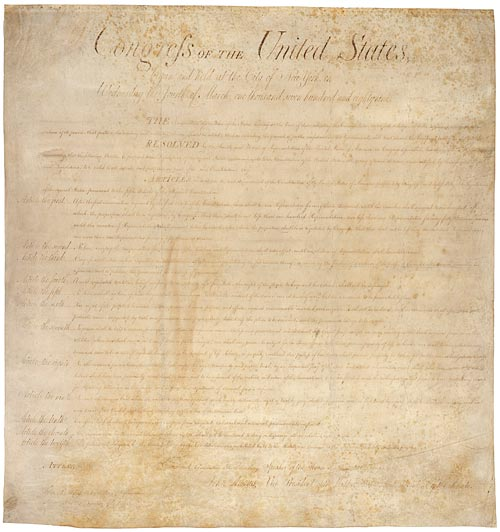
The engrossed Bill of Rights (Congress’s 1789 joint resolution proposing constitutional amendments) shows the amendments in their original, formal documentary form. Using the actual parchment emphasizes that the Bill of Rights was not merely an idea, but a concrete political commitment that moved through established constitutional procedures. Source
Understanding why it was demanded, how it was promised, and what that promise meant is essential to grasping early constitutional legitimacy.
Why the Bill of Rights Became a Ratification Condition
The ratification problem: legitimacy and trust
Ratification required approval in state conventions, where sceptics argued the new Constitution created a national government too capable of threatening liberty.
The absence of an explicit list of protected rights became a focal point because:
Many Americans associated written declarations of rights with legitimate republican government (state constitutions often had them).
Critics feared broad national powers could be interpreted expansively, especially against individuals and local communities.
Political support was closely divided in key states; small shifts could decide the outcome.
Anti-Federalist concerns that drove the demand
Anti-Federalists pressed for a bill of rights not as a symbolic add-on but as a necessary safeguard. Their central claims included:
Without explicit protections, individual liberties would depend on the goodwill of officials rather than enforceable limits.
Rights needed to be stated in writing to guide courts, legislators, and citizens.
Ratification without amendments would reduce bargaining leverage; once adopted, change would be harder.
What “a Bill of Rights” Meant in the Ratification Debate
Bill of Rights: A formal list of protections for individual liberties that limits government action by specifying what government may not do.
The demand was less about creating new freedoms than about ensuring explicit protections against possible abuses under the new constitutional framework.
Rights as enforceable limits, not aspirations
Supporters of amendments argued that enumerating rights would:
Clarify boundaries for federal action.
Provide a shared standard citizens could invoke in political debate and litigation.
Reinforce the idea that sovereignty ultimately rests with the people, not officeholders.
The Compromise: Promise Now, Amend Later
How supporters secured ratification
Federalist supporters (those urging adoption) used a strategy of conditional reassurance: ratify first, then quickly amend. The compromise worked because it offered a credible path to protections while avoiding reopening the entire Constitution for renegotiation.
Key elements of this bargain:
Public commitments in several state conventions that amendments would be proposed promptly.
Acceptance that initial ratification could proceed while still recognising the need for added protections.
A politically salient assurance: explicit protections for individual liberties would be added.
Why the promise mattered in close states
In closely divided states, the promise of a Bill of Rights reduced the perceived risk of ratifying an untested national government. It functioned as:
A confidence-building measure for undecided delegates.
A face-saving route for moderates who wanted stronger union but demanded safeguards.
A way to transform opposition into conditional acceptance rather than outright rejection.
Ratification with Recommended Amendments: A Practical Outcome
Conditional support without delaying adoption
Rather than requiring every state to wait for amendments to be written and adopted, many supporters accepted an approach in which states:
Ratified the Constitution, and
Simultaneously urged that a bill of rights be added soon after.
This preserved momentum toward establishing the new government while acknowledging that liberty protections were politically and morally urgent.
The underlying trade-off
The bargain reflected competing priorities:
Urgency of creating a functioning national government.
Fear that delayed ratification could unravel agreement.
Demand that the new government begin with clear, written constraints on power.
Why This Compromise Is Civically Significant
Building constitutional acceptance
The agreement to add a Bill of Rights helped frame the Constitution as legitimate in the eyes of citizens who were otherwise reluctant to empower a national government. In effect, ratification became not only a decision about structure, but also a commitment to safeguard liberty through explicitly stated rights.
Anchoring expectations about government limits
By treating amendments as a condition for broader acceptance, the ratification bargain embedded a lasting expectation in American politics: major constitutional authority should be paired with clearly articulated protections for individuals, especially when public trust is contested.
Practice Questions
(1–3 marks) Explain one reason the promise to add a Bill of Rights helped secure ratification of the Constitution.
1 mark: Identifies Anti-Federalist concern about lack of explicit rights protections.
1 mark: Explains that promising amendments reassured sceptics and reduced fear of government overreach.
1 mark: Links reassurance to gaining votes/support in state ratifying conventions.
(4–6 marks) Analyse how the Bill of Rights functioned as a political compromise during ratification, and why that compromise was effective.
1 mark: Describes the central dispute: Constitution lacked an explicit list of rights.
2 marks: Explains the compromise mechanism: ratify first while committing to propose/add amendments protecting liberties.
2 marks: Analyses effectiveness (e.g., built trust, won moderates, shifted close convention outcomes by reducing perceived risk).
1 mark: Uses accurate terminology (e.g., “explicit protections”, “individual liberties”, “ratification”, “amendments”) in context.
FAQ
No. Some conventions were more insistent, while others ratified with fewer conditions.
Differences often reflected local political cultures, levels of distrust of national power, and how close the convention vote appeared.
Some supporters feared listing rights could imply that unlisted rights were unprotected, or that the new government only had limited powers anyway.
Others prioritised finishing an agreed framework and believed amendments could come later.
Credibility came from public commitments made during ratification debates and the political reality that continued opposition could destabilise the new system.
The promise also created clear expectations that elected officials would be held accountable for proposing amendments.
It was both. Politically, it reassured wary citizens and delegates.
Legally, it established written constraints on government action that could be invoked in disputes about liberty.
Common concerns included protections for speech, press, religion, fair legal procedures, and limits on arbitrary government power.
The emphasis was on preventing abuses rather than expanding government responsibilities.