AP Syllabus focus:
‘The Electoral College established a system for electing the president through state electors rather than direct popular vote or selection by Congress.’
The Electoral College is the Constitution’s method for selecting the president. It reflects the Founders’ compromises about democracy, federalism, and separation of powers, balancing popular input with state-based representation.
Constitutional Design and Purpose
What the system is
The Constitution creates an indirect presidential election in which states appoint electors who formally choose the president and vice president. This avoided choosing the president by direct popular vote or by Congress, addressing fears of congressional dominance and concerns about how informed national popular choice would be.
Electoral College: the constitutionally created process in which voters choose slates of state electors, and those electors cast official votes for president and vice president.
This design also ties presidential selection to the states, reinforcing federalism by giving each state a role as a state in the election, not just as a collection of individual voters.
How electors are allocated
Electors are allocated by state based on representation in Congress:
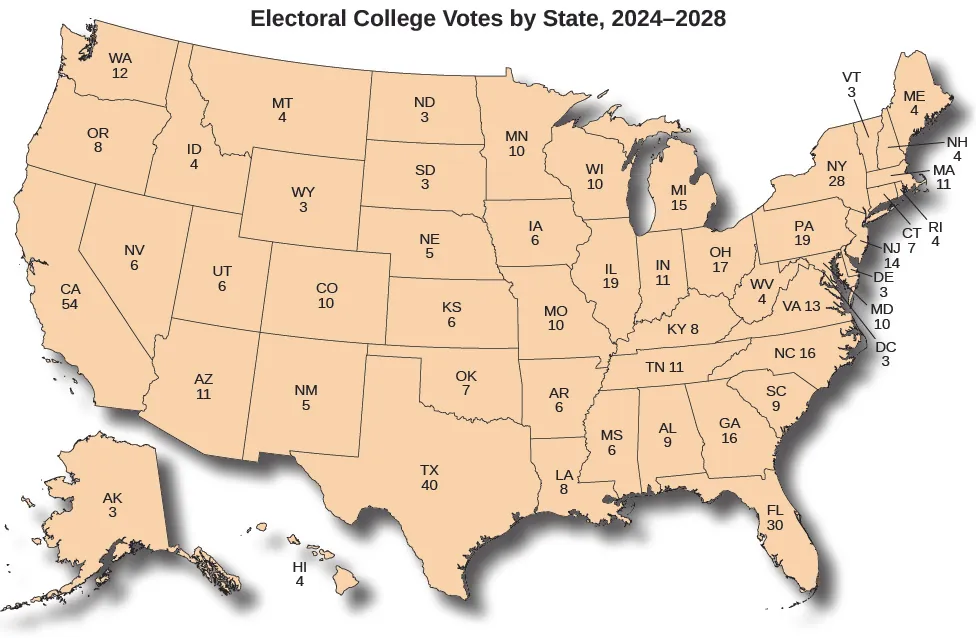
Map of Electoral College votes by state (2024–2028), with each state labeled by its electoral-vote total. The figure also notes the constitutional logic of allocation: a state’s electoral votes equal its House seats plus two Senate seats (with Washington, DC receiving electors via the 23rd Amendment). Source
Each state’s electors = House seats (population-based) + 2 senators (equal state representation).
This gives smaller states slightly more weight per voter than large states because every state gets two electors tied to its Senate seats.
How Presidential Elections Work in Practice
State-by-state competition
Voters typically vote for a party’s slate of electors pledged to a presidential ticket. In most states, the candidate who wins the most votes statewide receives all of that state’s electoral votes (winner-take-all), making elections a set of state contests rather than one national tally.
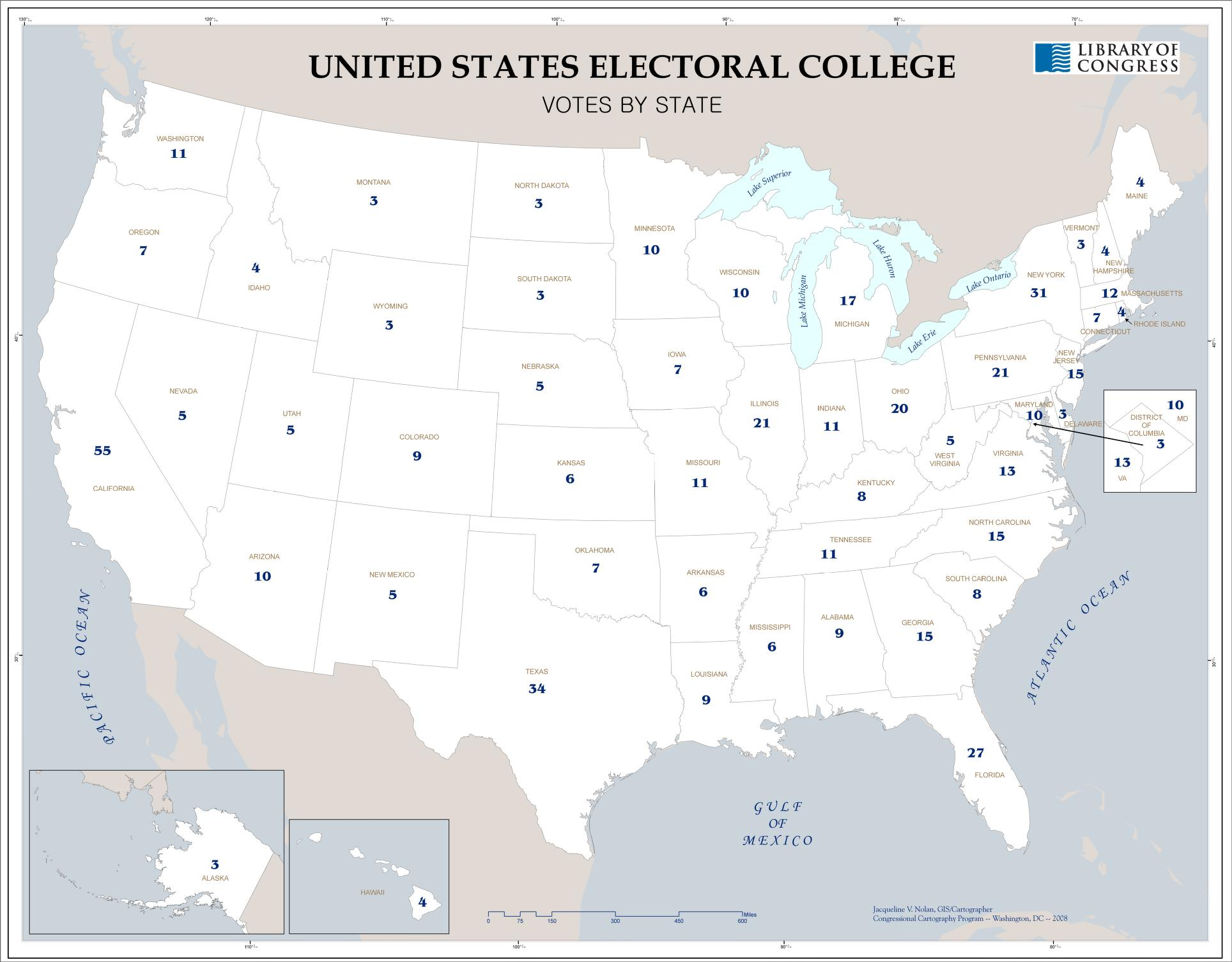
Library of Congress cartographic map showing the distribution of Electoral College votes by state (created for the 2008 context). Because it is a map-based presentation of electoral-vote weights, it helps students visualize how winner-take-all rules turn presidential elections into a series of state contests rather than one nationwide total. Source
Winner-take-all: the common state rule awarding all of a state’s electoral votes to the candidate who wins the statewide popular vote plurality.
Because campaigns seek to assemble an electoral majority, candidates often target competitive “battleground” states where the statewide outcome is uncertain.
Formal casting and counting of electoral votes
After the general election, electors meet (in their states) to cast ballots. Those votes are certified and then counted in a formal process. The presidency goes to the ticket that wins a majority of electoral votes, not necessarily the most nationwide popular votes.
Key Implications for Democracy and Governance
Indirect election and legitimacy debates
Because the system is not a national popular election, it can produce a split outcome where the popular vote winner does not win the presidency. This feature is central to ongoing debates about democratic responsiveness versus constitutional structure.
Incentives and representation
The Electoral College shapes political strategy and representation:
Incentivises building state-based coalitions rather than maximising national vote totals.
Elevates the importance of competitive states under winner-take-all rules.
Reflects a constitutional compromise: popular participation filtered through state institutions, consistent with a republican rather than purely majoritarian model.
Practice Questions
(2 marks) Explain one reason the Framers used state electors to choose the president rather than direct popular vote. Mark scheme:
1 mark: Identifies a valid reason (e.g., avoid congressional selection; filter popular choice; reinforce federalism/state role; address concerns about voter information across a large republic).
1 mark: Explains how that reason connects to using electors rather than a national popular vote.
(5 marks) Analyse two ways the winner-take-all allocation of electoral votes affects presidential campaign strategies and the representation of voters. Mark scheme:
1 mark: Correctly describes winner-take-all.
2 marks (1+1): Analyses campaign strategy effects (e.g., focus on battleground states; reduced attention to safe states; resource allocation).
2 marks (1+1): Analyses representation effects (e.g., votes in losing-state minorities less influential; amplifies narrow statewide pluralities into large electoral margins; encourages state-level rather than national appeals).
FAQ
If no ticket wins an electoral-vote majority, the election becomes contingent.
The House chooses the president from top candidates, with each state delegation casting one vote. The Senate chooses the vice president from the top vice-presidential candidates.
It is an agreement among participating states to award their electoral votes to the national popular vote winner.
It would take effect only once enough states join to total at least 270 electoral votes, effectively simulating a national popular vote while keeping the Electoral College structure.
Faithless electors are electors who do not vote for their pledged candidate.
Many states use laws requiring electors to vote as pledged or allowing replacement/penalties. Supreme Court rulings have upheld state authority to enforce pledges.
They allocate some electoral votes by congressional district rather than statewide winner-take-all.
This can split a state’s electoral votes between candidates, changing incentives by making certain districts, not just statewide totals, electorally valuable.
Common proposals include:
National popular vote (greater majoritarianism; less state-based weighting)
Proportional allocation within states (fewer “wasted” votes; more third-party leverage)
District-based allocation (more local targeting; risk of gerrymandered outcomes)
Each changes incentives for coalition-building and how “close” elections are translated into victory.